














Data Centers Now Half of AdTech’s Carbon Footprint — Is Anyone in India Measuring This?

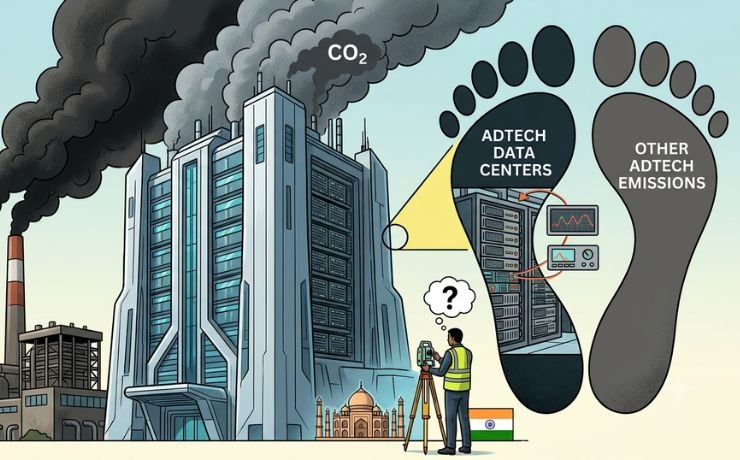
Global adtech is quietly admitting that its biggest environmental cost isn’t the ad, it’s the infrastructure behind it. India’s data centre economy is compounding faster than almost anywhere else in the world. Almost nobody in the country’s advertising industry is measuring what that compounding actually costs.
Every media plan carries a line for reach, a line for frequency, a line for cost per thousand. None of them carry a line for the electricity that made the plan possible. That absence is becoming harder to defend. Across the global adtech conversation, the industry has spent the better part of a decade arguing about where digital advertising’s carbon footprint actually sits — inside creative file sizes, inside programmatic bidding calls, inside the device screens people scroll past ads on. The argument has settled, more or less, on an uncomfortable answer: the largest and fastest-growing share sits in the data centres that power the bidding, the targeting, the rendering, and increasingly, the AI models now stitched into nearly every layer of the supply chain. Industry commentary this year has gone as far as calling data centres and servers, alongside programmatic auctions and creative production, the core sources of emissions in the AdTech stack — and unlike a creative file, a data centre doesn’t get lighter with better compression.
That framing matters because it changes who is actually responsible for the number. A brand can shrink a video ad’s file size, cut unnecessary retargeting frequency, or greenlight a lighter creative format, and each of those choices helps. But none of them touch the largest structural driver, which is the physical and computational buildout sitting underneath the entire ecosystem — the servers running real-time bidding auctions thousands of times a second, the content delivery networks pushing creative to every device, and now, the generative AI inference layer quietly added to demand-side platforms, supply-side platforms, and creative tools across the industry. One recent sustainability-focused analysis of the AI shift in advertising noted plainly that data centre consumption tied to advertising could more than double between 2022 and 2026, driven almost entirely by AI, and that this AI-driven share is rarely measured and even less frequently attributed back to individual campaigns. A brand can believe it has “greened” a campaign by trimming impressions while badly underestimating the much larger AI-driven infrastructure cost sitting invisibly behind it.
Where India Sits in This Story
India’s version of this story is not a footnote to the global one. It may end up being one of its defining chapters, because the country’s data centre buildout is compounding at a pace few other markets are matching. Industry estimates put India’s operational data centre capacity at roughly 1.5 to 1.8 gigawatts through 2025 and into 2026, with consultancy reports projecting that figure to more than quadruple — past 6.5 to 7 gigawatts — by 2030, and at least one forecast placing India’s operational capacity as high as 12 gigawatts by the same year, growing at a compound annual rate near 40 percent. AI-dedicated capacity specifically is expected to expand nearly 24-fold over that window, from roughly 275 megawatts to over 6,500 megawatts. Mumbai alone accounts for roughly a third to two-fifths of the country’s total operational supply, with Chennai, Delhi-NCR, Hyderabad and Pune absorbing most of the rest.
Every one of those megawatts is being built, in significant part, to serve exactly the kind of workload advertising now depends on: programmatic auctions running continuously, personalisation engines processing behavioural signals in real time, and generative tools now embedded across creative production and campaign optimisation. India’s ad economy — one of the fastest-growing digital advertising markets globally — is compounding on top of that infrastructure buildout, not alongside it. And the honest accounting question the industry has not yet answered is simple: as the country’s data centre stock quadruples this decade, does the advertising sector’s share of that footprint quadruple with it, and is anyone in Indian adtech actually tracking that number at the campaign level, the way they already track CPMs and viewability?
A Measurement Problem Before It’s a Reduction Problem
Globally, the industry has at least started building the scaffolding to answer this question, even if the scaffolding is incomplete. Frameworks such as the Green Media Sustainability Framework have introduced standardised methods for allocating emissions from data centres, networks, devices and delivery formats across advertisers, agencies, publishers and platforms. Independent measurement platforms have gained real traction precisely because they translate an abstract, industry-wide carbon number into something actionable at the level of an individual media plan, letting buyers route spend toward publishers and supply paths with genuinely lower-carbon infrastructure behind them. Media quality vendors that already sit inside programmatic buying stacks — measuring viewability, fraud and brand safety — have begun folding carbon measurement into that same suite, on the logic that emissions tracking belongs alongside the metrics media buyers already treat as non-negotiable.
A brand can believe it has “greened” a campaign by trimming impressions while badly underestimating the much larger infrastructure cost sitting invisibly behind it.
None of that scaffolding has meaningfully arrived in the Indian market yet, at least not as a standard practice inside media planning. Sustainability, when it does show up on an Indian agency or brand’s marketing agenda, tends to show up as a campaign theme — a creative brief about climate action, a sustainability-led brand campaign, an ESG-flavoured piece of content marketing — rather than as an operational discipline applied to the media supply chain producing the campaign itself. That distinction is the crux of the gap. A brand can run a beautifully art-directed campaign about reducing plastic waste while the programmatic infrastructure delivering that campaign to millions of screens runs on a data centre grid still heavily dependent on coal-fired power, with nobody in the planning chain required to disclose, measure, or even ask about that fact.
Part of the reason is structural. India’s programmatic ecosystem runs substantially through global demand-side and supply-side platforms whose infrastructure decisions, energy sourcing, and emissions disclosures happen at a corporate level far removed from the Indian planning teams actually buying against those platforms daily. A media planner in Mumbai or Bengaluru has limited practical ability to interrogate the power usage effectiveness of the specific data centre cluster serving a given auction, even if they wanted to. The reporting obligation, where it exists at all, currently sits with hyperscalers and global holding companies headquartered elsewhere — several of which have made net-zero pledges for 2030 or later — rather than with the India-based buying and planning function that actually decides where impressions get delivered.
The Google Andhra Pradesh Question
The tension came into sharp public focus with Google’s proposed multi-billion-dollar data centre campus in Andhra Pradesh, framed by state officials as a transformational win for the region’s digital economy. It arrives at almost the exact moment Google’s own environmental reporting has acknowledged that electricity demand from its data centres rose sharply year on year, driven overwhelmingly by AI infrastructure. That juxtaposition — a state celebrating a data centre campus as economic progress while the company building it is publicly acknowledging the emissions cost of the AI boom driving that same buildout — is a reasonably precise summary of where the entire conversation sits right now, not just for Google, but for every hyperscaler racing to add capacity across Mumbai, Chennai, Hyderabad and beyond. The infrastructure race and the sustainability reckoning are not separate conversations happening in parallel. They are the same conversation, and India’s advertising industry has largely opted out of participating in it.
That opt-out is becoming harder to justify on cost grounds alone, which is often the excuse offered when sustainability measurement gets raised in Indian planning conversations. Global carbon measurement platforms have brought the price of entry down considerably, and several already integrate directly into existing demand-side platform workflows rather than requiring a separate reporting layer. The real obstacle isn’t tooling. It’s that almost no Indian brand, agency or publisher has yet made carbon measurement a genuine procurement criterion — the way viewability or brand safety became non-negotiable inclusions in every RFP over the past decade. Until a large enough Indian advertiser starts asking its agency and its programmatic partners to disclose the emissions profile of a media plan the way it already asks for fraud and viewability guarantees, there is little commercial pressure pushing platforms to build India-specific reporting, and little incentive for agencies to build the internal capability to interpret it even if the reporting existed.
What Measurement Would Actually Require
Building that capability isn’t a single decision so much as a sequence of smaller, unglamorous ones. It starts with agencies and holding companies operating in India treating carbon disclosure as a standard question in every programmatic and platform partnership review, alongside data privacy and brand safety audits that already happen as a matter of course. It extends to media planners being given visibility into which supply paths and publisher inventory sit behind genuinely lower-carbon infrastructure, the same way they are already given viewability and fraud scores to weigh alongside price. It requires large Indian advertisers — the FMCG majors, the BFSI players, the e-commerce platforms running some of the country’s highest-volume programmatic spend — to treat a carbon line item in a media plan with the same seriousness they now bring to a diversity and inclusion audit of their creative, because both are increasingly what global stakeholders and regulators expect to see. And at the industry-body level, it means IAB India and the Advertising Standards Council of India engaging with global measurement standards now rather than waiting for a regulatory mandate to force the issue, the way several markets in Europe are already moving toward through emissions disclosure legislation tied to broader corporate sustainability reporting requirements.
None of this requires India’s adtech ecosystem to invent anything new. The frameworks exist. The measurement platforms exist. The precedent — an industry deciding, collectively, that an externality is too significant to keep leaving off the media plan — exists in exactly the form viewability and brand safety took a decade ago, when both went from niche concerns to baseline procurement requirements within a few admaking cycles. What’s missing in India isn’t capability. It’s a critical mass of advertisers and agencies willing to be first, publicly, in asking the question of their programmatic partners: what did this campaign actually cost the grid, and can you prove it?
The honest answer, for now, is that almost nobody is asking. India’s data centre economy is scaling at one of the fastest rates in the world, much of that scale driven directly by the compute the advertising industry depends on daily, and the industry sitting closest to that infrastructure has largely treated the question as somebody else’s to answer — the hyperscaler’s, the government’s, the global holding company’s headquarters. That division of responsibility might have made sense when data centres were a rounding error in adtech’s environmental conversation. It stops making sense the moment industry analysis starts describing data centres as accounting for roughly half of the sector’s total carbon footprint globally. At that scale, the infrastructure isn’t adjacent to the media plan anymore. It is the media plan, and sooner rather than later, somebody in Indian advertising is going to have to start measuring it that way.
• • •
