














The AI Slop Economy: What a ₹38 Crore-a-Year AI YouTube Channel Says About Attention, Not Talent

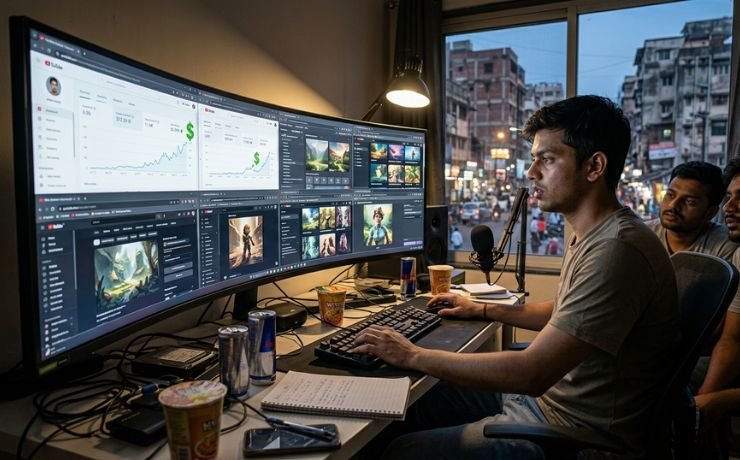
Picture the channel. No face appears in a single thumbnail. No name anyone would recognise sits in the byline. The narration is a text-to-speech voice explaining, in the same flat cadence every time, why octopuses have three hearts or what really happened to a lost civilisation. New videos land two, three, sometimes five times a day, each one a near-identical shape wearing a different topic. Nothing about it asks to be remembered.
And yet it earns, by conservative estimate, somewhere in the neighbourhood of ₹38 crore a year.
That number is the part that gets repeated in every trend piece about AI-generated content, and it is also the part that misleads. It reads like a story about artificial intelligence outsmarting human creativity. It is actually a story about something far less exotic and far more uncomfortable: what happens when the attention economy is asked, plainly, what it has really been paying for all along.
The uncomfortable answer, increasingly, is volume — not talent.
The economics were always going to end up here. Long before generative AI entered the picture, platforms had already built a system that rewards constant posting, aggressive retention optimisation, and rapid responsiveness to trending topics far more generously than it rewards originality or craft. Human creators adapted to that system as best they could, constrained by the simple fact that scripting, filming and editing take time no algorithm cares about. AI tooling did not invent the incentive. It just removed the last cost standing between the incentive and its logical extreme.
Text-to-speech narration, automated scriptwriting pulled from trending-topic scrapers, templated video assembly — none of it individually is revolutionary. What is new is the complete absence of friction. A production cycle that once took a small team a week now takes an afternoon, and the channels winning this game are not necessarily using the most sophisticated models available. They are the ones that have industrialised the pipeline most completely, treating content less like a craft and more like a manufacturing line tuned purely for throughput.
Reading the ₹38 Crore Correctly
It helps to be precise about what that revenue figure is actually measuring, because it is routinely mistaken for a signal of audience devotion when it is really a signal of audience volume. YouTube’s ad economics reward watch time and impressions multiplied across an enormous base — not whether any single viewer found the video meaningful enough to remember, let alone return for. A channel does not need loyalty to generate serious money. It needs scale wide enough, and content cheap enough, that thin margins per view compound into something substantial.
This is the distinction the marketing industry has spent years quietly collapsing, and it is now being forced to pull apart again: attention and affinity are not the same currency, and platforms have rarely had much reason to help advertisers tell the two apart, since the ad model is largely indifferent to which one it is capturing. A viewer who watches eight seconds of an AI-narrated video before scrolling past registers as measurable value in the platform’s own accounting — even if they could not name the channel five minutes later. Multiply that moment by millions and the revenue is undeniably real. The brand equity underneath it, mostly, is not.
For advertisers weighing where programmatic budgets actually land, that gap should be setting off alarms. Buying purely against reach and watch-time, without scrutinising what kind of content is generating those numbers, risks quietly financing exactly this style of production — brand dollars sitting beside content engineered to be watched just long enough to monetise, with no ambition beyond that threshold.
Attention and affinity have never been the same currency. The AI slop economy is just the first business model built to be completely honest about only wanting one of them.
The Talent Question the Industry Keeps Avoiding
Underneath the discomfort sits a harder question, one most people in the content business would rather not say out loud: how much of what has historically passed for “creative talent” was really a proxy for something more operational — the discipline to publish constantly, and the instinct to read what an algorithm rewards, faster than competitors could? Where that was true, AI tooling was always going to be an existential threat to that specific kind of creator, regardless of how advanced the underlying models eventually became.
None of this means craft, originality or a genuine point of view have stopped mattering. If anything, the slop economy makes their value easier to see, precisely because it demonstrates so plainly what content looks like once those qualities are removed entirely. What it does mean is that the vast competent middle of content production — consistent, algorithm-literate, but not especially distinctive — is now competing directly against a machine that can replicate the consistent and competent parts at close to zero marginal cost. Few creators are built to win that fight on volume, because volume was never really the point of what made them worth watching in the first place.
The ones likely to hold their ground are not racing the machine on output. They are the ones betting everything on the parts still stubbornly resistant to automation — a specific worldview, a voice an audience recognises instantly, the kind of trust built with a real person over years rather than manufactured by a content stream overnight. It is a narrower path. It is also the only one that survives contact with a competitor that never sleeps, never runs out of ideas, and never asks to be paid.
What Buyers Should Actually Do With This
For marketers, the more useful reading of the AI slop economy is not as a content trend to react to, but as a diagnostic on the health of the metrics they have been buying against for years. If a channel with no discernible creative identity can out-earn established studios purely on volume and retention optimisation, that is a fairly direct indictment of how thin “engagement” has become as a stand-in for anything advertisers actually care about — recall, trust, intent, purchase consideration.
Platforms will likely respond with some mix of labelling requirements, monetisation tweaks, and algorithmic throttling aimed at the most obviously synthetic, low-effort content. None of that touches the underlying incentive structure that made this economy possible in the first place, and buyers should not wait for platform policy to do work that media planning has always owned. That means auditing not just where impressions land, but what they actually land next to — and building buying strategies that reward genuine creative distinction instead of treating every second of watch time as interchangeable.
The AI slop economy was never really a test of how convincingly a machine could imitate a human creator. It is a test of how little the current attention economy has been asking of content in exchange for real money — and how efficiently a well-tuned pipeline can clear that bar. The uncomfortable finding is not that AI can replace talent. It is the reminder of how much of what got called talent was, all along, simply volume dressed up well enough to be mistaken for it.
