














AI Personalisation Adoption Hits 92% Globally — Where Indian Brands Are Actually Lagging

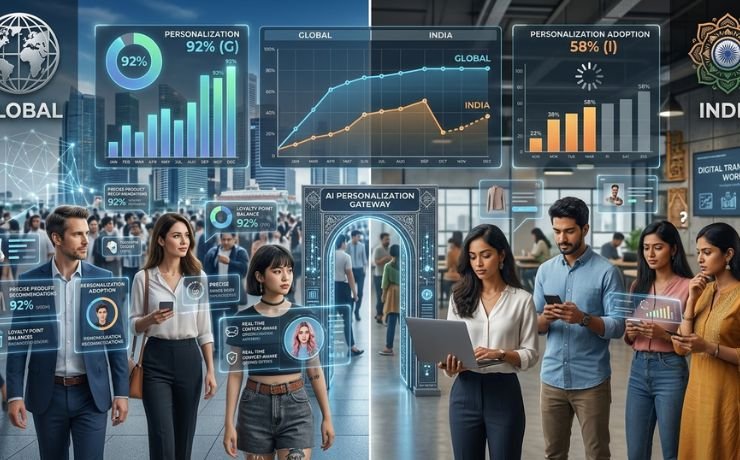
There is a number doing the rounds in marketing decks this year that sounds almost too clean to be true: 92 percent. That is the share of global brands, according to recent industry surveys, that now claim to have adopted some form of AI-driven personalisation in their marketing stack. Recommendation engines, dynamic creative, predictive segmentation, real-time offer optimisation — the tools have moved from experimental to expected with startling speed. On paper, it reads like a done deal, a war that’s already been won. Scratch beneath the headline figure, though, and a more uneven picture emerges — and nowhere is that unevenness more visible than in India, where “adoption” and “impact” have quietly become two very different conversations.
Indian brands are not absent from this AI personalisation wave. Most large enterprises, D2C players and even mid-sized regional brands will tell you, with some confidence, that they use AI to personalise something — a product recommendation widget, a WhatsApp nudge, a retargeted ad. The tooling is there. The intent is there. What’s lagging, consistently and specifically, is depth: the difference between deploying an AI feature and building an AI-native customer experience around it.
“92 percent of brands switched something on. The real divide is between those who treated that as a finish line, and those who treated it as a starting point.”
The adoption number hides a maturity gap
Global adoption statistics tend to count binary outcomes — does a brand use AI personalisation, yes or no — which flattens an enormous range of sophistication into a single tick mark. A brand running basic collaborative filtering on its e-commerce homepage counts the same as one running real-time, cross-channel, intent-based personalisation that adapts creative, offer and channel simultaneously based on a live behavioural signal. Globally, a meaningful share of “adopters” sit at the sophisticated end. In India, the concentration is heavily skewed toward the basic end — recommendation widgets, simple abandoned-cart triggers, rule-based segmentation dressed up as AI.
This isn’t a criticism of ambition. It’s a reflection of what the underlying infrastructure allows. Personalisation at any meaningful depth requires clean, unified, real-time customer data — a single view of a user across app, website, store and support touchpoints. Most Indian brands, even fairly large ones, are still operating with fragmented data sitting across siloed systems that don’t talk to each other cleanly. You cannot build sophisticated AI personalisation on top of broken plumbing, no matter how good the model is. The result is that a lot of Indian “AI personalisation” is AI in name, applied on top of a data foundation that was never designed to support it.
Where the lag is sharpest: real-time versus batch
One of the clearest fault lines separating genuinely advanced personalisation from its shallower cousin is timing. Batch-based personalisation — where a model processes customer data periodically and pushes out updated recommendations or segments on a daily or weekly cycle — is common and relatively achievable. Real-time personalisation, where a system reads a customer’s behaviour as it happens and adjusts the experience within the same session, is a different order of technical difficulty, requiring streaming data infrastructure, low-latency inference and tight integration between the personalisation engine and every customer-facing surface.
Global leaders in the space, particularly in retail and travel, have pushed hard into real-time capability, because the commercial upside is substantial — a personalised nudge delivered while intent is live converts meaningfully better than one delivered a day later when the moment has passed. Indian brands, by contrast, remain disproportionately batch-oriented.
“Ask a marketing technology lead at a large Indian retailer what ‘real-time’ means, and the honest answer is often ‘updated overnight.'”
This isn’t universal — a handful of India’s most digitally native D2C and fintech players have built genuinely real-time systems — but they remain the exception rather than the norm.
The talent and org-design bottleneck
Technology is only part of the story. Building and running sophisticated AI personalisation requires a specific blend of talent — data scientists who understand marketing objectives, marketers who understand what a model can and cannot reasonably do, and engineering teams who can ship and maintain the infrastructure connecting the two. This combination is scarce everywhere, but it is particularly scarce in India relative to the scale of ambition brands are expressing. Data science talent in India has historically gravitated toward global capability centres and product companies rather than domestic brand marketing teams, which means the in-house expertise needed to move personalisation from “vendor tool switched on” to “custom system tuned to our business” is often simply not sitting inside the organisation.
This has produced a familiar pattern: Indian brands buying capable, off-the-shelf personalisation platforms, but under-resourcing the internal team that would be needed to configure, test and iterate on them properly. A platform bought but not tuned tends to plateau quickly, delivering an initial lift and then flatlining, because nobody inside the organisation is running the ongoing experimentation that sophisticated personalisation actually requires.
“A platform bought but not tuned tends to plateau quickly — because nobody inside the organisation is running the ongoing experimentation it actually requires.”
Trust, data and a genuinely different consumer context
There is also a structural factor specific to India that doesn’t get discussed enough in these global benchmarking exercises: the country’s data and privacy environment is evolving in real time, and brands are, reasonably, cautious about how aggressively they lean into behavioural tracking while that framework settles. The Digital Personal Data Protection Act has pushed compliance and consent management higher up the priority list for any brand doing serious first-party data collection, and building robust consent infrastructure has, for many organisations, become a prerequisite that had to be solved before deeper personalisation work could even begin. In markets where data protection frameworks matured earlier, brands had a longer runway to build both the compliance layer and the personalisation layer in parallel. Indian brands are often now doing both simultaneously, under real regulatory attention, which naturally slows the pace of the more advanced experimentation.
Consumer expectations add another layer of nuance. Personalisation strategies built for Western markets don’t transplant cleanly onto India’s context — the sheer linguistic diversity, the mix of digital sophistication across tier-1 and tier-2/3 geographies, and price sensitivity that shapes what “relevant” even means for a given customer. A recommendation engine trained primarily on global e-commerce behaviour patterns will underperform in India unless it’s been meaningfully retrained on local data, and building that local dataset takes time, investment and patience that not every brand has been willing to commit.
The sectors pulling ahead
It would be misleading to paint the entire Indian market with one brush. Fintech and D2C — sectors born digital-first, with clean data architecture from day one and leadership teams fluent in technology — are closing the gap with global peers meaningfully faster than legacy retail, BFSI incumbents or traditional FMCG. These digitally native players didn’t have to retrofit personalisation onto decades-old systems; they built it in from the start, which has given them a structural head start that has little to do with budget and everything to do with architecture.
Quick commerce, in particular, has emerged as an unlikely bright spot. The category’s entire business model depends on predicting what a customer wants before they’ve finished typing it, which has forced genuinely sophisticated, low-latency personalisation into the core product experience rather than treating it as a marketing bolt-on. It’s a useful reminder that the lag isn’t really about India lacking AI capability — it’s about how deeply personalisation has been allowed to sit inside the business model, versus being layered on top of it after the fact.
What closing the gap will actually require
None of this suggests Indian brands are permanently behind, or that the gap is somehow unbridgeable. What it suggests is that the next phase of progress will look less like adding new AI tools and more like fixing foundations — consolidating fragmented customer data into a genuine single view, building the real-time infrastructure that batch systems were never designed to support, and investing in the internal talent needed to run personalisation as an ongoing discipline rather than a one-time deployment.
The 92 percent adoption figure isn’t wrong, but it measures the wrong thing if the goal is understanding competitive readiness. Nearly every serious brand in every serious market has switched something on. The real divide, in India and globally, is between brands that treated that switch as a finish line and brands that treated it as a starting point. For Indian marketing leaders reading their own AI maturity against the global number, that distinction is likely to matter far more over the next two years than the adoption statistic itself.
