














The 41% Problem: Why Most Marketers Still Need 3-4 Weeks to Launch a Campaign Despite AI Tools

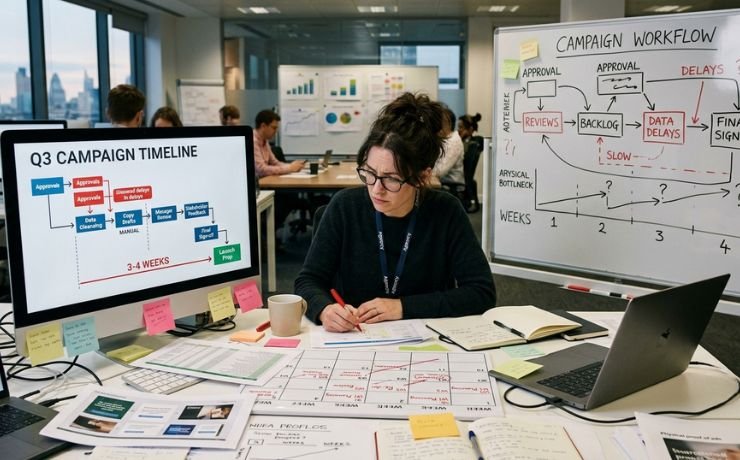
Somewhere between the AI keynote stages at Cannes and the actual campaign calendars sitting on marketers’ desks, a fairly large gap has opened up. The industry narrative of the last two years has been unambiguous: generative tools would compress production timelines, cut agency costs, and let marketing teams ship at a speed previously reserved for the most nimble startups. The data now emerging tells a different, considerably less triumphant story. Roughly 40 percent of marketing leaders now consider three to four weeks an acceptable timeline to launch a single campaign — not a stretch goal, not a worst-case estimate, but the baseline expectation, even with AI tools sitting inside the workflow.
The headline shift
93% of marketing leaders say AI has increased pressure to move faster. Yet campaign timelines have gotten longer, not shorter — with the share needing 1–2 months to launch jumping from just 5% in 2025 to 34% in 2026.
That figure comes from Typeface’s 2026 Signal Report, “The AI Speed Paradox,” which surveyed more than 200 VP-level marketing leaders across retail, financial services, professional services, manufacturing, healthcare, education, and hospitality, and compared the results against a baseline survey the company fielded eight months earlier. In 2025, 85 percent of leaders said one to two weeks was their preferred campaign timeline. A year later, that number has collapsed to 50 percent. More strikingly, the share who say they now need one to two months to launch has jumped nearly ninefold in under a year — at the exact moment content-generation AI became mainstream.
AI compressed the time it takes to write a draft. It did nothing for the time it takes to get that draft approved — and approval, not creation, is where campaigns actually die.
This is the paradox worth sitting with, because it inverts almost everything marketers were promised. The tools work. Content generation genuinely is faster. What’s slower is everything downstream of the first draft: the reviews, the sign-offs, the legal checks, the brand-safety passes, the handoffs between teams that were never designed to absorb this volume of output. Typeface’s data is specific about where the time actually goes — 88 percent of marketing leaders say their teams can now generate content quickly, but getting that content signed off remains the most persistent bottleneck in the entire process. AI accelerated the part of the workflow that was already the easiest to fix. It left the part that was actually broken almost untouched.
More People, Not Fewer
The stakeholder math tells the story most clearly. In 2025, most marketing teams managed campaigns with a relatively contained group of collaborators. By 2026, according to Typeface, 92 percent of leaders say a single campaign now requires ten or more stakeholders to execute, and 44 percent say it requires twenty or more — up from just 10 percent the year before. More than half now say they need at least nine separate vendors or tools just to get one campaign live, compared to the 93 percent who managed with eight or fewer tools the previous year.
This is the part of the AI story that rarely makes it into vendor pitch decks. Every new AI capability introduced into a marketing stack tends to add a stakeholder rather than remove one — a legal reviewer for AI-generated copy, a brand governance lead checking tone consistency across a much larger volume of assets, an IT partner brought in to manage integrations and data access. Typeface found that 67 percent of marketing leaders now spend more time working with IT than they did before AI arrived, and in financial services specifically, half of all marketers involve IT directly in workflow design. The tools didn’t remove friction from the system. They multiplied the number of people the system now has to route through.
- 85% of marketing teams missed at least one planned campaign launch date in the past year, per Knak — 1 in 10 missed more than five.
- Sending a single email now typically involves 4+ people, 3–5 tools, and 2–3 rounds of revision — roughly $300 in internal labour per send.
- For half of teams surveyed, approvals still move through email threads and Slack messages rather than any dedicated workflow tool.
Separate research from Knak, a marketing production platform, arrives at a strikingly similar conclusion through a different lens. The causes it identified for missed launches were overwhelmingly operational rather than creative — getting approvals and sign-off, design and creative production, and coordinating across teams topped the list, in that order.
The Readiness Gap Hiding Behind Adoption Numbers
What makes this especially uncomfortable for marketing leadership is that adoption, on paper, looks like a success story. Typeface found that 86 percent of marketing leaders say they’re already using AI agents somewhere in campaign execution, and the share who have deployed at least one AI agent at scale nearly doubled year-on-year, from 18 to 36 percent. Retail is out ahead of every other sector, with 53 percent of retail leaders reporting at least one AI agent running at scale — likely a function of the high content volumes, mature e-commerce data infrastructure, and comparatively lighter regulatory burden that retail marketers operate under relative to, say, financial services.
But adoption and readiness turned out to be two entirely different metrics, and the gap between them is where the real story lives.
Adoption vs. readiness
16% say their organisation is fully prepared to operate at AI speed
67% have the tools, but people and processes haven’t caught up
20% have workflows that are meaningfully standardised and documented
The remaining organisations describe pockets of capability scattered across teams with no coherent system tying them together. Underneath all of it sits a documentation problem — the baseline condition, as Typeface’s founder Abhay Parasnis put it, for AI to actually operate consistently at scale rather than as a series of isolated experiments that never compound into real capability.
That documentation gap explains why resourcing has gotten so much worse rather than better. In 2025, only 1 percent of marketing leaders said they lacked sufficient resources to keep up with demand. A year later, that figure sits at 39 percent, and at publicly listed companies specifically, only 15 percent feel adequately resourced. The mechanism here isn’t mysterious: AI made it cheap to produce more content, more content raised stakeholder expectations about volume and personalisation, and now more people are required simply to review, approve, and govern an output that has grown faster than the organisational capacity to manage it. Fifty-eight percent of organisations now personalise content for every audience segment, up from 53 percent a year earlier — more variations, more channels, all still moving through the same governance chokepoints that were never built for this scale.
Brand Control, Not Cost, Is Now the Top Fear
Perhaps the most telling shift in the data is what marketing leaders are actually worried about. It isn’t cost. It isn’t competitive pressure. Thirty-seven percent of leaders now rank losing brand control and quality as their single biggest risk from AI adoption — ahead of compliance, ahead of budget, ahead of everything else on the list. Compliance and legal concerns as a blocker to scaling AI rose from 56 to 66 percent year-on-year, and brand governance entered the list of top blockers for the first time at 50 percent, having not even been measured the year before.
That reordering of anxieties is itself a sign of where marketing organisations actually sit on the maturity curve. The blockers that dominated conversation a year ago — lack of IT support, poor data quality, plain cultural resistance to new tools — have all declined sharply, in some cases by more than half. Those were, relatively speaking, the easy problems. What’s replaced them are governance problems: can this AI-generated asset be trusted at the volume it’s now being produced, does it stay on-brand across twenty stakeholders’ worth of review, and does the legal team have any confidence signing off on something that moved through the pipeline this fast. Those aren’t questions a better prompt or a faster model solves. They’re organisational design questions, and most enterprise marketing functions simply haven’t redesigned themselves to answer them yet.
Time savings, to be fair, are real — leaders report an average of 12.3 hours a week freed up by automatable tasks, down from 15 hours the previous year as more of that time gets consumed elsewhere. But where the saved time goes matters more than the fact that it exists. Strategic planning has actually shrunk as a share of marketers’ time, from 29 to 26 percent, while time spent on tactical execution has barely moved. AI was supposed to buy marketers back their strategic hours. So far, the data says it hasn’t.
The uncomfortable conclusion sitting underneath all of this is that marketing organisations bought speed and got complexity instead. AI tools compressed the one part of the campaign lifecycle — first-draft content — that was never really the bottleneck to begin with, while leaving the approval chains, the stakeholder counts, the governance layers, and the tool sprawl almost entirely untouched, or in some cases actively worse. Until enterprise marketing functions do the unglamorous work of standardising workflows, consolidating tool stacks, and redesigning approval chains for a world with more content moving through them, the 40-plus percent stuck at three to four weeks — and the growing share stuck at one to two months — will keep buying faster engines bolted onto the same slow chassis.
