














The AVGC Skilling Push: Will Budget 2026’s Creator Labs Solve AdTech’s Talent Shortage

India’s creative economy has spent years sitting between two worlds. It has had the scale of a technology market, the storytelling ambitions of an entertainment industry and the production demands of advertising, yet its talent pipeline has often been treated as a specialist education problem rather than a strategic economic one.
Budget 2026-27 changes that framing.
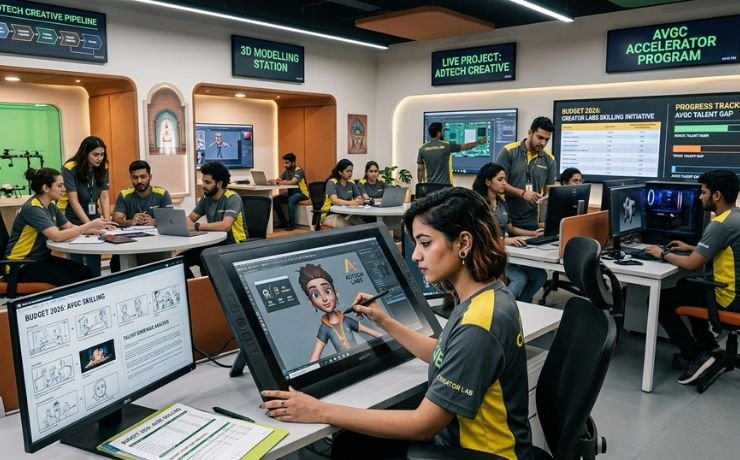
The Union Budget proposed support for the Indian Institute of Creative Technologies (IICT), Mumbai, to establish Animation, Visual Effects, Gaming and Comics (AVGC) Content Creator Labs across 15,000 secondary schools and 500 colleges. The initiative has been allocated ₹250 crore and is part of the government’s broader push around the creative or “orange” economy. The government has said India’s AVGC sector could require nearly two million professionals by 2030.
On paper, the numbers are striking. Thousands of institutions, hundreds of colleges and a large projected workforce requirement suggest an attempt to build the talent pipeline much earlier than the point at which a graduate enters a studio, agency or media company.
But the more interesting question for advertising and AdTech is not whether India needs more creators. It clearly does. The question is whether putting creator infrastructure into classrooms can solve the industry’s more complicated problem: finding people who can combine creative thinking with technology, data, platforms, production and commercial understanding.
“In a creative technology economy, the challenge is not simply creating more talent. It is creating talent that understands how creativity, technology and business increasingly work together.”
That points to the central tension in the Budget’s AVGC push. Building labs is relatively straightforward. Building an ecosystem capable of teaching what the industry actually needs is considerably harder.
The Talent Problem Has Changed
For much of the advertising industry’s history, creative specialisation was relatively clear. Copywriters wrote. Art directors designed. Editors edited. Media planners planned. Developers built. Production teams produced.
The digital economy has steadily blurred those boundaries.
A modern creative team might need someone who understands motion design, social formats, AI-assisted production, user experience, data visualisation and platform behaviour. A performance marketer increasingly needs to understand creative testing. A content producer may need to work with generative AI tools. A gaming or immersive-media project can require designers, animators, programmers, storytellers and data specialists to work within the same production pipeline.
For AdTech, the convergence is even more pronounced.
Advertising technology is no longer simply about buying impressions. Programmatic advertising now sits alongside contextual intelligence, connected TV, retail media, digital out-of-home, first-party data, commerce signals, AI-generated creative and increasingly automated optimisation.
The people building and operating these systems therefore need a hybrid vocabulary. They need to understand the creative asset as well as the technology delivering it. They need to understand audience signals without losing sight of the consumer. And they need to know where automation ends and human judgement begins.
This is why the AVGC conversation matters beyond animation studios and gaming companies.
Why Creator Labs Matter to Advertising
The word “creator” can sometimes make the initiative sound like an influencer-economy programme. It is broader than that.
AVGC covers production capabilities that increasingly sit underneath modern brand communication: animation, 3D design, visual effects, gaming, immersive experiences, virtual production, motion graphics and digital storytelling.
These skills are already finding their way into advertising.
Brands are producing more short-form video. Digital campaigns are becoming more dynamic. Retail media requires large volumes of creative variations. CTV creates opportunities for richer visual storytelling. DOOH can use motion and contextual triggers. Gaming environments are becoming advertising spaces. AI is accelerating the creation and adaptation of assets.
The result is a production environment where the ability to make one polished campaign asset is no longer enough.
Teams increasingly need to create dozens or hundreds of versions, adapt them across formats and platforms, test them against audiences and modify them based on performance.
“The next generation of creative talent will have to understand not just how to make an asset, but how that asset behaves across platforms, audiences and formats.”
That is where AVGC skills intersect directly with AdTech.
From Creative Talent to Creative Systems
The most important shift may be from thinking about talent as individual craft to thinking about talent as part of a production system.
A designer working in an agency five years ago could primarily be evaluated on visual quality. Today, the same designer may be expected to understand motion, responsive formats, social-first storytelling, platform specifications, AI tools and performance feedback.
The industry does not necessarily need everyone to become a generalist. It needs specialists who understand enough of adjacent disciplines to collaborate effectively.
That distinction will matter enormously for the creator labs.
If a student learns a piece of animation software but never works on a live brief, understands audience behaviour or collaborates with other disciplines, the lab may produce technical familiarity without workplace readiness.
If, however, students learn through real production problems, the value changes. A student could develop a campaign concept, create multiple visual executions, adapt them for different platforms, use AI tools responsibly, analyse audience response and present the commercial rationale.
That is much closer to how the advertising industry actually operates.
The Teacher Is the First Technology
One of the less visible challenges is faculty.
Setting up thousands of labs will require people capable of operating them and, more importantly, teaching students how to use them meaningfully.
That creates a difficult equation. The industry is trying to close a talent shortage while simultaneously requiring more people capable of teaching the skills needed to close that shortage.
Technology changes the problem further.
Software workflows that were considered advanced a few years ago can become routine surprisingly quickly. AI-assisted image generation, video production, 3D workflows and automated editing are already altering production processes. A curriculum designed around one generation of tools could become outdated before students graduate.
The answer, therefore, cannot simply be software training.
Students need principles that survive software cycles: visual storytelling, design fundamentals, editing, composition, narrative structure, user experience, creative problem-solving, critical thinking and an understanding of how technology changes production.
Tools can be replaced. Creative judgement is harder to automate.
AI Makes the Skills Question More Complicated
The timing of the Budget’s intervention is significant because the AVGC industry is entering an AI-driven production era.
Generative AI can already accelerate ideation, storyboarding, image creation, editing, voice work and asset variations. For agencies and brands, that promises greater creative output with potentially shorter production cycles.
But it also changes the definition of entry-level talent.
If a junior employee is no longer spending hours on basic production tasks, what does the industry expect them to contribute instead?
The answer is increasingly likely to involve judgement.
Someone still has to decide whether an idea is culturally relevant, whether an image communicates the brand correctly, whether a generated asset is legally and ethically usable, whether a piece of content feels authentic and whether the creative actually solves the business problem.
“AI can accelerate production, but acceleration does not remove the need for creative judgement. It changes where that judgement is applied.”
That suggests the creator labs should not be designed around producing faster operators of software alone. They need to produce people who understand why something should be created, not simply how it can be created.
Where AdTech Enters the Picture
For AdTech companies, this talent shift creates an interesting opportunity.
The industry has historically recruited heavily from technology, engineering, mathematics, marketing and media backgrounds. But as advertising becomes more visual and automated, there is room for a different type of professional: someone who understands the creative asset as data.
Consider dynamic creative optimisation.
A campaign may have hundreds of creative combinations based on audience, geography, context, device, time or inventory. Someone needs to understand both the production logic and the performance logic behind those combinations.
Similarly, CTV advertising increasingly involves contextual signals, content environments and creative formats that require closer collaboration between media and production teams.
DOOH can connect creative execution with real-world triggers such as location, weather, traffic or time. Retail media can connect product data with creative messaging. Gaming can merge interactive environments with brand experiences.
These are not purely creative jobs or purely technical jobs.
They are hybrid roles.
“The industry is moving towards people who can speak both creative and technology. The valuable skill is increasingly the ability to connect the two.”
The Two-Million Target Is Only the Beginning
The government’s projection of nearly two million AVGC professionals required by 2030 creates a useful sense of scale, but workforce volume should not become the sole measure of success.
For employers, the more meaningful question will be how many graduates are genuinely employable.
There is a difference between having a certificate in animation and being able to contribute to an animation pipeline. There is a difference between learning a design application and understanding how to develop a campaign system. There is a difference between knowing how to generate an image with AI and knowing when that image is strategically appropriate.
Industry readiness therefore needs to become part of the measurement framework.
Internships, apprenticeships, studio collaborations, live briefs and portfolio-based assessments could matter as much as classroom hours. Employers could play a more active role in defining curriculum requirements, while educational institutions could build stronger feedback loops with agencies, production houses, gaming companies and technology platforms.
IICT Has an Early Role to Play
The Indian Institute of Creative Technologies is positioned to become an important part of this ecosystem. The institute has been operating from the IICT-NFDC campus in Mumbai since July 2025. The government has also highlighted its early course offerings and Train-the-Trainer programme as part of the institution’s development.
Those numbers are still early, but the Train-the-Trainer component is particularly relevant to the scale of the new initiative.
If creator labs are to operate across thousands of institutions, the system needs a way to multiply expertise without diluting quality.
That could mean standardised curriculum frameworks combined with regional adaptation, centralised training resources, industry-led modules and continuous faculty development.
The challenge is not simply reaching 15,000 schools. It is ensuring that a student in a smaller city receives meaningful exposure rather than a nominal lab experience.
Tier-II and Tier-III India Could Change the Talent Map
One of the more consequential possibilities is geographic.
Creative technology talent has often clustered around established production centres and metropolitan ecosystems because that is where institutions, employers and professional networks are concentrated.
Putting creator labs into schools and colleges could broaden the discovery funnel.
A student who might never have considered animation, game development, VFX or digital design as a career could encounter these disciplines before choosing a professional path. That matters because talent is not necessarily concentrated where the industry currently hires.
However, exposure alone will not create an employment ecosystem.
Students still need access to mentors, portfolios, internships, connectivity, industry networks and opportunities to work on real projects. Without those bridges, the labs could introduce aspiration without providing a clear route into employment.
What the Advertising Industry Should Do With This
Agencies, AdTech firms, production houses and platforms do not necessarily need to wait for the education system to produce the perfect candidate.
The Budget creates an opportunity for the industry to participate in the talent pipeline itself.
Agencies could offer live briefs to institutions. AdTech companies could build modules around creative technology and data-driven advertising. Production studios could provide mentorship. Platforms could expose students to real-world content formats and workflows.
Such partnerships could also help employers identify talent earlier.
Instead of recruiting solely from a small pool of conventional design and media programmes, companies could discover students through project work, competitions, portfolios and collaborative assignments.
That would make the talent pipeline more distributed and potentially more diverse.
The IP Question Cannot Be Ignored
There is another issue that sits beyond skills: ownership.
Training people to produce content is not the same as building a sustainable creative economy. For India to capture greater value from AVGC, talent needs pathways to develop, own and monetise intellectual property as well as provide production services.
That distinction matters to advertising because agencies have historically been strong at execution, while ownership of enduring franchises, characters and platforms can create a different economic model.
A country can become exceptionally good at producing animation, VFX or digital assets without necessarily owning the intellectual property behind the world’s most valuable entertainment properties.
Skilling can address the supply of talent. It cannot, by itself, solve the questions of financing, IP ownership, commercialisation and global distribution.
So, Will Creator Labs Solve the Talent Shortage?
The answer will depend on what happens beyond the labs themselves.
A talent shortage of the scale projected for AVGC is unlikely to have a single solution. The creator labs can address an important part of the problem: early exposure, access to tools and the creation of a wider talent pipeline.
The next layer has to come from higher education, industry training, apprenticeships, employment opportunities, faculty development and continuous reskilling.
“The real test of a skilling initiative is not how many people complete a course. It is whether the skills translate into meaningful work.”
For AdTech and advertising, the opportunity is particularly significant because the industry’s talent requirement is moving in the same direction as AVGC: towards people who can operate across creativity and technology.
The future creative professional may not fit neatly into the traditional labels of designer, marketer, developer or media specialist. They may be a little of each, using technology to produce at scale while relying on human judgement to decide what deserves to be made.
That is ultimately what will determine whether the Budget’s creator labs become another skilling programme or the foundation of a new creative workforce.
The real test will not be how many labs are opened.
It will be how many students emerge from them able to walk into an agency, studio, gaming company, AdTech firm or production house and contribute from day one.
If the pipeline can make that transition, the ₹250 crore allocation will have done more than put AVGC on the policy map. It will have helped move creative technology from the margins of education into the mainstream of India’s future workforce.
