














When AI Gets the Claim Wrong: ASCI, misleading copy and who is accountable

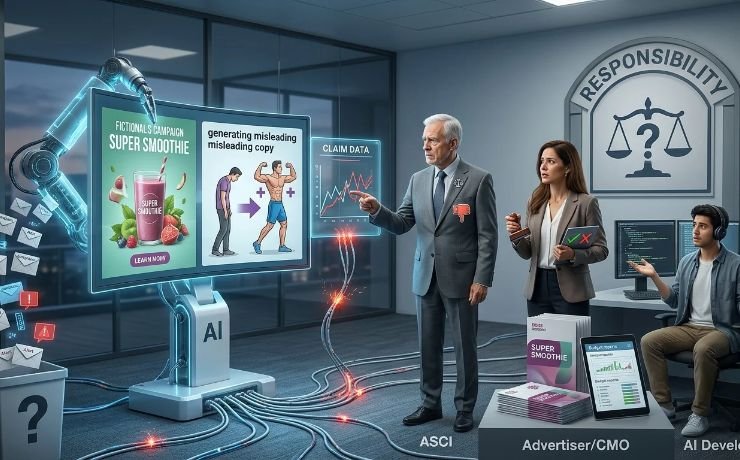
Artificial intelligence has changed the way advertising is conceived, written and produced. A campaign that once required multiple rounds of copywriting, research and creative development can now begin with a few prompts. Generative AI can produce product descriptions, write headlines, create testimonials, suggest performance claims and develop entire campaign narratives in minutes. For brands and agencies working under tight timelines, the efficiency is difficult to ignore.
But speed introduces a different kind of risk. What happens when an AI tool generates a product claim that sounds convincing but has no factual basis? What if a campaign promises results that the product cannot deliver, or presents an invented statistic as an established fact? And when that advertisement reaches consumers, who is responsible for the mistake: the AI platform, the agency that used it, or the brand whose name appears on the communication?
These questions are becoming increasingly relevant as AI moves from an experimental creative tool to an everyday part of advertising operations. The challenge is no longer limited to identifying AI-generated content. It is about ensuring that the information communicated through that content is accurate, substantiated and responsible.
In India, this conversation brings the Advertising Standards Council of India (ASCI) into sharper focus. Its existing advertising standards already require truthful representations and substantiation of objective claims. Its guidelines on synthetically generated content add another layer of responsibility, particularly where AI-generated visuals, voices or representations could influence consumer understanding. The underlying principle remains straightforward: technology may change how an advertisement is made, but it does not change the obligation to tell the truth.
When AI Turns a Prompt Into a Product Promise
One of the most common uses of generative AI in advertising is copy development. Marketing teams use it to generate product descriptions, social media captions, campaign propositions, email subject lines and promotional scripts. The technology can also help teams explore different ways of presenting product benefits to different consumer groups.
The difficulty begins when creative assistance turns into factual invention.
Imagine a skincare brand asking an AI tool to write a product description for a new moisturiser. The brief mentions hydration, a lightweight formula and suitability for everyday use. The resulting copy may go further, claiming that the product improves skin elasticity, repairs the skin barrier within seven days or delivers clinically proven results. These statements may sound like natural extensions of the brief, but unless the brand has evidence to support them, they cannot automatically become advertising claims.
The same problem can emerge across categories. A financial services advertisement could describe an investment product as offering guaranteed returns without accounting for market risks. A health and wellness brand could make unsupported claims about weight loss or immunity. An educational platform could promise improved examination performance using statistics that have not been independently verified.
In each instance, the problem is not necessarily that the AI has produced grammatically incorrect copy. The language may be polished, persuasive and perfectly suited to the brand’s tone. The problem is that the information behind the language may be inaccurate.
Generative AI systems produce responses based on patterns in their training data and the context supplied through prompts. They do not independently establish whether every statement is true. They may generate plausible-sounding information, invent research references or combine unrelated facts into a statement that appears authoritative.
For advertising, this creates a distinction that marketing teams cannot afford to overlook: a well-written claim is not necessarily a substantiated claim.
What ASCI Expects From Advertisers
The ASCI Code for Self-Regulation in Advertising is built around the principles of legality, decency, honesty and truthfulness. Its first chapter requires advertisements to present truthful representations and protect consumers against misleading claims.
Under Chapter I, objectively ascertainable claims must be capable of substantiation. Advertisers and agencies may be required to provide supporting evidence when called upon by ASCI. The Code also addresses misleading representations created through exaggeration, ambiguity, omissions or visual presentation.
This is particularly relevant to AI-generated copy because misleading communication does not always involve an outright false statement. An advertisement can create an inaccurate impression through the way a benefit is described, the information it leaves out or the visual context in which a claim appears.
For example, an AI-generated advertisement for a consumer product might show a dramatic before-and-after transformation. Even if the accompanying copy avoids an explicit performance guarantee, the visual could communicate an expectation that the product cannot substantiate. Similarly, a headline suggesting that a financial product offers risk-free returns could mislead consumers even if a disclaimer elsewhere in the advertisement mentions market conditions.
ASCI’s guidelines on disclaimers also make an important distinction. A disclaimer can clarify or qualify a claim, but it cannot contradict the central message or change the impression created by the advertisement. In other words, brands cannot make an exaggerated promise in large type and expect a small disclaimer to correct it.
The Code applies to advertisers, agencies and media involved in commissioning, creating, placing or publishing advertisements. This makes responsibility an industry-wide concern rather than a matter that can be delegated entirely to the team operating the AI tool.
It is also important to understand ASCI’s position within the regulatory framework. ASCI is a voluntary self-regulatory organisation, not a government regulator. Its Consumer Complaints Council examines complaints and issues recommendations under its Code. Statutory enforcement powers sit with relevant government authorities, including the Central Consumer Protection Authority.
AI Labelling Is Not a Licence to Mislead
As AI-generated images, videos, voices and virtual personalities become more common in advertising, transparency around synthetic content has become another important part of the discussion.
ASCI’s guidelines for responsible labelling of synthetically generated content in advertising take a consumer-outcome approach. The focus is not on labelling every minor use of AI. Instead, the question is whether synthetic content could create a misleading impression or materially influence a consumer’s understanding of a product, service or advertised experience.
The guidelines distinguish between different levels of risk. Some uses of synthetic content are prohibited because they violate the underlying principles of honest advertising. These include fabricated endorsements or testimonials, exaggerated product results, misleading depictions of non-existent locations and unauthorised use of an individual’s likeness or copyrighted work.
Other uses require disclosure when the absence of a label could mislead consumers. Examples include synthetically generated influencers, digitally replicated voices or faces used in personalised communication, and realistic AI-generated settings that materially affect how a product or service is understood.
This distinction matters because disclosure and truthfulness are two separate responsibilities.
An AI-generated virtual influencer may be acceptable when appropriately disclosed and used responsibly. However, using the same virtual influencer to claim that they personally used and benefited from a product would create a different problem if that experience never occurred.
Similarly, labelling an AI-generated before-and-after image does not make an unsupported product performance claim acceptable. A disclosure can tell consumers that an image was generated using AI, but it cannot validate the result being portrayed.
The broader message is that AI labelling cannot be treated as a compliance shortcut. The content itself must still meet the standards expected of any other advertisement.
Who Is Accountable When the Claim Goes Wrong?
This is perhaps the most consequential question for the advertising industry. AI-assisted production introduces more participants into the creative process, but it does not automatically distribute legal responsibility among them equally.
The brand remains central to the accountability chain because it commissions the communication and has access to the information required to verify its product claims. It knows what the product contains, what research supports its benefits, what limitations apply and which promises can legitimately be made to consumers.
If an AI tool generates an unsupported claim, the brand cannot reasonably defend its use by arguing that the technology produced the wording. The claim still appears in the brand’s advertisement, and the brand must ensure that it is accurate.
Agencies have a separate responsibility. Their involvement extends beyond producing creative material. They interpret briefs, develop propositions, shape claims and translate product information into consumer-facing communication. If an agency uses AI to generate advertising copy, the resulting output still requires editorial and factual review.
This is particularly important when agencies use automated tools to generate multiple campaign variations. A single approved claim can be adapted into dozens of headlines, captions, scripts and platform-specific formats. If an inaccurate statement enters the original workflow, automation can multiply the error across different channels.
AI platforms and technology providers also have a role in responsible deployment. They can improve safeguards, communicate limitations and develop systems that reduce the likelihood of fabricated information. However, their involvement does not replace the obligations of the businesses using their tools to communicate with consumers.
The legal position also needs to be understood separately from the ASCI framework. Under the Consumer Protection Act, 2019, and the CCPA’s Guidelines for Prevention of Misleading Advertisements and Endorsements for Misleading Advertisements, 2022, responsibilities and potential consequences extend to relevant manufacturers, service providers, advertisers and endorsers.
The CCPA has the authority to direct discontinuation or modification of misleading advertisements and impose penalties under the Act. The statutory framework provides for penalties of up to Rs 10 lakh for a first contravention and up to Rs 50 lakh for subsequent contraventions in relevant cases. Endorsers can also face restrictions on making endorsements following violations, subject to the applicable provisions.
Therefore, while the precise liability depends on the facts, the parties involved and the applicable law, one principle is clear: an AI tool cannot become a convenient substitute for human accountability.
The Risk Extends Beyond Copywriting
Discussions around AI-generated advertising often focus on text because fabricated claims are relatively easy to identify in a written advertisement. However, the risks extend across the entire creative process.
AI-generated visuals can make products appear to perform differently from their actual capabilities. A furniture brand might showcase a digitally altered product in a setting that does not accurately represent its dimensions or materials. A travel company could depict a hotel with facilities that do not exist. A consumer electronics advertisement might use exaggerated sound effects or visual demonstrations that suggest capabilities the product does not possess.
Voice generation introduces another layer of complexity. A digitally replicated celebrity voice or a synthetic expert testimonial can create an impression of endorsement or professional authority. If consumers believe that a real individual has recommended a product when no such endorsement exists, the issue goes beyond creative execution.
These concerns become more significant in categories where consumers depend on advertising to make important decisions. Healthcare, financial services, education and real estate are particularly sensitive because misleading information can influence decisions involving money, health and long-term opportunities.
For agencies, this means that fact-checking cannot remain limited to the final written copy. The visuals, audio, demonstrations, testimonials and overall context of an advertisement must also be reviewed.
Why Human Review Needs to Become Part of the AI Workflow
As brands integrate AI into their marketing operations, the solution is not to remove the technology from the creative process. Doing so would ignore the efficiency and scale it can offer. Instead, businesses need to establish a clear review system that separates creative generation from factual approval.
The first requirement is a verified source of product information. Marketing teams should maintain approved product descriptions, specifications, research findings, performance data and permitted claims. AI tools should work from these verified inputs rather than relying on open-ended prompts to generate product benefits.
The second is a claim verification process. Every statement that can be objectively tested should be checked against supporting evidence. This includes performance percentages, superiority claims, clinical references, consumer statistics, financial promises and comparative statements.
Third, human review should be mandatory before publication. A copywriter or creative team may approve the language, but category specialists, legal teams or compliance professionals should review claims that require technical or regulatory expertise.
Fourth, brands should establish clear approval responsibilities. It should be possible to identify who generated the content, who checked the claim, who approved the final creative and who authorised its publication. Maintaining this record becomes particularly useful when campaigns are produced through multiple teams or external partners.
Finally, organisations need to review content after publication. AI-generated advertising may be adapted across social platforms, websites, influencer partnerships and digital campaigns. A claim that was approved in one context may become misleading when shortened, translated or separated from its original disclaimer.
These checks need to become part of the production process rather than an additional exercise conducted only when a complaint is received.
The Agency’s Role Is Moving From Creation to Verification
AI is changing the value agencies bring to their clients. If technology can generate multiple versions of an advertisement within minutes, the ability to produce more copy is no longer the only competitive advantage.
Strategic interpretation, category understanding, editorial judgement and the ability to distinguish a persuasive claim from a misleading one become equally important. Agencies will need to demonstrate that they can use AI efficiently without allowing its output to bypass established standards of advertising responsibility.
This also has implications for the relationship between creative, strategy, account management and legal teams. Traditionally, factual verification may have entered the process at specific approval stages. With AI-generated content being produced and modified continuously, review needs to become more integrated.
Brands should also reconsider how they brief agencies. A brief that simply asks for the most persuasive product claim or the strongest possible performance headline can encourage exaggerated language. Providing verified information, approved claims and clear limitations gives both human teams and AI tools a more reliable foundation.
There is an opportunity here for agencies to build stronger internal AI governance frameworks. These could include approved tools, prompt guidelines, restricted data inputs, claim verification checklists and escalation procedures for sensitive categories.
Such measures may add a few steps to the creative process, but they can prevent the much larger cost of withdrawing an advertisement, correcting misinformation or damaging consumer trust.
Trust Will Remain the Most Important Advertising Metric
AI will continue to influence advertising production. It will help brands personalise communication, accelerate content development, explore new creative formats and produce campaigns at a scale that was previously difficult to achieve. Its role in the industry is likely to expand as the technology becomes more accessible and integrated into everyday marketing systems.
But efficiency cannot become the only measure of progress. An advertisement is ultimately a communication between a brand and a consumer. Its purpose is not simply to attract attention or generate a response, but to present a product or service in a way that allows people to make informed choices.
For ASCI, the challenge is to ensure that established principles of truthful advertising remain relevant as the methods of creating advertisements change. For brands, it is about ensuring that every claim can withstand scrutiny. For agencies, it is about recognising that creative innovation and responsible communication must operate together.
The industry does not need to choose between AI-led creativity and advertising accountability. It needs systems that allow both to work together.
Because when AI gets the claim wrong, the consumer does not see a prompt, a language model or an automated workflow. They see a brand making a promise. And in advertising, the responsibility for that promise cannot be outsourced to the technology that helped write it.
