












The Creator Billboard Effect — Why DOOH Is Becoming CTV’s Unexpected Ally

For years, connected TV and digital out-of-home have been discussed as separate chapters in the media planning playbook. CTV belonged to the living room, while digital out-of-home owned the street, the mall, the airport and the commute. One was built around the television screen and streaming behaviour; the other around physical movement and location.
That distinction is becoming less useful.
As audiences move fluidly between streaming platforms, social feeds, creator content and physical environments, advertisers are beginning to think less about individual screens and more about how a piece of content travels across them. This is where digital out-of-home, or DOOH, is finding an unexpected role in the growth of connected TV.
The connection is particularly interesting when creators are involved.
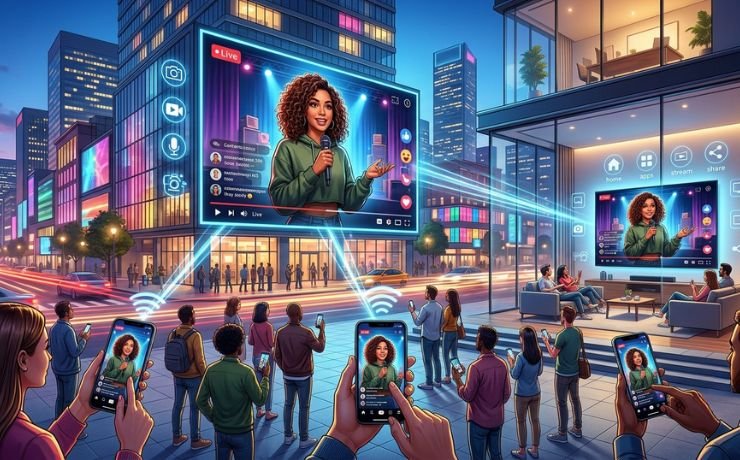
A creator-led campaign can begin with a video on Instagram or YouTube, move into a CTV environment through a longer-form adaptation, and then appear on a large-format screen in a high-footfall location. The same creative idea can live across the phone, television and physical world without necessarily feeling like three unrelated media executions.
That is creating what could be called the Creator Billboard Effect: the ability of creator-led ideas to gain a second life when they are amplified beyond personal screens and placed in high-visibility physical environments.
For brands, the opportunity is not simply about adding DOOH to a CTV plan. It is about using the two channels to solve different parts of the same attention problem.
CTV and DOOH are moving closer to the same audience
The first reason the relationship matters is simple: people do not consume media in neat channel buckets.
A consumer may watch a creator’s review on YouTube, see a brand integration while streaming a show on a connected television, encounter the same campaign while commuting and then search for the product later on a mobile device.
The media plan may classify these as video, CTV, DOOH and search. The consumer experiences them as one brand journey.
This behavioural reality is forcing marketers to rethink how channels work together.
CTV brings the advantages traditionally associated with television: a large screen, sound, sight and a more immersive viewing environment. It also adds digital targeting, addressability and measurable delivery. DOOH brings something CTV cannot: physical presence at scale.
A CTV ad can command attention inside the home. A DOOH screen can command attention in the spaces where people move through everyday life.
That difference makes the combination potentially powerful.
Instead of asking whether a brand should buy CTV or DOOH, planners can ask what each environment is best placed to do.
The creator changes the role of the billboard
DOOH has traditionally been associated with short, visually simple brand messages. A billboard needed to communicate quickly because audiences were often moving past it.
Creator marketing operates differently. Its strength lies in familiarity, personality and cultural relevance.
When those two formats meet, the billboard can become more than a static amplification vehicle.
A creator’s face, visual language or recognisable content format can turn a DOOH execution into something that feels native to the culture surrounding the campaign. Instead of simply putting a product message on a large screen, brands can extend a piece of creator content into a public environment.
That matters because creators have become increasingly important in how audiences discover and interpret brands.
The creator does not necessarily need to be the celebrity face of the campaign. The creator can be the organising idea around which a broader media system is built.
A creator’s short-form video can become a CTV cut. The CTV version can then become a DOOH adaptation. A social conversation can become a live digital screen execution. A product demonstration can be reformatted for a large public display.
The creative asset becomes modular.
And that is where the economics of creator content become more interesting.
From one piece of content to a media system
The old creator model often looked like this: brief the creator, produce a piece of content, publish it on the creator’s social channel and measure views, engagement or clicks.
The newer model is increasingly about extracting more value from the creative idea.
One creator shoot can generate multiple formats, lengths, aspect ratios and narratives. Some versions can be designed for social. Others can be adapted for CTV. Still others can be built specifically for DOOH.
This does not mean simply resizing the same video.
Large public screens have different creative requirements. The message needs to work without relying on sound. Branding must be recognisable quickly. Copy has to be legible from a distance. The visual hierarchy needs to survive a few seconds of attention.
CTV has more room for storytelling. A viewer may sit through a 15- or 30-second narrative in a lean-back environment. DOOH needs to make an impression in a much shorter window.
The smart approach is therefore not to duplicate creative across screens but to design a common creative system in which every format plays to the strengths of its environment.
That is where creators can become particularly useful.
Their content is already built around recognisable hooks, visual cues and concise storytelling. Those characteristics can translate well into environments where attention is limited.
CTV gives creator content a bigger screen
The relationship works in the other direction too.
Creators have historically been associated with mobile-first consumption. Their content lives in feeds, stories and short-form video platforms. CTV gives that content a different viewing context.
A creator-led campaign appearing on a television screen can feel more like premium video content than a social post. It can bring the familiarity of the creator into an environment associated with longer viewing sessions and shared household consumption.
This is particularly relevant as streaming becomes increasingly central to television viewing.
CTV is also becoming more flexible for advertisers. Instead of treating television as a single national broadcast environment, brands can increasingly use audience signals, content environments and campaign data to plan video more selectively.
That opens up possibilities for creator campaigns that were previously difficult to execute at scale.
A brand could work with a set of creators around a cultural moment, distribute short-form content through social channels, use longer edits across CTV and then build DOOH executions around the same creative theme.
The creator becomes the bridge between different media environments.
DOOH adds something digital video cannot replicate
The most obvious advantage of DOOH is physical scale.
A mobile screen is personal. A CTV screen is immersive. A large-format DOOH screen is public.
That public dimension changes the psychology of exposure.
When a creator appears on a large digital screen in a busy commercial district, airport or transit environment, the content becomes part of the physical landscape. It can create social visibility that an individual mobile impression cannot.
This can be particularly useful for brands trying to turn digital culture into cultural presence.
A creator campaign may generate engagement online, but a large-format public execution can signal that the idea has moved beyond the feed. It makes the campaign visible to people who may never have encountered the original content.
That creates an interesting loop.
Social creates the conversation. CTV adds depth and scale. DOOH gives the idea physical visibility. Social can then capture and amplify that physical moment again.
The campaign effectively feeds itself across environments.
The rise of the shareable billboard
One of the most interesting consequences is that DOOH is no longer necessarily the end point of a campaign.
It can become content in its own right.
A striking billboard can be photographed, recorded and shared on social platforms. A creator appearing on a digital screen can turn the physical placement into a piece of social content. A real-time DOOH execution can become part of the conversation it was designed to support.
This creates a new relationship between paid media and earned attention.
The billboard is bought as media, but the resulting image or video can travel organically through social channels.
Creators make this effect even stronger because their audiences are already accustomed to seeing them in different contexts. A creator may post a video reacting to their face appearing on a billboard, while followers share images of the placement. The physical media becomes part of the creator narrative.
The value therefore extends beyond the original impression.
Data can connect the two worlds
The case for combining CTV and DOOH becomes stronger when both channels can be planned and measured as part of a broader media strategy.
Modern DOOH is increasingly digital and programmable. Inventory can be bought based on location, time, audience characteristics and contextual conditions. CTV similarly provides increasingly sophisticated targeting and measurement capabilities.
This creates the possibility of coordinating exposure rather than simply buying channels independently.
For example, a brand could use CTV to build reach among a defined audience segment and use DOOH to reinforce the campaign in locations where those consumers are likely to spend time.
The objective is not necessarily to identify the same individual across both screens. In many cases, that would be neither necessary nor desirable.
The more useful question is whether the channels can be planned around the same audience, moment or objective.
That shift is important in a privacy-conscious advertising environment. Context, geography, time of day and aggregate audience signals can become valuable planning tools without requiring every exposure to be tied to an identifiable individual.
Frequency becomes a creative question
Cross-channel planning also changes the way marketers should think about frequency.
Seeing the same 20-second advertisement repeatedly on television can create fatigue. Seeing the same billboard repeatedly can do the same.
But coordinated frequency does not have to mean repeated creative.
A brand could introduce a story through CTV, extend a visual cue through DOOH and use social or creator content to add another layer. The audience encounters the same campaign idea through different expressions.
This is where creative strategy becomes as important as media strategy.
The goal is not to maximise the number of times a consumer sees identical content. It is to create enough consistency for recognition while allowing each medium to contribute something different.
CTV can tell the story. DOOH can reinforce the memory structure. Social can invite participation.
Creators can give the campaign a human voice across all three.
Not every creator campaign needs a billboard
There is, however, a danger in turning the creator-DOOH connection into another media checklist.
Not every creator campaign becomes more effective simply because it appears on a large screen.
The creative idea needs a reason to travel.
A creator whose appeal is built around intimate storytelling may not automatically translate into a public billboard. A product tutorial may need substantial adaptation before it can work without sound. A campaign built around comments and community interaction may lose its strength when reduced to a six-second screen loop.
The strongest opportunities will come when the creator idea itself has an element that benefits from scale, visibility or public participation.
That could be humour, a recognisable visual identity, a cultural moment, a product reveal or a piece of content that audiences already want to share.
In those cases, DOOH is not merely an extension of the media plan. It becomes part of the creative idea.
The agency model will have to change
The convergence of CTV, DOOH and creator marketing also has implications for agencies.
These channels have traditionally been managed by different teams, with separate planning assumptions, production workflows and measurement frameworks.
But the consumer does not experience those organisational divisions.
As media becomes more connected, agencies will need to think in terms of campaign systems rather than channel executions.
Creative teams will need to consider how an idea behaves on a television screen, a phone and a six-metre digital billboard. Media teams will need to understand how creator content can influence attention and participation. Measurement teams will need to evaluate whether exposure across different environments is reinforcing the same brand outcome.
This is particularly relevant as AI reduces the cost and time required to create multiple creative variants.
The bottleneck may shift from producing enough content to deciding which content belongs where.
That makes creative intelligence more valuable, not less.
The billboard is becoming part of the screen ecosystem
For a long time, the phrase “screen ecosystem” meant phones, laptops, tablets and televisions.
DOOH changes that definition.
The physical world is increasingly becoming another programmable media environment. Digital screens can respond to time, place, events and contextual signals. Content can be updated dynamically. Campaigns can be connected to broader digital strategies.
That makes the distinction between online and offline media increasingly artificial.
CTV and DOOH sit on opposite sides of the traditional media map, but they increasingly share the characteristics that matter to modern advertisers: digital delivery, addressability, measurable exposure, dynamic creative and the ability to integrate with broader audience strategies.
Creators add another layer by giving brands a recognisable human identity that can travel between environments.
What the Creator Billboard Effect really signals
The bigger story is not that DOOH is becoming a useful companion to CTV.
It is that media planning is moving away from the idea that every channel needs to perform the same job.
The strongest campaigns are beginning to treat screens as connected points in an audience journey.
CTV can provide immersion. DOOH can provide physical scale. Social can provide participation. Creators can provide personality and cultural relevance.
When those roles are designed together, a single creative idea can gain multiple lives without becoming repetitive.
That is the real promise of the Creator Billboard Effect.
It is not about putting influencers on billboards because billboards are big. It is about taking an idea that already has cultural currency and giving it another environment in which to be seen, experienced and shared.
For advertisers, the opportunity is to stop thinking of CTV and DOOH as competing destinations for video budgets and start treating them as complementary parts of a broader attention strategy.
As streaming, creator content and digital outdoor media continue to converge, the most interesting campaigns may no longer belong to one screen.
They will move between them.
