













The Creator-to-CEO Transition: What It Takes to Turn a Digital Following Into a Scalable Business

For years, the creator economy has been built around a relatively simple proposition: build an audience, earn its attention and monetise that relationship through brand partnerships, advertising revenue and platform-led opportunities. But as the industry matures, a growing number of digital creators are beginning to look beyond sponsored posts and campaign fees. They are building consumer brands, launching product lines, establishing media companies and creating businesses that operate independently of their social media presence.
The shift marks an important evolution in the creator economy. A digital following can create awareness, generate demand and provide access to an established community. However, turning that attention into a scalable business requires an entirely different set of capabilities. Product development, supply chains, financial management, hiring, customer experience and distribution become as important as content creation.
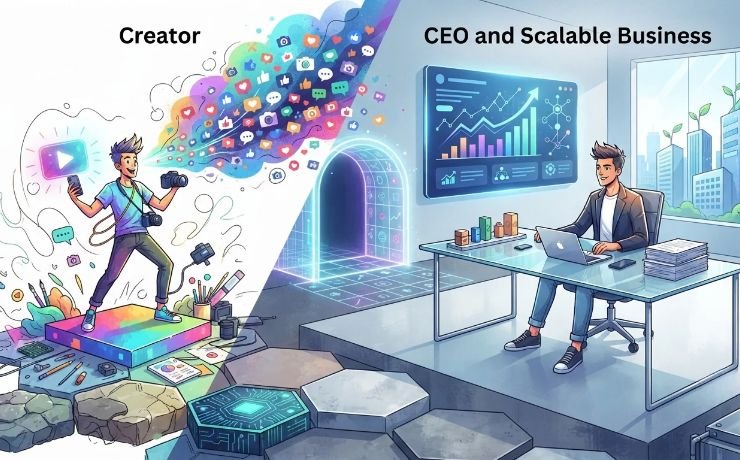
The transition from creator to entrepreneur is therefore not simply about launching a product or registering a company. It is about moving from being the face of a personal brand to building an organisation that can operate, compete and grow beyond the individual behind it.
For the marketing and advertising industry, this transition is equally significant. Creators are no longer only media partners helping brands reach audiences. They are increasingly becoming business owners, competitors, distributors and brand builders in their own right.
When Influence Becomes a Business Asset
A creator’s biggest advantage is often the relationship they have built with their audience. Unlike conventional businesses that may spend years developing consumer awareness, creators can begin with an established community that already recognises their voice, understands their interests and engages with their recommendations.
This relationship can reduce some of the barriers associated with launching a new business. A beauty creator, for instance, may have spent years discussing skincare routines, reviewing products and understanding the concerns of their followers. Launching a skincare brand allows that knowledge to translate into a commercial offering. Similarly, a fitness creator may identify demand for nutrition products, training programmes or wellness services within an existing community.
The advantage is not restricted to awareness. Creators can use their platforms to test ideas, collect feedback, understand product preferences and generate early demand. Comments, polls, direct messages and community discussions can offer insights into consumer behaviour that conventional market research may take longer to uncover.
However, an engaged audience does not automatically translate into paying customers. Followers may enjoy a creator’s content without having any intention of purchasing their products. The challenge is to understand whether an audience relationship reflects genuine demand for a particular category or simply an interest in the creator’s personality and content.
This distinction is where the first entrepreneurial decision begins: identifying a business opportunity that exists beyond the popularity of an individual.
From Personal Brand to Product-Market Fit
One of the most common mistakes in creator-led entrepreneurship is assuming that a large following guarantees product success. In reality, the size of an audience is only one part of the equation. A sustainable business needs a clearly defined consumer problem, a relevant product, competitive pricing and a reason for customers to return.
Creators entering entrepreneurship must therefore move from content-led thinking to product-led decision-making. Instead of asking what their followers might like to see next, they need to understand what consumers are willing to pay for, how frequently they will purchase it and what makes the offering different from existing alternatives.
Consider the difference between a creator recommending a beauty product and developing one. The former involves sharing an opinion or experience. The latter requires decisions around formulation, ingredients, packaging, manufacturing, regulatory compliance, pricing, distribution and customer support.
Each decision has implications for the brand’s credibility and profitability. A product that performs well in a launch campaign but fails to meet consumer expectations can damage trust far more quickly than a poorly performing social media post.
Product-market fit also requires creators to look beyond their immediate follower base. A business that depends entirely on existing followers may reach a growth ceiling. To scale, the product must appeal to consumers who may not know the creator personally but recognise the value of the offering.
The strongest creator-led businesses are therefore built around a product proposition that can stand independently of the founder’s popularity.
The Creator Becomes the Brand, but Cannot Remain the Entire Business
In the early stages, a creator’s personal identity often plays a central role in the business. Their credibility provides the initial trust, their content introduces the product and their community helps generate early sales. This founder-led model can be effective during launch, but it becomes difficult to sustain as the business expands.
When every product announcement, customer interaction, campaign and business decision depends on the creator, growth becomes closely tied to their personal availability. The individual who once managed a content calendar may now be expected to oversee marketing, product development, partnerships, hiring and business operations.
This is where the transition from creator to CEO becomes particularly important.
A CEO must build systems, delegate responsibilities and create an organisation that can function without requiring constant founder involvement. The creator’s role gradually shifts from producing every piece of communication to setting the brand’s direction, building the leadership team and making decisions about long-term growth.
It also requires a change in mindset. Content creation rewards consistency, visibility and immediate audience engagement. Business leadership demands patience, operational discipline and decisions that may not generate instant public attention.
The creator must learn to separate personal popularity from business performance. A campaign receiving millions of views is not necessarily successful if it fails to generate profitable sales. Similarly, a product category with limited social media excitement may deliver stronger repeat purchases and long-term revenue.
Building the Business Beyond Social Media
Social platforms are powerful discovery and distribution channels, but they are not businesses that creators control entirely. Algorithms change, reach fluctuates, monetisation policies evolve and platform preferences can shift overnight.
For creator-led businesses, depending exclusively on Instagram, YouTube or other social networks creates a structural risk. A change in recommendation systems or account visibility can affect customer acquisition even when the underlying product remains competitive.
Building independent distribution channels is therefore essential. This can include a dedicated website, direct-to-consumer commerce, email databases, customer relationship management systems, retail partnerships and marketplace presence.
These channels allow businesses to develop relationships with customers beyond the platforms where they first discovered the creator. They also create opportunities for repeat communication, personalised offers, customer service and loyalty programmes.
For example, a creator-led fashion label may initially generate sales through Instagram launches. As the business grows, its website can become the primary sales destination, while marketplaces and offline retail partnerships expand its reach. The creator’s social presence continues to drive awareness, but the business is no longer dependent on a single platform for transactions.
This distinction is important because scalable businesses require repeatable distribution systems. An audience can help open the door, but a reliable sales infrastructure is what keeps the business moving.
Learning the Economics of Entrepreneurship
Another major challenge in the creator-to-CEO transition is understanding the financial realities of running a business.
Creators may be familiar with campaign fees, platform revenue and sponsorship negotiations. However, operating a product-based business introduces a different financial structure. Revenue must account for manufacturing costs, packaging, logistics, returns, marketplace commissions, marketing expenditure, employee salaries and other operational expenses.
A business generating substantial sales may still struggle to become profitable if customer acquisition costs are high or margins are insufficient. Similarly, rapid growth can create cash-flow pressure when inventory, production and distribution expenses increase faster than incoming payments.
Creators must become comfortable with metrics such as gross margin, contribution margin, customer acquisition cost (CAC), customer lifetime value (LTV), average order value and repeat purchase rate.
These indicators provide a more complete picture of business health than follower counts, impressions or engagement rates.
For instance, a creator-led brand may attract thousands of first-time buyers through a launch campaign. But if only a small percentage return for another purchase, the business may need to reconsider its product quality, pricing, customer experience or retention strategy.
Understanding these numbers also helps founders make informed decisions about expansion. Opening new product categories, entering additional markets or increasing advertising expenditure should be based on business fundamentals rather than the excitement surrounding a successful launch.
Hiring the Right People and Building an Organisation
A creator’s individual skill set may be sufficient to build an audience, but scaling a business requires expertise across several functions. The founder cannot be expected to understand every operational detail or personally manage every department.
As the company grows, hiring becomes a strategic priority. Depending on the business model, the organisation may need specialists in product development, finance, supply chain, technology, performance marketing, sales, legal compliance and customer experience.
This can be a difficult transition for creators who are accustomed to having direct control over their content and public identity. Building a company requires trusting people with responsibilities that may previously have remained entirely within the founder’s control.
It also requires recognising where external expertise is necessary. A creator entering the beauty business may understand consumer preferences but still need experienced professionals to manage formulation, manufacturing and regulatory requirements. A creator launching a fashion label may have a strong design sensibility but require specialists to manage sourcing, production planning and inventory.
The objective is not to remove the creator from the business. It is to ensure that their contribution is directed towards areas where they add the most value.
In the long run, the quality of the leadership team can determine whether a creator-led venture remains a personality-driven operation or develops into a professionally managed company.
What the Global Creator Economy Is Teaching Us
International markets offer several examples of creators using their audiences as a starting point for building consumer businesses.
MrBeast, through Feastables, has expanded beyond digital entertainment into the consumer packaged goods category. The business uses the creator’s existing audience and media presence to generate awareness, while retail distribution and product availability support its commercial expansion.
Emma Chamberlain’s Chamberlain Coffee demonstrates how a creator’s personal interests and content identity can be translated into a consumer brand. The business operates through its own product range and distribution channels, extending the relationship beyond the creator’s original content.
Similarly, Huda Kattan built Huda Beauty by combining her influence in the beauty community with a product-led business. The brand’s growth illustrates how category knowledge, product development and consumer relationships can work together to establish a company beyond its founder’s social presence.
These examples differ in scale, category and business structure, but they highlight an important principle: an audience can provide a launch advantage, while the long-term value of a company depends on its ability to deliver products and experiences that consumers continue to choose.
India’s Creator Economy Is Entering Its Entrepreneurial Phase
India’s creator ecosystem is also moving towards a more entrepreneurial model. The growth of regional creators, influencer-led communities, digital commerce and direct-to-consumer brands has created opportunities for individuals to move from content monetisation into business ownership.
Creators across beauty, fashion, food, fitness, finance and lifestyle have access to audiences that are increasingly comfortable discovering products through digital personalities. The combination of social commerce, e-commerce marketplaces and expanding digital payments infrastructure provides multiple routes to market.
Indian creators also operate in a market with considerable category diversity. A regional food creator may identify opportunities in packaged foods, while a fashion influencer may build a label around a specific consumer segment. A fitness personality may develop digital programmes, wellness products or subscription-based services.
However, the transition comes with market-specific challenges. Price sensitivity, regional preferences, intense competition and distribution complexity can make scaling difficult. A product that performs well among an urban, digitally active audience may require significant adaptation before it can reach consumers across different cities and income groups.
There is also a growing need for stronger business infrastructure. Creators entering regulated categories must understand compliance requirements, product standards, taxation and consumer protection. The ability to build professional teams and establish reliable operating processes will become increasingly important.
For India’s marketing industry, this development presents a new category of business leaders. Creators are increasingly entering spaces traditionally occupied by established consumer brands, bringing their own distribution advantages, community relationships and understanding of digital culture.
The Risks Behind the Creator-to-CEO Narrative
While creator-led entrepreneurship offers considerable opportunities, the transition is not without risks. The visibility of successful launches can create the impression that building a business is a natural extension of having a large digital following. In practice, many ventures face challenges that have little to do with social media performance.
Audience dependency: A business that relies heavily on the founder’s personal visibility may struggle when content output declines or audience interest changes.
Overexpansion: Launching multiple categories before establishing a strong core product can stretch resources and create operational complexity.
Weak differentiation: Entering a crowded market with products that offer little beyond the creator’s name can make it difficult to build lasting consumer preference.
Operational gaps: Poor inventory planning, inconsistent quality, delayed deliveries and weak customer support can damage trust, regardless of how strong the marketing campaign may be.
Founder dependency: When the creator remains involved in every decision, the business can struggle to develop the systems and leadership required for scale.
These challenges underline why business planning must precede expansion. The creator’s influence may generate initial interest, but operational performance determines whether customers stay.
From Influence to Enterprise Value
The creator-to-CEO transition is ultimately a shift in how value is created. As a content creator, the individual monetises attention, reach and audience relationships. As an entrepreneur, the individual builds products, systems, distribution networks and an organisation capable of generating revenue over time.
This also changes how brands and agencies engage with creators. Partnerships may increasingly involve more than campaign deliverables. Creator-led businesses can become retail partners, product collaborators, competitors and long-term commercial stakeholders.
For marketers, understanding this evolution will be important when evaluating creator partnerships. Follower count and engagement remain relevant, but a creator’s category understanding, consumer credibility and ability to build products can offer a different kind of value.
The next generation of creator-led businesses will likely be judged by the same standards as other enterprises: product quality, customer loyalty, financial discipline, operational efficiency and the ability to adapt to changing markets.
A digital following can provide the first customer, the first sale and the first wave of brand awareness. But it cannot replace a sound business model, a capable team or a product that delivers on its promise.
The real measure of a creator’s entrepreneurial success will not be how many people follow them, but how many customers continue to choose what they have built, even when the creator is not in the room.
