













Social Search: Why Gen Z Searches on Instagram and Shorts

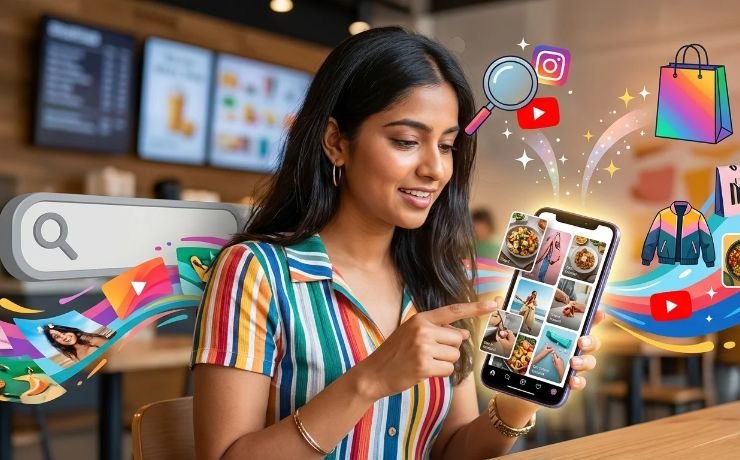
Ask a twenty-year-old in Delhi, Pune or Hyderabad where they would look for a new café, a monsoon skincare routine or an honest verdict on a pair of running shoes, and the answer is increasingly unlikely to be a blue search bar. It is more likely to be a thumb-sized magnifying glass inside Instagram, or the search field above a column of YouTube Shorts. The query is typed in a hurry, often in Hinglish, and the result is not a list of links but a stream of faces, voices and real-life evidence.
The industry has a name for this behaviour: social search. For brand marketers it is no longer a curiosity to be noted in a trends deck. It is changing where purchase journeys begin, which content gets discovered, and who earns the trust that eventually turns into a sale.
From Keywords to Moments
The idea first entered boardroom conversation in 2022, when Google’s Prabhakar Raghavan told the Fortune Brainstorm Tech conference that roughly 40% of young people, when looking for somewhere to have lunch, did not turn to Google Maps or Search. They opened TikTok or Instagram. The remark was striking not because it announced the end of search, but because it came from the company that defined it.
Since then, the supporting evidence has accumulated, though it is worth reading carefully. Sprout Social’s 2025 research found that 41% of Gen Z begin a search on social media, compared with 32% who start on a traditional search engine. A Forbes Advisor and Talker Research survey of 2,000 Americans, reported by eMarketer, found that 46% of Gen Z and 35% of millennials prefer social media over search engines, and that 44% of Gen Z discover new brands on social platforms daily. A separate GRIN survey of 18 to 27 year olds asked where they most often discover products. Instagram came first at 30.4%, TikTok second at 23.2%, and Google third at 18.8%.
An honest note on sourcing is necessary here. Most of these studies are American or global, and Indian data is thinner. TikTok remains banned in India, which means the local contest is fought almost entirely between Instagram Reels and YouTube Shorts, with a very different competitive set from the one in Western surveys. But the direction of travel is not in doubt, and Indian Gen Z, among the most mobile-first and video-fluent cohorts in the world, has every reason to behave at least as aggressively.
The deeper change is in the nature of the query. Raghavan’s own observation, made at the time, was that younger users do not necessarily search with keywords at all. They want to discover, in visual form. A search for “best ramen” on Google is a request for a list. The same search on Instagram is a request for a vibe: the steam, the queue, the interiors, the price on the receipt, the friend who said it was overrated.
Why Google Is Not Enough
It is tempting to explain this shift through convenience, but convenience is the lesser reason. The more potent one is trust. Traditional search results, particularly in categories like beauty, travel and consumer technology, have become crowded with sponsored placements, affiliate listicles and content engineered for ranking rather than usefulness. A young shopper has learned to be suspicious of page one.
Social video offers something different: proof of life. A creator holding the product, showing it fail in sunlight, or confessing that the shade looks different on darker skin is persuasive in a way that polished copy rarely is. The comments section works as a live review layer, where strangers contradict, confirm and correct. Search on these platforms is, in effect, a way of reaching other people’s lived experience quickly.
There is also a matter of format. Gen Z has grown up consuming answers, not documents. A sixty-second video that shows how to tie a saree pleat, compare two phones or assemble a college-dorm capsule wardrobe is a more natural unit of information than a 1,500-word article, however well written. The medium is the answer.
Instagram and YouTube Shorts Play Different Roles
The phrase “social search” can hide an important distinction. The platforms are not interchangeable, and a brand that treats them as such is likely to waste effort.
eMarketer’s research on Gen Z social search found that no single platform is the clear go-to, and that YouTube was the most popular destination for social searches, with nearly 60% of Gen Z social searchers having searched there in the preceding month, ahead of both TikTok and Instagram. Its analysts noted that Gen Z often gravitates to YouTube for deeper, more detailed searches, while turning to Instagram or TikTok for quicker queries such as fashion trends or travel recommendations.
That maps neatly onto how Indian brands should think about their roles. Instagram is where inspiration is found and social proof is gathered. Its search behaviour tends to be visual and impulsive: a restaurant, an outfit, a skincare product, a destination. It is a discovery engine wrapped inside an identity platform, which means the content that performs is often the content that makes someone want to be associated with it.
YouTube, by contrast, is where research is completed. Its Shorts format has become a significant doorway, with Google’s own executives citing around 70 billion views a day, but the surrounding library of long-form reviews, tutorials and comparisons is what turns curiosity into conviction. Morgan Stanley AlphaWise data cited by the agency DAC suggests that about 40% of YouTube Shorts users are not using Instagram Reels or TikTok at all, which makes Shorts a route to an audience that Instagram alone will not reach. In India, a Kantar survey found that 76% of Gen Z viewers feel their time is well spent on YouTube, compared with 65% for Instagram and 57% for television. That is a remarkable measure of how the platform is perceived: not as a distraction, but as a useful place.
The Myth of the Google Exodus
None of this means Gen Z has abandoned Google, and brands that plan as though it has will make an expensive mistake. Google’s own people have been quick to point this out. Chris Loschiavo, a strategic agency manager at Google and YouTube, argued at an agency summit that the idea of Gen Z deserting search quickly falls apart under scrutiny. Google’s research on Indian Gen Z shows the cohort remains highly active on both Google Search and YouTube. And the eMarketer data underlines that 57% of people use YouTube as they would use Google, which is a point about Google’s ecosystem as much as about social.
The more accurate picture is a layered journey. A user spots a product in a Reel, searches for reviews on YouTube, scans the comments, checks another creator’s opinion, and finally lands on Google or a marketplace to verify price and availability. Each platform contributes a different kind of evidence. A brand that is invisible at any step in that chain loses a chance to be considered.
That reframes the strategic question. It is not whether to invest in social or in search. It is whether the brand’s information is findable, credible and consistent across every surface where a young consumer might look.
What Brands Should Actually Do
The practical response is less glamorous than the trend suggests. It does not begin with a viral idea. It begins with a discipline most social teams have been slow to adopt: planning content around the questions people actually ask.
Start with the query, not the campaign. Social calendars are typically built around festivals, product launches and brand moments. Search-led content planning begins with demand. What do customers want to know before buying in your category? Which comparisons do they make? What anxieties do they have about price, fit, ingredients or after-sales service? A brand’s own customer-service logs, comment sections and marketplace reviews are often richer sources than any keyword tool. A handful of well-made answers to the most common questions will outperform dozens of generic brand reels.
Treat captions, on-screen text and spoken words as metadata. On platforms where search is increasingly central, what a video says, shows and names helps determine whether it surfaces. Clear titles, plain-language captions, relevant on-screen text and descriptive spoken dialogue give the platform something to read. This is the same logic that governed web SEO a decade ago, applied to a medium where the discoverable layer is partly visual and partly verbal. For Indian brands, it also means deciding deliberately which language or mix of languages the audience is likely to type, and covering them.
Build a library, not a feed. The traditional social post is perishable. A search-friendly video is closer to an asset: it can be found months later by someone with a specific need. Brands should think in terms of evergreen series on Instagram and YouTube, such as how-tos, comparisons, buying guides and myth-busting explainers, and invest in refreshing them. A mid-sized fashion brand that has a well-structured set of videos answering “what to wear to a wedding in summer” will quietly capture demand every season.
Use Shorts as the front door and long-form as the room. Given YouTube’s role in deeper research, the most efficient structure is often a short, sharp video designed to attract and a longer piece that completes the explanation. The short earns attention. The long-form earns the sale. Linking the two, through pinned comments, end screens and playlists, helps the journey continue inside the same ecosystem.
Make creators part of the search layer. If social search is, at heart, a hunt for other people’s experience, then creators are effectively search results. Their reviews, comparisons and tutorials are what a curious user will encounter, and which ones surface will shape perception long before a brand’s own content is seen. The smarter move is to brief creators around real customer questions rather than slogans, to prioritise those with credibility in a specific niche over generic reach, and to allow honest criticism. The GWI research cited across the industry makes a related point: nearly half of Gen Z primarily use social networks to research brands, and a content ecosystem of unconvincing endorsements invites scepticism rather than purchase.
Manage the comments as an asset. In a search-driven journey, the comment section is a review page. Brands that respond quickly, correct misinformation, pin useful answers and acknowledge complaints demonstrate transparency to the people who are reading but not commenting. Silence reads as indifference, or worse, as a sign the brand has something to hide.
Close the loop with commerce. Discovery that cannot become action leaks away. Where a brand sells through its own site or marketplaces, the path from a Reel or Short to a product page should be as short as the platform allows, and the product information a user lands on should match what they saw. A Forrester study from 2025 found that 81% of surveyed Gen Z respondents had discovered new products to buy through social media, a reminder of how closely discovery and shopping now sit together.
Measurement Will Need to Catch Up
One of the quieter obstacles to taking social search seriously is that it does not fit neatly into existing dashboards. Search marketers are accustomed to impressions, clicks and conversions mapped to keywords. Social teams are used to reach, engagement and follower growth. Social search sits awkwardly between the two. A video that answers a question may attract modest likes but steady, long-tail views from highly motivated viewers. Its influence may show up later in branded search, direct traffic or marketplace conversion.
Brands will need to adapt their measurement accordingly: tracking how often their content appears for the queries that matter, watching the growth of branded search following content pushes, and treating saves, shares and repeat views as signals of usefulness rather than vanity. Agencies that can stitch social, search and commerce data into a single view of the journey will have a clear advantage in the years ahead.
There is also the next layer to consider. As younger users begin to ask chatbots and AI assistants the same questions they once typed into search engines, the content that earns visibility will need to be clear, structured and credible enough to be understood by machines as well as people. Brands that answer questions well on social platforms are, by accident or design, building the raw material for that future too.
A Question of Usefulness
It would be easy to treat social search as another buzzword to be absorbed into a strategy deck and forgotten. But the shift underneath it is real, and the lesson is simple enough to state. Young consumers are not asking brands to be louder. They are asking them to be more useful, and to be useful in the places they already spend their time.
The brands that win on Instagram and YouTube Shorts will not necessarily be the ones with the biggest budgets or the cleverest hooks. They will be the ones that understand what their customers want to know, answer it honestly in a format the platform rewards, and keep showing up with the same clarity at every step of the journey. In a feed built on distraction, being genuinely helpful may turn out to be the most distinctive creative idea of all.
