














India’s Smart TV Penetration Milestone — What It Unlocks for Advertisers

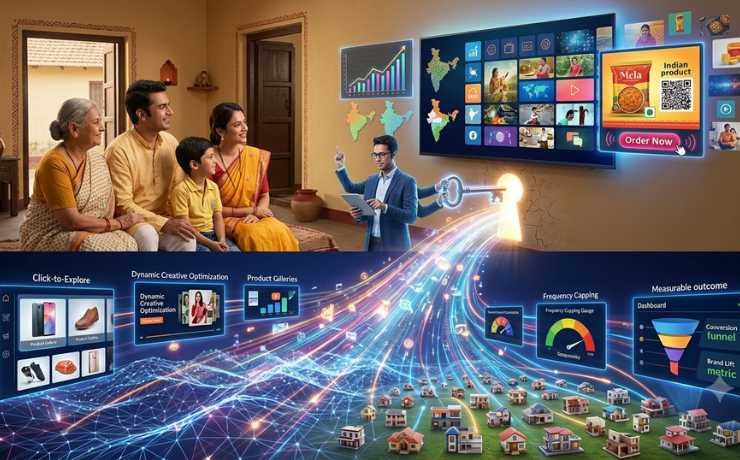
Picture a living room in Lucknow. A 38-year-old teacher has just unboxed a new television — a 43-inch smart TV she picked up during a festive sale for under eighteen thousand rupees. Within the hour, she has signed into YouTube, downloaded a streaming app her daughter recommended, and is watching a cooking show in crisp 1080p. She has never owned a set-top box. She never will. In that single living room, three things happened simultaneously: a household crossed into the connected TV economy, a media planner’s addressable audience grew by one, and a cable distributor lost a customer forever.
That scene is playing out millions of times across India, and the cumulative effect is reshaping the country’s advertising landscape at a pace that few in the industry fully anticipated. India has crossed a meaningful threshold in smart TV penetration — one that transforms connected television from a premium niche into a mass-market media channel. For advertisers, media planners, and the programmatic ecosystem that serves them, the implications are significant and immediate. The question is no longer whether CTV deserves a place in the Indian media plan. It is how quickly the industry can build the infrastructure, measurement standards, and creative capabilities to capitalise on what is fast becoming one of the most valuable advertising surfaces in the country.
The Numbers Behind the Milestone
India’s smart TV installed base has grown at a pace that consistently outstrips projections. Falling hardware prices — driven by aggressive competition among brands like Mi, Vu, Thomson, OnePlus, and Samsung — have brought smart TV technology within reach of middle-income households across Tier 1, Tier 2, and increasingly Tier 3 markets. The average selling price of a 32-inch smart TV in India has dropped to levels that make it a realistic aspirational purchase for a much broader income band than was possible even three years ago. As a result, the installed base of connected televisions in Indian homes has crossed into territory where it commands genuine scale for advertisers — not the selective, urban-skewed reach of early CTV adoption, but something approaching mass market coverage in key demographic segments.
Internet penetration has been the essential co-condition. A smart TV without a reliable broadband connection is an expensive picture frame. The rapid expansion of Jio’s broadband and fibre infrastructure, alongside the continued rollout of 5G and fixed wireless access, has brought sufficient connectivity into the homes where smart TVs are landing. The household is online; the television is connected; the viewer is streaming. That combination is what creates the advertising opportunity, and it is now present at a scale that changes the strategic calculus for national advertisers.
What Connected TV Unlocks That Linear Television Never Could
The significance of India’s smart TV milestone is not simply that more households own internet-connected screens. It is that those screens now carry a fundamentally different advertising proposition than the linear television they are replacing or supplementing. Linear TV offered reach and brand salience — powerful tools in the right context, but blunt instruments when precision was the goal. Connected TV offers reach and precision simultaneously, and that combination has been the holy grail of video advertising for two decades.
On a connected TV, the viewer is authenticated. The household’s streaming behaviour — what they watch, when they watch it, how long they stay, what they skip — generates a data exhaust that is richer in signal than almost any other media touchpoint. When layered with first-party data from brands and second-party signals from streaming platforms, this data enables audience targeting at the household level with a specificity that linear TV never approached. A financial services brand can reach households that have recently searched for home loan products. An automobile brand can target viewers in specific pin codes who have watched car review content across multiple sessions. A FMCG brand can exclude existing customers and direct budget entirely toward conquest audiences. None of this was possible when the channel was a broadcast feed and the viewer was anonymous.
“India’s CTV moment is different from what happened in the US or the UK, because here the smart TV and the smartphone grew up together. The viewer has already been conditioned to personalised, on-demand content. The advertising experience needs to meet that expectation.”
The format capabilities of CTV advertising extend well beyond the thirty-second pre-roll. Interactive overlays allow viewers to engage with an ad without leaving the content — requesting a callback, adding a product to a cart, or scanning a QR code with a second screen. Sequential storytelling across multiple ad exposures within a viewing session enables narrative arcs that single-exposure TV spots cannot achieve. Pause ads, which appear when a viewer pauses content, deliver brand impressions in a low-friction, non-interruptive context that is uniquely native to the streaming experience. These formats are already available on India’s major streaming platforms; what the scale milestone does is make deploying them at meaningful reach a viable proposition for a wider range of advertisers.
The Programmatic Layer and Why It Matters
India’s CTV advertising ecosystem is increasingly programmatic in its architecture, even where the buying workflow retains some manual elements. The major streaming platforms — JioCinema, Disney+ Hotstar, SonyLIV, Zee5, and others — have opened their inventory to programmatic channels either directly or through supply-side platform integrations. Demand-side platforms with CTV capabilities can now access this inventory alongside mobile and desktop video supply, enabling media buyers to build unified video strategies across screens without managing separate direct deals for each platform.
The programmatic layer matters for several reasons beyond buying efficiency. It enables frequency management across screens — ensuring that a viewer who has seen a brand’s message on mobile is not overexposed to the same creative on CTV, a problem that manual buying across siloed platforms cannot solve. It enables dynamic creative optimisation, serving different versions of an ad based on the viewer’s profile, the time of day, or the content context. And it creates the audit trail that accountability-focused advertisers require — impression verification, brand safety enforcement, and viewability measurement that brings CTV closer to the standards that digital buyers expect.
India-specific programmatic CTV infrastructure is still maturing. Identity resolution across the CTV environment — connecting a household’s streaming behaviour to its mobile and desktop signals — remains a work in progress, particularly as third-party cookie deprecation reshapes the identity landscape across all digital channels. Publishers are building out their first-party data capabilities, and the industry is working toward common measurement standards that would allow advertisers to compare CTV reach and frequency metrics with linear TV and digital video on a consistent basis. These are solvable problems, and the scale milestone creates the commercial incentive to solve them faster.
Tier 2 and Tier 3: The Advertiser Opportunity Beyond the Metros
One of the most strategically significant dimensions of India’s smart TV penetration story is its geographic spread. Early CTV adoption in India, like early digital adoption broadly, was concentrated in the major metros — Mumbai, Delhi, Bengaluru, Hyderabad, Chennai. That is no longer the case. The combination of affordable hardware and improving rural and semi-urban connectivity has pushed smart TV ownership into markets that have historically been difficult to reach with precise, digital-grade advertising.
For categories like FMCG, consumer durables, agri-inputs, regional financial services, and government schemes, this geographic expansion is transformative. Hindi, Tamil, Telugu, Kannada, Bengali, and Marathi content consumption on CTV is growing rapidly, and the advertising ecosystem around regional language streaming is developing accordingly. Brands that have historically relied on regional linear television to reach these audiences — accepting the measurement limitations and creative constraints that came with it — now have access to a connected, addressable version of those same audiences. The media plan that was once a blunt instrument in Patna or Coimbatore can now carry the same targeting precision as a campaign running in Gurugram.
Creative Implications: Building for the Big Screen in the Streaming Era
The shift to CTV demands a rethink of creative strategy, not just media strategy. Television creative has traditionally been optimised for passive, lean-back consumption — high production values, emotional storytelling, broad brand messaging designed to work across a heterogeneous audience. CTV creative needs to work in that mode too, because the viewing environment is fundamentally the same. But it also needs to account for the interactive potential of the medium, the data-informed precision of the targeting, and the shortened attention that carries over from mobile viewing habits.
Brands investing in CTV in India are learning that six-second and fifteen-second formats perform differently on the big screen than they do on mobile. The lean-back context of television viewing gives the viewer more patience for narrative — but only if the creative earns it quickly. The first three seconds on CTV are as critical as they are on any digital video format; the difference is that the payoff for holding attention longer is proportionally greater, because the screen size and audio environment create a more immersive brand impression than a phone screen ever can.
Measurement: Closing the Gap Between Promise and Proof
The most significant work still to be done in India’s CTV advertising ecosystem is on measurement. Advertisers investing in CTV need to be able to demonstrate outcomes — not just reach and frequency, but brand lift, consideration shift, and ultimately sales attribution. The tools to do this exist in mature CTV markets, and they are making their way into the Indian ecosystem, but the pace of adoption has lagged the pace of inventory growth.
Cross-screen measurement — the ability to understand how a viewer’s exposure to CTV advertising interacts with their subsequent digital behaviour on mobile and desktop — is particularly important for performance-oriented advertisers. A viewer who sees a financial services brand’s CTV ad in the evening and searches for the brand’s product on their phone the following morning represents a measurable, attributable outcome. Building the data infrastructure to capture and report on that journey at scale is the next frontier for India’s CTV advertising ecosystem, and the milestone in smart TV penetration is the catalyst that makes investing in that infrastructure commercially rational.
India’s smart TV moment has arrived on its own terms — faster in some dimensions, more complex in others, and more geographically dispersed than the CTV transitions in Western markets that the industry has used as its reference point. Advertisers that approach it with that distinctiveness in mind, rather than simply transplanting playbooks from other markets, will find themselves at the leading edge of what is shaping up to be one of the most consequential shifts in Indian media since the arrival of digital video itself.
