














Synthetic Focus Groups — Are Brands Really Testing Creative on AI-Simulated Audiences Now

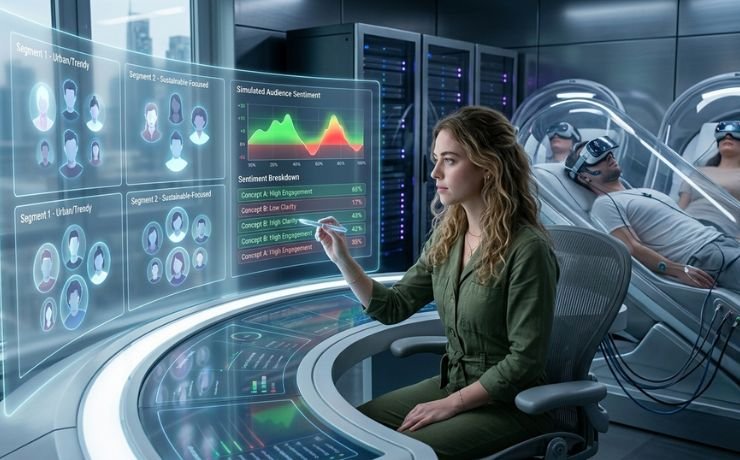
For decades, testing a piece of advertising meant asking people what they thought about it. A research agency recruited respondents, a moderator put a concept in front of them, and marketers waited for the familiar mix of reactions: what caught attention, what felt relevant, what confused people and, occasionally, the comment that changed the direction of the entire campaign.
That process is now acquiring a new participant: the machine.
Across market research and marketing, companies are experimenting with synthetic audiences, AI-generated respondents and simulated focus groups to test concepts, messaging, products and creative. Instead of recruiting a group of consumers and asking them to react to an advertisement, marketers can create simulated audiences based on demographic, behavioural or attitudinal characteristics and ask those audiences to respond.
The proposition is difficult to ignore. What if an agency could test 50 creative routes before narrowing them down? What if a brand could run an initial audience read overnight rather than waiting weeks? What if an early-stage campaign could be pressure-tested before a single rupee was committed to production or media?
That is the promise behind synthetic focus groups.
But the more important question for marketers is not whether AI can produce an answer. It clearly can. The question is whether the answer represents something a real consumer might actually think, feel or do.
From Focus Groups to Simulated Consumers
Synthetic research is not one single technology. The term can refer to AI-generated personas, simulated survey respondents, digital twins, synthetic datasets or AI-led conversations designed to resemble qualitative research.
In a synthetic focus group, marketers typically define an audience and provide the AI system with information about the relevant consumer segment. The system then creates or accesses simulated respondents with particular demographic, behavioural or psychographic characteristics. Creative, packaging, propositions or messages can be presented to these respondents, who generate reactions that can subsequently be analysed.
The technology is attractive because it changes the economics of early-stage research.
Traditional focus groups require recruitment, scheduling, incentives, moderation and analysis. They also operate within the limits of the participants who can realistically be recruited. Synthetic audiences, by comparison, can be queried repeatedly and at scale.
The appeal, therefore, is less about replacing a room full of consumers with computers and more about moving some research further upstream in the decision-making process.
Creative Testing Is Where the Idea Gets Interesting
Advertising may be one of the most obvious applications.
Creative teams increasingly produce more variations than traditional research processes can comfortably test. Different hooks, headlines, scripts, visual treatments, calls to action and platform adaptations can multiply quickly, particularly when generative AI is involved in production.
The bottleneck is no longer necessarily creating options. It is deciding which options deserve attention.
Synthetic audiences can potentially help with that first filter.
A brand could, for example, develop several territories for a festive campaign and ask simulated consumers from different audience segments to react to each. One group could represent existing customers, another category switchers and another price-sensitive consumers. The output could help identify recurring points of confusion, relevance or resistance before the creative moves into conventional testing.
This is where synthetic research may have a practical role: not necessarily telling marketers what campaign to run, but helping them decide which ideas deserve further investigation.
Some research platforms are already positioning synthetic audiences specifically for concept, message and creative testing. The underlying approach is to model audience responses using existing consumer research rather than treating a general-purpose AI model as a direct substitute for respondents.
The Data Underneath the Simulation Matters
This may be the biggest issue in the synthetic-research debate.
An AI model can produce an extremely convincing consumer response without actually representing a consumer.
Ask a language model to respond as a 28-year-old urban professional who shops for premium skincare and it will almost certainly produce a coherent answer. But coherence is not evidence.
The quality of a synthetic audience depends heavily on what information sits underneath it.
This is why the emerging distinction between AI-generated personas and data-grounded synthetic audiences matters for marketers. One is essentially a constructed character. The other attempts to model consumer behaviour using evidence from real respondents or behavioural datasets.
That difference will become increasingly important as more research providers enter the market.
The Speed Advantage Is Real
There is a reason marketers are paying attention despite the methodological questions.
Speed.
Marketing organisations are being asked to produce more creative, personalise more messages and respond to changing consumer behaviour faster than traditional research cycles were designed to accommodate.
A focus group can provide depth, but it is not designed to test hundreds of variations. A synthetic system can potentially run many more scenarios at relatively low marginal cost.
Recent industry research has pointed to synthetic panels being used to test concepts, pricing and other variables. At the same time, researchers have cautioned that synthetic panels cannot replace traditional market research and may be less effective for radically innovative products.
That caveat is arguably more important than any headline accuracy number.
If a brand is testing a familiar proposition in a well-understood category, historical data can provide a useful foundation for modelling likely responses. If the brand is launching something consumers have never encountered, the historical evidence becomes much thinner.
And that is precisely where marketers often need research the most.
The Problem With Asking a Machine to Predict Novelty
Consumer research has always had a relationship with the past. Researchers use what people have previously said or done to understand what they might do next.
AI does something similar, only at a much larger scale.
The problem arises when the future looks sufficiently different from the data used to construct the model.
A radically new product, cultural behaviour or creative idea may not have an obvious historical analogue. The model can still generate a response, but the response may reflect patterns it has already learned rather than a genuinely new consumer reaction.
That creates an uncomfortable paradox.
The better a synthetic audience is at representing existing consumer behaviour, the more useful it may be for testing familiar decisions. But the more disruptive the decision, the less confidence marketers should place in a simulated response derived from existing patterns.
For advertising, that could mean synthetic testing is more useful for optimising a campaign territory than deciding whether an entirely new creative language will work.
But What About the Messiness of Real People?
There is another reason human research remains difficult to replicate: people do not simply answer questions. They influence one another.
In a conventional focus group, a participant’s reaction can trigger another participant to reconsider their view. Someone’s hesitation can expose a problem the moderator had not anticipated. A joke can reveal cultural context. A participant can contradict the group’s dominant opinion.
That messiness is not necessarily a flaw. Sometimes it is the research.
Synthetic focus groups can simulate interaction, but the interaction remains generated by models. It is therefore difficult to know whether an apparently spontaneous disagreement represents an authentic social dynamic or a statistically plausible imitation of one.
For marketers, this means the apparent richness of an AI conversation should not automatically be mistaken for qualitative depth.
The Danger of the Confident Answer
Perhaps the most dangerous characteristic of synthetic research is also its most attractive one: it sounds certain.
A synthetic respondent does not say, “I’m not sure what I think.” It can explain its reasoning fluently. It can describe why a headline feels authentic, why a product seems expensive or why a campaign might appeal to a particular demographic.
That makes the output easy to present in a marketing meeting.
It also makes it easy to overinterpret.
Research has traditionally carried a degree of friction. Recruit participants. Ask questions. Examine sample size. Challenge the methodology. Look at the data. With AI, a marketer can generate a polished qualitative narrative almost instantly.
The risk is that fluency becomes confused with validity.
That suggests a new discipline for marketers: interrogating the provenance of an AI-generated insight as carefully as they interrogate the insight itself.
The Agency Opportunity Is Bigger Than the Research Opportunity
For agencies, synthetic research could change the way strategy and creative development work together.
Today, research can sometimes arrive at defined points in the process: the brief is developed, concepts are created, research is commissioned and the results come back.
With synthetic audiences, testing can potentially become continuous.
A strategist could pressure-test a brief. A creative team could evaluate multiple territories. A planner could explore audience objections. A copywriter could compare messages. A performance team could identify potential friction points before producing multiple variants.
The result would not necessarily be a replacement for formal research. It could become an additional layer between intuition and validation.
That distinction matters because agencies have historically struggled with the tension between creative instinct and consumer evidence. Too much dependence on research can flatten creative work. Too little can leave brands guessing.
Synthetic audiences offer a possible middle layer: fast enough to support creative exploration, but structured enough to challenge assumptions.
What Marketers Should Actually Use It For
The emerging conversation is less about “synthetic versus human” and more about where each method fits.
Synthetic research can be useful for early-stage screening, message comparison, identifying potential objections, exploring audience hypotheses and narrowing a large number of creative options.
Human research remains important when the decision carries substantial commercial risk, when the product or proposition is genuinely novel, when emotional nuance is central, or when marketers need to observe actual behaviour rather than simulated opinion.
That creates a hybrid model.
AI can help determine what should be tested. Humans can determine whether the answer holds up in the real world.
The Next Research Stack Will Probably Be Hybrid
The debate around synthetic focus groups is sometimes framed as a contest: will AI replace traditional market research?
That may be the wrong question.
The more likely outcome is that research itself becomes layered.
A brand might begin with AI-generated hypotheses, use a synthetic audience to narrow the options, run a smaller human study to validate the leading concepts, launch the campaign and then use actual behavioural data to recalibrate the model.
In that workflow, AI does not eliminate the consumer. It changes when and how the consumer enters the process.
That could prove to be the more meaningful shift.
The focus group room may not disappear. It may simply become one of several checkpoints in a much larger research system.
The Real Test Is Not Whether AI Can Answer
Marketing has always searched for a faster way to understand people.
Surveys made consumer opinion measurable. Focus groups added depth. Digital analytics brought behavioural data into the picture. Social listening made conversations observable at scale. Now AI is attempting to simulate the audience itself.
The attraction is obvious. Synthetic audiences can be faster, scalable and available on demand. But the limitations are equally important: models can inherit bias, reproduce historical patterns and generate plausible responses without guaranteeing that those responses reflect real consumers.
The question, then, is not whether synthetic focus groups are “real”. They are not real people, and they should not be treated as such.
The useful question is whether they are appropriate for a particular decision.
For a headline that needs an early sanity check, an AI audience may be useful. For a campaign built around a new cultural insight, a product entering an unfamiliar category or a high-value launch, simulated confidence should not be confused with consumer evidence.
The smartest use of synthetic focus groups may therefore be surprisingly modest. Not replacing human judgment, but giving it more things to question.
Because the future of consumer research is unlikely to be a choice between people and machines.
It is more likely to be a process in which machines help marketers ask better questions, while real people remain the final reality check.
