














How One BFSI Brand Used AI-Personalised Creative to Cut CAC by Half

For years, personalisation in digital advertising has largely meant changing a name, a product recommendation or a headline based on what a consumer has previously clicked. In financial services, however, the opportunity is much larger. A consumer looking for a personal loan is not necessarily motivated by the same message as someone researching a credit card, planning an investment or comparing insurance products.
That difference has become increasingly important as customer acquisition costs rise and financial brands compete for attention across search, social, video, programmatic media and owned platforms.
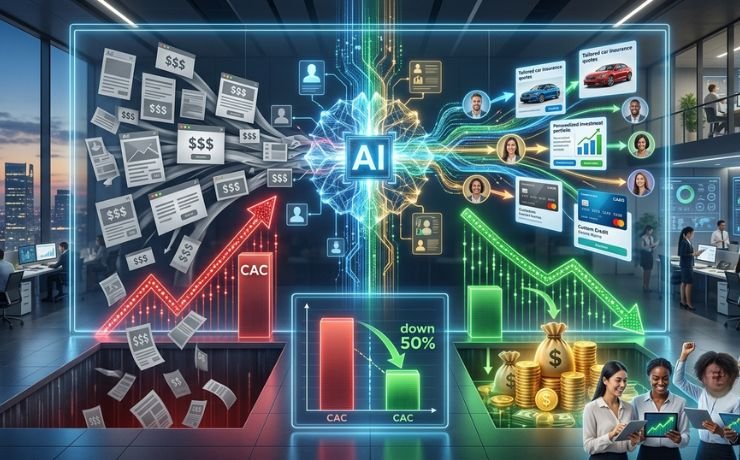
One BFSI brand found a way to address the problem by using artificial intelligence to personalise its creative at scale. Rather than creating a handful of campaign variants and manually assigning them to audience segments, the brand used AI to connect audience signals with creative decisions across the customer journey.
The result was a significant change in campaign economics: customer acquisition cost was reduced by half.
The more interesting story, however, is not the number itself. It is what the case says about the next stage of performance marketing. AI is increasingly moving beyond media optimisation and into the creative layer, where decisions about what a consumer sees, when they see it and how the message is framed can be made dynamically.
The BFSI Acquisition Problem
Customer acquisition in BFSI has always been a balancing act.
Financial products often involve higher consideration than everyday consumer categories. A user may click on an advertisement for a loan or investment product, but the journey from interest to application can involve research, comparison, documentation, eligibility checks and several points of hesitation.
That makes the cost of acquiring a customer particularly sensitive to the quality of the journey.
A generic advertisement can generate reach, clicks and even traffic without necessarily creating qualified demand. At the other end of the spectrum, highly specific creative can improve relevance but become difficult and expensive to produce when dozens or hundreds of audience combinations are involved.
This is where AI-personalised creative begins to change the equation.
Instead of treating creative as a fixed asset that is distributed across audiences, the approach treats creative as a system. Audience signals, contextual information, product propositions and historical campaign data can be combined to determine which message has the strongest relevance for a particular consumer or situation.
From Audience Segments to Audience Signals
Traditional performance marketing often starts with segmentation.
A brand identifies a set of audiences, develops creative for each group and then measures which segment delivers the strongest results. The process can work, but it assumes that people within a segment will respond similarly.
AI allows marketers to work with a more granular view of intent.
Instead of simply identifying someone as a particular demographic or interest group, a system can consider a wider combination of signals. These may include browsing behaviour, content consumption, engagement history, device characteristics, campaign interactions, time of interaction, geography and the stage of the customer journey.
For a BFSI advertiser, the distinction can be meaningful.
A young professional researching how to improve their credit score may require a different message from a consumer actively comparing loan interest rates. Someone who has already visited a product page may not need another awareness message at all. They may need reassurance, a simplified explanation of eligibility or a clear next step.
The objective is therefore not personalisation for its own sake. It is relevance at the moment when relevance can influence action.
Creative Becomes a Performance Variable
One of the most important changes in this model is the way marketers think about creative.
For a long time, creative and media have operated as related but separate disciplines. Creative teams developed the message, media teams determined where to place it and performance teams measured what happened next.
AI-powered personalisation brings these layers closer together.
Instead of asking only whether the media buy is reaching the right audience, marketers can ask whether the creative being delivered is appropriate for that audience and context.
The headline can change. The visual can change. The product benefit can change. The call to action can change.
Importantly, this does not necessarily mean creating thousands of campaigns. It means building a creative framework in which individual components can be adapted without rebuilding the entire asset from scratch.
For the BFSI brand in question, this distinction was central to the approach. AI was used not simply to produce more creative, but to help determine which creative combination should be presented to different users.
Why BFSI Is Particularly Suited to This Model
Financial services have an unusual advantage when it comes to personalisation: the category contains a large number of distinct consumer needs.
The same financial product can be relevant for completely different reasons.
A credit card can be positioned around rewards for one consumer, convenience for another and financial flexibility for a third. A loan can be relevant because of a planned purchase, an emergency expense or a business requirement. An investment product can be framed around long-term wealth creation, tax planning or a specific financial goal.
A single message cannot communicate all of those motivations with equal effectiveness.
AI-personalised creative allows the brand to move away from a one-message-fits-all approach without requiring a completely separate production process for every audience.
That becomes particularly valuable when campaigns operate across multiple platforms. A consumer may encounter a brand on social media, search, online video and publisher environments before converting. Each interaction can provide another signal about intent.
The challenge is to use those signals responsibly and translate them into useful communication rather than simply increasing the number of messages.
The Mechanics Behind the Model
At a practical level, AI-personalised creative typically requires three components to work together: data, decisioning and creative assets.
The data layer provides signals. This can include first-party behavioural data, campaign engagement, contextual information and other permitted inputs.
The decisioning layer determines what those signals mean for the next communication. Machine-learning models can identify patterns associated with engagement or conversion and help determine which message, proposition or creative combination is appropriate.
The creative layer provides the building blocks. Rather than one static advertisement, the system can work with multiple headlines, visuals, benefits, offers and calls to action that can be assembled according to the relevant audience or context.
The effectiveness of the system depends on how well those three layers connect.
More data does not automatically create better personalisation. More creative variants do not automatically create better performance. And a sophisticated model cannot compensate for a weak proposition.
The goal is to create a feedback loop in which campaign outcomes inform future creative decisions.
Why Cutting CAC Requires More Than Better Targeting
Customer acquisition cost is often discussed as a media metric, but it is actually the outcome of several interconnected variables.
There is the cost of reaching a consumer. There is the probability that the consumer will engage. There is the probability that the engagement will lead to an application. And there is the probability that the application will ultimately become a customer.
Improving any one of these stages can influence CAC. Improving several simultaneously can create a much larger impact.
AI-personalised creative can contribute by increasing the efficiency of the journey between exposure and action.
A more relevant advertisement can improve engagement. A clearer product message can reduce uncertainty. A contextually appropriate call to action can reduce friction. And better matching between message and intent can potentially improve the quality of traffic entering the conversion funnel.
This is why a 50% reduction in CAC should not be interpreted simply as evidence that AI makes advertisements cheaper.
The more meaningful interpretation is that better alignment between audience intent, creative relevance and conversion can change the economics of acquisition.
The Role of Testing
Personalisation becomes valuable only when it is measurable.
For performance marketers, that means moving beyond basic A/B testing towards a more structured experimentation framework.
Instead of comparing two advertisements, marketers can evaluate multiple combinations of audience signals, creative elements and conversion outcomes. Machine learning can help identify which combinations appear to perform better and where patterns emerge.
But the discipline of experimentation remains important.
A model can find correlations that look promising without necessarily proving causation. A particular creative may perform well because it was shown to a high-intent audience rather than because the creative itself was responsible for the improvement.
This makes control groups, attribution frameworks and consistent measurement critical.
In other words, AI can accelerate experimentation, but it does not remove the need for marketing science.
Creative Production Changes Too
There is another consequence that is easy to overlook: AI-personalised advertising changes the production model.
Historically, producing multiple creative variants required additional briefs, copywriting, design, editing, approvals and trafficking. At a certain point, the number of variants became too large to manage economically.
Generative AI and automated creative production are changing that constraint.
Brands can increasingly create modular creative systems in which a central visual identity remains consistent while headlines, product information, supporting copy and calls to action adapt according to the audience.
For regulated categories such as BFSI, however, this needs strong governance.
Every variation still needs to comply with brand guidelines and applicable regulatory requirements. Claims cannot change simply because an algorithm determines that a particular promise might perform better. Disclosures, product information and eligibility conditions need to remain accurate.
The winning model is therefore not unlimited creative freedom. It is controlled variation.
Personalisation Without Crossing the Line
Financial advertising carries a particular responsibility because the information involved can be sensitive and the consequences of misleading communication can be significant.
Consumers may accept a recommendation engine showing them a pair of shoes based on their browsing history. Financial decisions operate differently.
Brands need to be transparent about how consumer data is used and ensure that personalisation does not become intrusive. A message that feels relevant to a marketer can feel unsettling to a consumer if it reveals too much about what the brand appears to know.
This creates an important principle for AI-driven marketing: the most sophisticated personalisation is not necessarily the most useful personalisation.
The objective should be to make communication more relevant without making the consumer feel watched.
What the Case Signals for Performance Marketing
The BFSI example points towards a broader change in the performance marketing landscape.
For years, optimisation has focused heavily on bids, budgets, placements and audience targeting. Those variables remain important, but creative is increasingly becoming an optimisation layer in its own right.
AI makes it possible to test and adapt creative at a speed that traditional workflows cannot easily match.
That could change the role of the performance marketer. Instead of simply choosing which audiences to buy and how much to spend, the marketer increasingly becomes the architect of a system that connects audience signals, creative decisions and business outcomes.
It also changes the role of the creative team.
The future is unlikely to be about producing endless versions of the same advertisement. It may instead involve creating flexible creative systems, defining the brand boundaries within which AI can operate and developing the strategic ideas that machines can then adapt to different contexts.
The Bigger Lesson: AI Is Moving Up the Funnel
Much of the early conversation around AI in advertising focused on efficiency. Automate reporting. Optimise bids. Generate copy. Reduce production time.
The next phase is more strategic.
AI is beginning to influence decisions about what the brand should say, to whom, in what context and at which point in the journey.
That is a much bigger shift.
For BFSI brands, where customer journeys can be complex and acquisition costs can be closely scrutinised, the ability to connect intent with communication could become a meaningful competitive advantage.
But the lesson from this case is not that every financial brand needs to deploy AI-generated creative immediately. The lesson is that personalisation works best when it is connected to a clear business problem.
Here, the problem was acquisition efficiency.
AI provided a way to make the creative layer more responsive to consumer signals, while measurement provided the mechanism to understand whether that responsiveness translated into business results.
That distinction matters because the future of AI in marketing will not be determined by how many assets a machine can generate. It will be determined by whether those assets make marketing more relevant, more measurable and ultimately more effective.
The 50% reduction in CAC is therefore only one part of the story. The larger shift is from static creative to adaptive creative, from broad audience buckets to dynamic signals and from campaign optimisation to continuous learning.
For marketers, that represents a new operating model.
The advertisement is no longer necessarily a finished object. It can become a responsive layer within the customer journey, changing as the system learns more about what works.
And as AI takes on more of that optimisation, the marketer’s job becomes less about producing more messages and more about deciding which messages are worth making, which signals are worth using and where the boundaries of personalisation should sit.
In a category where every qualified customer can materially affect acquisition economics, that may be where AI’s real value lies: not in making advertising louder, but in making every interaction count for more.
