














Interactive Voice Ads on CTV — Are Smart Remotes the Next Ad Format Frontier

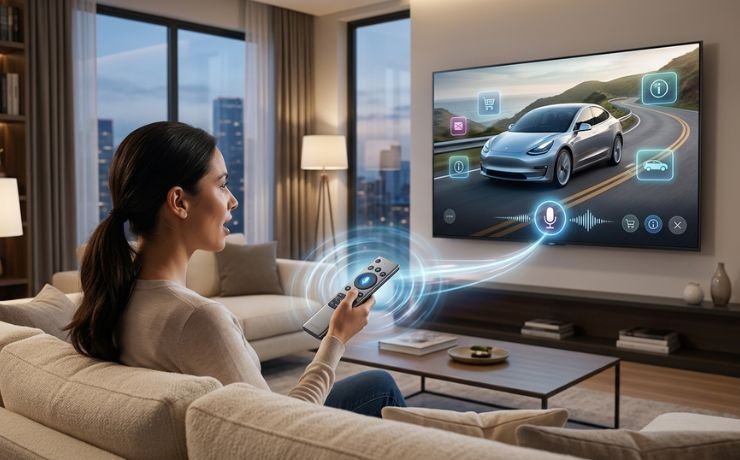
Picture a Saturday evening in a Pune living room. A family is halfway through a cricket highlights package when a car commercial rolls in. The father, mildly curious, lifts the remote, presses the microphone button and says, in a mix of Hindi and English, that he would like to book a test drive. The screen confirms. A dealership will call tomorrow. No QR code, no phone fumbling, no browser tab abandoned by morning.
It is a small scene, and for now a largely hypothetical one in India. But it captures an idea that is quietly gaining ground across the connected TV industry: that the humble smart remote, with its built-in microphone, could become a genuine advertising surface. Interactive voice ads promise to give television the one thing it has always lacked, an immediate way for the viewer to answer back.
Connected TV solved the targeting problem. It has not yet solved the action problem.
Why does the last step still break?
CTV’s strengths are well rehearsed: big-screen attention, household-level addressability, streaming-scale reach and measurement that linear television could only envy. Its weakness is quieter. The moment a viewer feels the pull of an ad, the path to acting on it is long. The phone has to be found, the code scanned, the site loaded, the details entered. Most impulses do not survive that journey.
Industry attempts to shorten it have had mixed results. On-screen QR codes demand a second device. Remote-button prompts keep the viewer on the television but offer only a narrow set of choices. Companion apps ask for a commitment few viewers are willing to make during a commercial break. Voice looks different because it asks for almost nothing: the remote is already in hand, and speaking is the easiest input people have.
What does a voice ad actually do?
The mechanics are straightforward. An ad carries a prompt, either on screen or spoken, inviting the viewer to press the voice button and say a short phrase. The platform interprets the request and responds: saving a product to a list, sending details to a phone, setting a reminder, launching an app or booking a slot. Several streaming platforms and operating system providers have tested versions of this, and the companies behind the major voice assistants have an evident interest in bringing them to advertising.
The format is also getting smarter. Early implementations needed an exact phrase; newer speech recognition and language models are far more forgiving, interpreting natural phrasing and even supporting a brief back-and-forth. A thirty-second spot can start to resemble a miniature conversation, in which the viewer asks about price or availability and the brand answers.
“[Expert quote on why voice shortens the path from intent to action on CTV. Replace with a confirmed statement.]”
[Name], [Designation], [Company]
Is India the hardest market or the best one?
Probably both. The country’s CTV footprint is widening fast, helped by affordable streaming sticks, competitively priced smart TVs and a steady drift of viewing from linear to streaming. Voice is already a comfortable habit for many Indian users, who have long preferred speaking a search in their own language to typing it. A viewer who would never tap out a query on a television might happily say it aloud.
That is the opportunity. The difficulty is the same fact seen from the other side. India does not speak one language; it speaks dozens, and people routinely switch between them mid-sentence. A voice ad that handles polished English but falters on regional accents or Hinglish would fail precisely the audiences that make the format exciting. Platform investment in Indian-language recognition will, in large part, decide how far voice advertising travels here.
In India, the real test of a voice ad is not whether it understands English. It is whether it understands everyone.
What do brands stand to gain?
The first gain is intent. A viewer who speaks to an ad has made a conscious choice, which is a far richer signal than a passive view. Performance advertisers can act on it; brand advertisers gain an engagement measure that sits beyond reach and recall.
The second is context. Television is often a shared, evening activity, and big purchases such as cars, appliances, holidays and financial products are frequently discussed by the whole household. A spoken response in that setting can feed an existing family conversation instead of interrupting it.
The third is creative range. Voice pushes brands to think of an ad as a service rather than a story: a recipe on request, a nearest-store locator, a trial booking, a launch reminder. For quick service restaurants, automotive, consumer durables and entertainment, those moments of utility could outperform another repetition of a tagline.
Where does the scepticism come from?
Mostly from human behaviour. People pick up the remote to skip, pause or browse, not to chat with a commercial. Unless the prompt offers a clear and immediate benefit, it will be ignored, and a gimmick that annoys can do more harm than a plain ad that simply plays.
Privacy is the heavier objection. A microphone in the living room is a sensitive thing, and consumers have grown wary of devices that seem to listen. Smart remotes typically activate only when the button is pressed, but trust is easier to lose than to explain. With the Digital Personal Data Protection Act raising expectations around consent and purpose in India, voice recordings need to be treated as personal data. Platforms and advertisers will have to say plainly what is captured, how long it is kept and whether it feeds targeting.
“[Expert quote on privacy, consent and consumer trust in voice-enabled advertising. Replace with a confirmed statement.]”
[Name], [Designation], [Company]
Fragmentation is the third obstacle. Voice capabilities vary across operating systems, device makers and remote hardware. A format that works on one platform may not exist on another, and without common standards for specifying and reporting voice ads, agencies will find them hard to plan at scale.
How will anyone know it works?
Measurement will make or break the format. Interaction rate is the obvious headline number, but it says little about value. Buyers will want to know how many interactions led to a real outcome, whether voice-engaged households behave differently from those that simply watched, and how to separate the effect of the interaction from the effect of the creative.
Incrementality testing is the honest answer. If someone who speaks to an ad would have bought anyway, the format delivered convenience rather than impact. Brands that compare exposed and unexposed households and follow downstream behaviour will learn far more than those counting engagements. Quality matters too: recognition accuracy, response speed and relevance of the answer decide whether a viewer ever tries the format a second time.
A voice ad that misunderstands the viewer teaches the audience to stop talking.
What should agencies do this quarter?
Experiment, but with discipline. Start with a use case where the follow-up action is simple and genuinely useful: a reminder, a callback, a saved item, details sent to a phone. Avoid anything that demands complex decisions or sensitive information. Design the creative around the prompt rather than bolting one on afterwards, keep the call to speak short and obvious, and always provide a graceful path for viewers who stay silent.
Press platforms on the unglamorous questions as well: language coverage, consent flows, data retention, reporting granularity and brand safety. Those answers will decide whether a pilot can grow into a budget line. And treat the first campaigns as research, building internal knowledge about which prompts work and where friction appears.
“[Expert quote on how brands and agencies should pilot interactive voice formats. Replace with a confirmed statement.]”
[Name], [Designation], [Company]
So, is the remote the next frontier?
It is tempting to label every new format a revolution or a fad. Interactive voice advertising is likely to be neither. A more plausible future is a specialised, useful role: converting intent into action on the screen where intent is often born, for the categories and audiences where speaking feels natural.
The remote will not replace the thirty-second spot, and viewers will not start chatting with every brand between episodes. Yet it offers the television something it has seldom had, a direct and low-friction line from the viewer back to the advertiser. For an industry that has spent years trying to make CTV as actionable as it is attractive, that is worth pursuing with care.
The winners will not be the brands that stamp a microphone icon on every ad. They will be the ones that understand why a viewer would speak at all, and give them something worth saying.
