














The Quick Commerce Launch Playbook — Anatomy of a 10-Minute-Delivery Product Drop

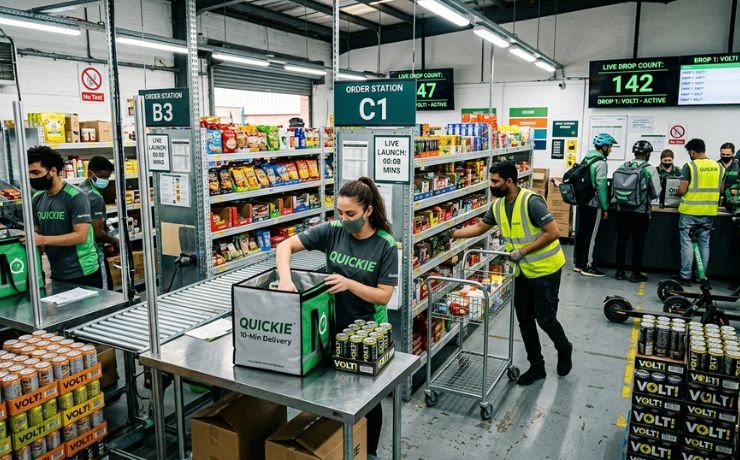
In quick commerce, a product launch is no longer a campaign that begins when the product reaches the shelf. The shelf itself is moving, the audience is already scrolling, and the window between awareness and purchase can be measured in minutes. A new product can be announced on social media, discovered through a creator, searched on an app and delivered to a consumer before a traditional media campaign has even completed its first media cycle.
That has fundamentally changed what a product launch means.
The rise of 10-minute delivery has turned quick commerce platforms into something larger than convenience-led retail channels. They are becoming discovery engines, media platforms, sampling networks and increasingly important points of brand interaction. For marketers, that means the launch playbook has to account for much more than distribution.
“In quick commerce, the distance between discovery and purchase has collapsed. The launch is no longer about getting consumers to remember a product. It is about giving them a reason to act while the intent is still fresh.”
The central question is no longer simply: how do we tell consumers about the new product?
It is: how do we create enough curiosity, relevance and availability for a consumer to move from seeing a product to buying it within the same moment?
The Product Drop Has Become a Media Event
Traditional launches are built around anticipation. A brand develops a campaign, secures media, creates retail visibility and then waits for consumers to encounter the product. Quick commerce compresses that journey.
The product can appear in an app at the exact moment a consumer is thinking about a category. Search, recommendations, advertising, promotions and inventory can all converge around the same transaction.
This changes the role of the launch campaign. Awareness is still important, but awareness without immediate availability can become a missed opportunity. A consumer who sees a new beverage, snack, beauty product or household item and becomes interested can potentially buy it within minutes. The distance between inspiration and conversion has effectively collapsed.
For marketers, this makes quick commerce particularly interesting for products that benefit from impulse, trial or immediate consumption. The platform does not merely complete the purchase. It can become part of the creative proposition.
A 10-minute delivery promise, for instance, can itself become a storytelling device. A campaign can move beyond saying that a product is new and instead demonstrate how quickly it can become part of a consumer’s current situation.
Step One: Build the Launch Around a Consumer Occasion
The strongest quick commerce launches do not begin with the product catalogue. They begin with the occasion.
Consumers rarely open a delivery app thinking about a brand’s launch calendar. They open it because they want something. They need a snack before a movie, a beverage during a workday, skincare before an event, ingredients for an unexpected dinner plan or a small indulgence late at night.
That behavioural context provides the starting point for the launch.
Instead of asking where the product fits within a category, marketers can ask where it fits within a consumer moment. A new energy drink may belong to the functional beverage category, but its strongest launch opportunity could be the afternoon productivity slump. A new dessert may be positioned as a food product, but its cultural territory could be the post-dinner craving.
“The most effective quick commerce launches begin with an occasion, not a SKU. Consumers are not shopping for products in isolation; they are solving an immediate need, mood or moment.”
Quick commerce gives brands the ability to connect those occasions with immediate purchase. The creative idea, therefore, needs to make the occasion recognisable before the product becomes the answer.
Step Two: Create Curiosity Before the Product Arrives
Speed does not eliminate the need for anticipation. It changes how anticipation is created.
Social media remains one of the most effective places to build curiosity before a product drop. But instead of running a conventional awareness campaign for several weeks, brands can use a shorter, sharper sequence.
The first phase creates a problem, tension or cultural observation. The second introduces clues. The third reveals the product and directs consumers towards the quick commerce platform.
That sequence can be particularly effective when the product has an unusual format, flavour, pack or proposition. Rather than immediately showing the product, brands can make audiences wonder what is coming.
The objective is not simply reach. It is to create a level of curiosity that can be converted while the product is available.
This is where creator marketing can play a useful role. Creators can demonstrate the product in real situations, create unboxing moments or turn the launch into a participation-led format. For products driven by novelty, the creator can become the first layer of product discovery while the quick commerce platform becomes the second.
The Ten-Minute Advantage Is Also a Creative Advantage
Quick commerce brands often sell speed as the product benefit. For consumer brands launching through these platforms, speed can become something more interesting: a creative constraint.
“Speed is no longer just an operational promise. For marketers, it can become part of the creative idea itself.”
Imagine a campaign built around a consumer problem that exists right now. The message is not simply that a new product is available. It is that the product can arrive while the situation is still happening.
That distinction gives marketers access to a different kind of storytelling.
A cricket-night snack launch can be designed around the moment a match gets intense. A summer beverage can be positioned around the sudden heat of an afternoon. A beauty product can be tied to an unexpected plan that appears with little notice.
The product becomes useful because it is immediate.
In this model, the delivery proposition and the product proposition reinforce each other. The consumer does not just buy the product; they buy the ability to solve a current need quickly.
Step Three: Make the App Shelf Work Harder
One of the most overlooked parts of a quick commerce launch is the digital shelf.
A product page has to perform the job that packaging, store displays and sales staff traditionally handled. Product images, naming, descriptions, pricing, offers, ratings and search visibility can all influence conversion.
“On a quick commerce platform, the product page is effectively the last piece of advertising before the transaction. Every image, word and piece of information has to work harder.”
This makes content optimisation an important part of launch planning.
If a consumer searches for a category or occasion, the new product needs a chance of appearing in that journey. Product titles and descriptions should be clear rather than overly clever. The first image should communicate what the product is without requiring interpretation. Pack shots need to remain recognisable even when displayed in a small mobile interface.
For new products, reviews also become part of the launch equation. Early sampling and controlled distribution can help generate authentic consumer feedback, giving later shoppers more information at the point of purchase.
The digital shelf is effectively the final creative frame before conversion. Treating it as an afterthought can weaken an otherwise strong campaign.
Step Four: Use Quick Commerce as a Media Channel
The evolution of quick commerce has also created a new media opportunity. Platforms can offer brands sponsored placements, search visibility, banners, category integrations and other forms of retail media.
This matters because the audience is already in a purchase environment.
A conventional digital ad may generate interest and require the consumer to visit another destination. A retail media placement can potentially move from discovery to product page to transaction within the same ecosystem.
“Retail media becomes particularly powerful when awareness and availability sit in the same ecosystem. The consumer does not have to leave the journey to complete the purchase.”
For a launch, this creates an opportunity to coordinate paid media with inventory.
A brand could build external awareness through social and video while using quick commerce media to capture high-intent shoppers. Search placements can intercept category demand, while homepage or contextual placements can create discovery among consumers who were not actively searching for the product.
The key is integration. Buying visibility on the platform without creating a broader narrative can turn the launch into a performance exercise. Conversely, generating massive awareness without securing sufficient visibility and stock on the platform can waste demand.
Inventory Is Part of the Campaign
In conventional advertising, a creative can run even when a product is temporarily unavailable. In quick commerce, that disconnect becomes immediately visible.
If a campaign creates demand but consumers cannot find the product, the brand loses the most valuable part of the moment: intent.
“In a 10-minute delivery environment, inventory is no longer just an operations metric. It is part of the marketing promise.”
That makes inventory planning a marketing responsibility as much as an operational one.
Brands need to think about where demand is likely to emerge, how much stock should be available in relevant dark stores and how quickly replenishment can happen. A launch may perform differently across neighbourhoods depending on consumer profiles, purchasing behaviour and local availability.
The result is a more geographically granular launch model.
Instead of treating an entire city as one market, marketers can potentially identify clusters where the product has stronger relevance and concentrate initial communication and inventory accordingly.
Sampling Gets a New Lease of Life
Sampling has always been useful for products where trial drives conversion. Quick commerce adds an interesting layer to the model because sampling can be linked to an existing transaction.
A brand can potentially introduce a new product through relevant baskets, promotional bundles or targeted offers, allowing consumers to experience something they did not initially intend to buy.
This is particularly relevant for new variants and adjacent-category launches.
The challenge is to make sampling feel relevant rather than intrusive. A consumer buying coffee may be more receptive to a new biscuit or beverage than an unrelated product. Context can determine whether the sample feels like discovery or clutter.
When the trial leads to a second purchase, the quick commerce platform can effectively become part of the product’s acquisition funnel.
Creators Can Turn Speed Into Social Currency
There is another reason quick commerce launches lend themselves to creator-led campaigns: immediacy is inherently demonstrable.
A creator can place an order, receive the product and react to it within a single piece of content. That makes the delivery promise visible rather than theoretical.
“The value of creator content in quick commerce lies in making immediacy visible. When discovery, ordering, delivery and first reaction can happen almost in one continuous story, the format becomes naturally demonstrative.”
Creators can also create formats around surprise, challenges, taste tests, first impressions and real-time consumption. For products with strong visual or experiential appeal, this can make the launch feel less like advertising and more like an event unfolding in public.
However, creator selection remains important. A large following does not automatically translate into relevance for a quick commerce launch. The creator’s audience, geography, category affinity and content behaviour can matter more than headline reach.
The best fit is often a creator who can naturally place the product inside the consumer occasion the campaign is trying to own.
Measure the Launch Beyond Sales
The biggest advantage of a digitally native product drop is the amount of behavioural data generated around it.
Brands can examine impressions, product-page visits, searches, add-to-cart behaviour, conversion, repeat purchases and promotional response. They can also look at how performance changes by geography, audience and time of day.
“The real advantage of a digitally native launch is not simply faster sales reporting. It is the ability to learn while the launch is still happening.”
This allows the launch to become an iterative process.
If consumers are clicking on the product but not purchasing, the issue may be price, packaging communication, reviews or proposition clarity. If search demand is high but visibility is low, media placement may need adjustment. If first purchases are strong but repeat rates fall, the product experience may require attention.
In other words, the campaign can provide feedback not only on media effectiveness but also on the product itself.
This is where quick commerce begins to resemble a living test market. A launch can generate behavioural signals rapidly enough for marketers to make changes while the campaign is still active.
The Risk of Turning Every Launch Into a Flash Sale
There is, however, a strategic trap in the quick commerce model.
Because the platforms are built around convenience and promotions, brands can become overly dependent on discounts to generate trial. That may deliver an immediate spike in transactions but can make it harder to understand whether consumers genuinely value the product.
Discounting can be useful as part of a launch, but the product needs a reason to remain relevant after the introductory offer disappears.
The strongest launches therefore balance promotion with proposition. The deal can encourage the first purchase, while product quality, differentiation and cultural relevance need to drive the next one.
That distinction becomes particularly important as quick commerce moves deeper into categories such as beauty, electronics, fashion accessories and premium consumer products, where the purchase decision may involve more consideration.
From Launch Campaign to Continuous Discovery
The larger shift is that quick commerce is challenging the traditional idea of a product launch as a single moment.
A product can launch in one neighbourhood, learn from early buyers, adjust its communication and expand into new markets. Creators can generate new content weeks after the initial drop. Retail media can continue capturing category demand. Search behaviour can reveal new consumer occasions that the brand had not originally considered.
The launch becomes less of a straight line and more of a feedback loop.
That requires closer collaboration between brand, creative, media, commerce, supply chain and analytics teams. The old separation between marketing and distribution becomes harder to maintain when the promise of the campaign depends on the product actually arriving at the consumer’s doorstep.
The New Launch Equation
For marketers, the quick commerce launch playbook can ultimately be reduced to a simple sequence: create curiosity, identify the occasion, build availability, capture intent and learn quickly.
But the real opportunity lies in connecting those pieces.
Social media can create anticipation. Creators can demonstrate relevance. Retail media can intercept intent. The app can complete discovery and conversion. Inventory can make the promise real. Data can then inform the next iteration.
“The future of product launches may be less about creating one big moment and more about creating a system that can turn every moment of consumer intent into an opportunity for discovery.”
Ten-minute delivery is therefore not simply a faster route to the consumer. It represents a different operating model for marketing, one where media and commerce sit much closer together.
As quick commerce platforms become increasingly sophisticated retail media environments, product launches are likely to become more immediate, measurable and occasion-led. The brands that understand this shift will not necessarily be the ones that shout the loudest about being new.
They will be the ones that understand exactly when a consumer is ready to discover something, make that discovery easy to act on, and ensure the product is already waiting on the other side of the click.
