














The Cost Curve of Generative Video: When an AI video ad beats a production shoot

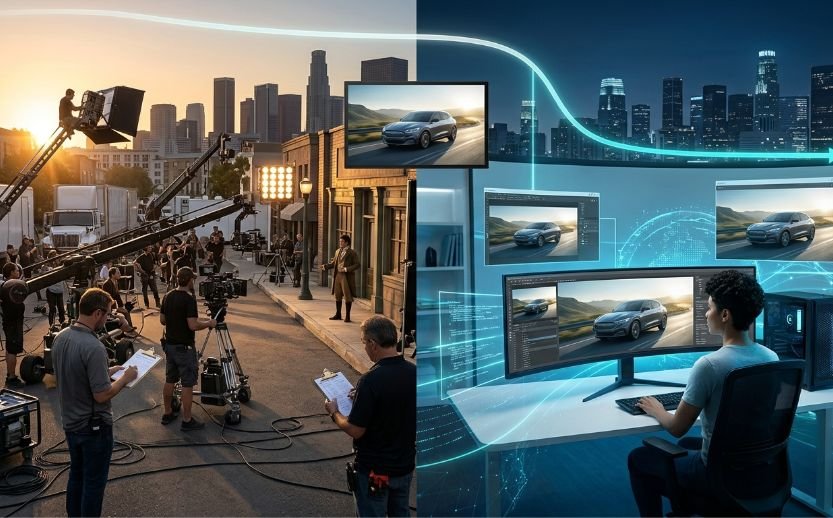
Every few years, advertising rediscovers an old truth about technology: it rarely replaces the craft, but it almost always rewrites the budget. Digital cameras did not kill the film set. They changed what a “small” shoot could cost. Stock footage did not end cinematography. It gave low-budget campaigns a shortcut. Generative video is the latest entrant in this lineage, and the question on marketing leaders’ desks is no longer whether it works, but when it wins.
That “when” is the real story. Headlines tend to frame AI video as a binary contest between a machine and a crew. In practice, the more useful lens is a cost curve: a map of how the economics of an ad change as volume, complexity and ambition rise. Somewhere along that curve there is a crossover point, where an AI-generated spot becomes the smarter commercial decision than a conventional production shoot. Knowing where that point sits for a given brief is fast becoming a core planning skill for brands and agencies.
The question is no longer whether generative video works, but when it wins.
Understanding the two cost structures
A traditional shoot is a fixed-cost business dressed up as a creative one. Before a single frame is captured, the budget is already committed to a director, cinematographer, crew, equipment, locations, talent, permissions and a post-production pipeline. Whether the campaign delivers one film or five, much of that cost is spent upfront. The marginal cost of an additional variation, such as a new cut, a different language or an alternate ending, is lower than the original but never close to zero. Reshoots are the expensive exception that every producer dreads.
Generative video inverts that structure. The upfront cost is modest: a subscription or credit-based platform, a skilled operator, and time spent on scripting, prompting and iteration. What changes dramatically is the marginal cost. Producing the tenth variation of an ad costs little more than producing the second. Vendors and industry commentators now routinely claim savings in the range of 40 to 80 percent against traditional workflows, and compress timelines from weeks to hours. Those numbers deserve scepticism, since many come from companies selling the tools, but the direction of travel is not in doubt. The shape of the curve has changed: AI video is cheap to start and cheap to multiply.
The adoption data backs that up. A 2025 report from the Interactive Advertising Bureau found that roughly half of advertisers were already using generative AI to build video ads, with about 86 percent of buyers either using or planning to use it. This is no longer an experiment run by a handful of early adopters. It is becoming a default line item.
AI video is cheap to start and cheap to multiply.
Where AI wins decisively
The crossover point arrives earliest in briefs that reward volume over singularity. Performance marketing is the clearest example. A D2C brand running paid campaigns across Instagram, YouTube and connected TV does not need one masterpiece. It needs dozens of hooks, formats and calls to action, tested quickly and retired just as fast. Under a traditional model, that appetite is prohibitively expensive. Under a generative workflow, a team can test twenty openings in the time it once took to brief a production house.
Localisation is the second sweet spot, and for India it may be the most important. A national brand that wants its message to land in Hindi, Tamil, Bengali, Marathi and Telugu faces a costly multiplication problem. Re-shooting with regional talent for every market is rarely viable outside the biggest campaigns. Generative tools, combined with synthetic voiceovers and regionally adapted visuals, can rework a single concept for multiple audiences at a fraction of the usual outlay. For mid-sized advertisers, that can be the difference between a Hindi-belt-only campaign and a genuinely pan-India one.
The third category is product-led and atmospheric content. Short B-roll, scenic establishing shots, abstract brand visuals and stylised product moments are areas where generative output is already convincing and where audiences rarely scrutinise the frame. A real-estate developer who once paid for a drone shoot, or a food brand that once booked a studio for a few seconds of steam rising from a plate, now has a cheaper alternative. And for small advertisers who could never afford television-grade creative, AI-generated spots open up formats, including connected TV, that were previously out of reach.
Speed is the common thread. In a festive season where a trend can peak and fade within days, the ability to move from idea to live ad in a single afternoon is not just a saving. It is a competitive advantage.
In a market where a trend can peak and fade within days, speed is not just a saving. It is a competitive advantage.
Where the shoot still earns its fee
None of this means the production house is obsolete. The cost curve bends back in favour of conventional shoots wherever the brief depends on things generative models still struggle to deliver consistently.
Human performance is the first. A flinch of recognition, a laugh that breaks the script, a pause that lands precisely: these are the moments that make emotional advertising work, and they remain the territory of real actors directed by people who know how to draw them out. The second is continuity and control. A story that needs the same character, wardrobe, location and lighting across multiple scenes can still produce drift in generated output, with faces and details subtly shifting from shot to shot. Fixing that can consume the time that automation was supposed to save.
The third is product accuracy. For categories where the exact texture of a fabric, the precise shade of a lipstick or the true proportions of a gadget is the whole point, a hallucinated detail is not a quirk but a liability. A viewer who buys on the strength of an ad and receives something different is a complaint and potentially a regulatory problem. And at the top end, hero films and tentpole brand campaigns trade on craft, authenticity and cultural weight that audiences can feel. Here, the production cost is not waste. It is the product.
The costs that never make the pitch deck
The most common mistake in this debate is comparing the sticker price of a platform subscription with the full invoice of a shoot. AI video has its own cost structure. It is much lower, but it is not zero, and several line items rarely appear in the vendor’s case study.
Iteration is the first. Generative output is probabilistic, so a usable clip often emerges only after many attempts. Credits burn on rejected generations, and the hours spent selecting, regenerating and stitching shots together are real labour. The second is human finishing: editing, sound design, colour matching, motion polish and brand compliance. A professional-grade AI ad is rarely a one-click output, and the operator who can steer these tools well is a skilled, and increasingly well-paid, hire.
The third is legal and compliance overhead, which has grown sharper in India this year. Under the amended IT Rules that came into force in February 2026, synthetically generated content must be clearly labelled and carry embedded metadata, and platforms face compressed takedown timelines for unlawful material. An ad that uses a synthetic likeness of a real person without clean consent invites precisely the kind of litigation that Indian courts have shown themselves willing to act on swiftly. Clearing rights, documenting consent and building disclosure into the creative are now part of the cost of doing AI video responsibly.
The fourth is brand risk. Surveys suggest consumers remain divided on AI-made advertising, with a significant share expressing discomfort, particularly where the ad does not disclose its origins. An ad that saves money but triggers a backlash, or simply feels hollow, can cost far more than the shoot it replaced.
AI video has its own cost structure. It is much lower, but it is not zero.
Finding the crossover point
So when does an AI video ad beat a production shoot? A practical framework comes down to four questions.
How many variations does the campaign need? The more versions, languages and formats required, the more the economics tilt towards generative. A single flagship film favours the shoot; a hundred performance creatives favour the model.
How much does emotional performance matter? If the idea lives or dies on human nuance, the shoot retains its advantage. If the ad is informational, atmospheric or product-led, AI is a strong contender.
How tolerant is the category of imperfection? A quick social test for a snack brand has more room for error than a regulated financial product or a luxury launch.
And how fast must it move? When speed to market is itself a source of value, as in trend-led social, festive promotions or reactive marketing, the time saved is a benefit that belongs on the balance sheet.
Where the answers point in different directions, which is most of the time, the sensible answer is a hybrid. Increasingly, the smartest production models shoot the hero asset conventionally, capturing real talent and real product, and then use generative tools to extend it: to build variants, localise language, produce cutdowns, create supporting visuals and test concepts before committing to a full shoot. In this model, AI does not replace the crew. It stretches the value of everything the crew captures.
AI does not replace the crew. It stretches the value of everything the crew captures.
What it means for agencies
For agencies, the cost curve is also a business-model question. If production margins have historically been a meaningful part of the revenue picture, a technology that compresses production cost forces a rethink of where value is created and billed. The agencies likely to thrive are those that move up the stack: owning the idea, the strategy, the brand governance and the testing framework, while treating production, whether human or synthetic, as a flexible input rather than a fixed asset.
Clients, meanwhile, are asking sharper questions. They want to know why a brief that once required a six-figure shoot should still cost the same when part of it can be generated. Agencies that can explain, transparently, where AI was used, where humans were essential and what that meant for cost and risk will build trust. Those that obscure the process will find the conversation harder with every renewal.
The curve keeps moving
The honest conclusion is that the crossover point is not fixed. It is moving, and moving fast. Every few months, new models deliver better consistency, longer clips, more reliable character control and sharper audio. Tasks that were unthinkable for generative video a year ago, such as stable characters across scenes or convincing lip-sync in regional languages, are becoming routine. The ground that belongs to the shoot is shrinking at the edges even as its core remains defensible.
That is why the smartest marketers are not choosing sides. They are building the muscle to evaluate each brief on its merits: what the idea needs, what the audience will accept, what the law requires and what the budget allows. In a market where the cost of making a video is collapsing, the scarce resources are no longer cameras or crews. They are taste, judgement and trust. The brands that remember this will use AI where it makes them faster and sharper, and keep the camera rolling where only a human moment will do.
The scarce resources are no longer cameras or crews. They are taste, judgement and trust.
