














Voice AI and Conversational Ads — What Happens When Assistants Start Recommending Products Mid-Chat

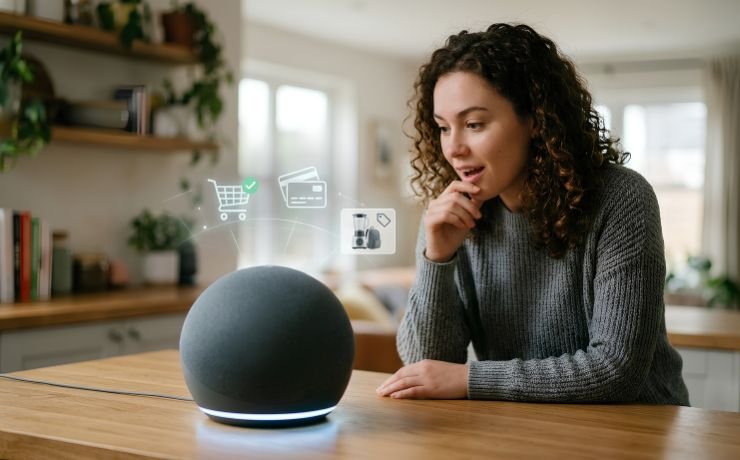
The next ad may not look like an ad at all. It may sound like an answer.
A consumer asks an AI assistant: “I need running shoes for daily use, but I have flat feet, a budget of ₹8,000 and mostly run on roads.” Instead of returning ten blue links, the assistant could ask a few follow-up questions, narrow the choices and explain why particular products fit the brief. Somewhere inside that conversation, a brand recommendation can appear.
This is the shift conversational advertising is beginning to introduce: moving the commercial message from a banner, search result or product page into the dialogue itself.
The change matters because conversation is becoming a new interface for discovery. Google is testing ads in AI Mode that are integrated into AI-generated responses and designed to explain why a product is relevant. Amazon has expanded conversational shopping through Alexa for Shopping, while its advertising business is experimenting with prompts that open product conversations. OpenAI, meanwhile, is developing sponsored agents that allow users to start a conversation with a business after interacting with an ad.
“The ad is no longer necessarily the destination. It can become the beginning of a conversation.”
For advertisers, this is more than another format to add to a media plan. It raises a larger question: what happens when the entity recommending a product is also the interface through which the consumer makes the decision?
From Search Results to Answers
Traditional digital advertising has largely worked by interrupting or accompanying an existing journey. A consumer searches, scrolls, watches or visits a site, and advertising appears alongside that behaviour.
Conversational AI changes the sequence.
The consumer can begin with an incomplete thought rather than a fully formed query. They can describe a problem, add constraints, change their mind and ask for clarification. The system does the work of narrowing the decision.
That makes the commercial opportunity fundamentally different. The valuable moment is no longer simply the impression or the click. It is the moment when the assistant helps transform an open-ended question into a shortlist.
“The valuable moment is no longer simply the impression or the click. It is the moment when the assistant helps transform an open-ended question into a shortlist.”
Google’s current AI advertising experiments illustrate this direction. Its AI Mode formats are designed to place sponsored products and retailers inside AI-generated experiences, while AI Max for Shopping is built to help advertisers respond to more complex, conversational searches rather than relying only on conventional product queries.
In India, Google has also introduced Business Agent for Leads in beta, placing an AI-powered brand agent inside an advertisement so prospective customers can interact with it in real time.
The implication is significant. The ad is no longer necessarily a static piece of communication. It can become an interactive layer within the consumer journey.
The Rise of the AI Product Recommender
Product recommendation is not new. Retailers have spent years building “recommended for you” modules, personalised homepages and algorithmic product feeds.
What is different about conversational AI is the ability to explain the recommendation.
Instead of saying, “Customers also bought this,” an assistant can potentially say why a particular product fits a specific requirement. It can compare alternatives, identify trade-offs and respond when the consumer changes the brief.
Amazon has been moving in this direction with Alexa for Shopping, which combines conversational shopping capabilities with product discovery, comparisons, price history, deal-finding and purchasing workflows. Amazon’s advertising products are now extending into these conversations through Sponsored Products and Sponsored Brands prompts.
Its Branded Conversations initiative takes the model further by allowing brand-provided expertise to inform conversations with Alexa for Shopping. The objective is to give the assistant deeper information about what differentiates a product, how it addresses customer needs and how products can work together.
“The brand therefore has to become legible to the machine as well as persuasive to the consumer.”
That creates an interesting new layer of brand communication.
Historically, brands have controlled their messaging through advertising copy, packaging, websites and sales scripts. In conversational commerce, some of that communication may be mediated by an AI system that decides which product attributes are relevant to the question being asked.
The brand therefore has to become legible to the machine as well as persuasive to the consumer.
When the Ad Starts Talking Back
The most obvious change will be creative.
A conventional display ad has a finite amount of space. A video has a defined duration. A social post has a particular visual and textual structure. A conversational ad has potentially unlimited permutations because the response changes according to the user’s question.
This creates a new creative discipline.
Instead of writing one headline for one audience segment, marketers may need to prepare a structured body of product knowledge that an AI can draw from. Product benefits, use cases, specifications, objections, comparisons, FAQs, pricing information and eligibility rules can all become part of the conversational experience.
Creative teams may consequently find themselves working alongside product marketers, data teams and AI specialists to determine not just what the brand says, but how the brand should answer.
“The strongest conversational advertising will probably not feel like a script. It will feel like useful assistance.”
The strongest conversational advertising will probably not feel like a script. It will feel like useful assistance.
That distinction matters. Consumers are accustomed to advertising being persuasive. They are less likely to accept an assistant that pretends to be neutral while quietly behaving like a salesperson.
The Trust Problem
This is where the category becomes complicated.
When a banner recommends a product, consumers understand that an advertiser paid for the placement. When a search engine displays a sponsored result, the commercial nature of the placement is generally familiar.
But when an assistant says, “Based on what you’ve told me, this product could work for you,” the recommendation carries a different psychological weight.
The system appears to be helping the consumer make a decision.
That makes transparency essential. Google’s current AI advertising products distinguish sponsored placements, while OpenAI says its shopping product results are separate from ads and are not influenced by advertising partnerships.
That distinction will become increasingly important as commercial and organic recommendations occupy the same conversational environment.
The industry will have to answer difficult questions. When does a recommendation become an advertisement? Should an assistant disclose commercial relationships before making a recommendation? How prominently should sponsorship be identified? Can brands pay for inclusion without influencing the assistant’s underlying recommendation logic?
These are not merely regulatory questions. They are brand-trust questions.
“When an assistant becomes part of the consumer’s decision-making process, transparency stops being a compliance detail and becomes part of the brand experience.”
The Death of the Click?
Conversational advertising could also challenge one of digital advertising’s most established metrics: the click.
If the assistant answers the question inside the interface, the consumer may have no reason to click through to a brand website during the early stages of the journey.
The traditional funnel of impression → click → landing page → consideration → conversion could become more compressed.
A consumer might instead move from question → conversation → recommendation → purchase.
OpenAI’s shopping experience already allows users to discover and compare products within ChatGPT, while eligible merchants can support checkout without necessarily requiring the consumer to leave the environment.
“Media planning may therefore move from buying exposure to buying moments of intent.”
For advertisers, that means measurement will need to evolve. The meaningful signal may not be a click but the quality of the interaction: whether the assistant understood the user’s intent, whether the product entered the consideration set, whether the consumer asked follow-up questions, and ultimately whether the conversation contributed to a transaction.
Media planning may therefore move from buying exposure to buying moments of intent.
Brands Need Better Product Data
There is another consequence that is less glamorous but potentially more important: product information becomes advertising infrastructure.
An AI assistant cannot make a reliable recommendation from weak or outdated product data.
Specifications, pricing, inventory, compatibility, product benefits, reviews, delivery information and usage instructions all become inputs into the recommendation process.
OpenAI’s shopping infrastructure uses merchant product data and other retail information to generate product results, while Amazon’s conversational advertising products draw on information from product detail pages, Brand Stores and campaign data.
“Product information is no longer just a retail asset. It is becoming part of the advertising infrastructure.”
This puts pressure on brands to clean up the information architecture behind their marketing.
The product feed that once existed mainly to support Shopping ads could increasingly become part of the brand’s conversational identity.
In practical terms, marketers may need to ask: Can an AI understand what makes our product different? Can it distinguish our premium variant from the entry-level one? Does it know who the product is actually for? Can it answer a consumer’s objection accurately?
If the answer is no, the problem may not be the media strategy. It may be the data.
From Keywords to Intent
Search advertising was built around keywords. Conversational advertising is built around intent expressed in natural language.
That distinction creates a much richer but messier advertising environment.
Consider the difference between “best moisturiser for dry skin” and a conversation in which a consumer explains that they have sensitive skin, live in a humid city, dislike fragrance and want something under ₹1,000.
The second interaction contains far more commercial information.
It also creates an opportunity for brands to compete on relevance rather than simply keyword coverage.
Google’s AI Max for Shopping is designed to help advertisers reach consumers making complex, conversational searches and to adapt product information to those longer-form expressions of intent.
“The future of search may be less about matching the right keyword and more about understanding the right problem.”
This could push search marketing towards a more nuanced understanding of consumer problems. The objective may no longer be simply to contain the highest-value keyword. It may be to give an AI system enough information to recognise where the product genuinely belongs in a conversation.
Voice Makes the Stakes Higher
Text-based conversational advertising is already changing the interface. Voice could make the experience even more intimate.
Imagine asking an assistant while driving, cooking or getting ready for work: “What should I buy for my weekend trip?”
The response does not arrive as a grid of ten products. It arrives as a voice.
That changes the dynamics of advertising.
Audio recommendations are sequential rather than visual. The assistant might mention two products, explain a difference and ask whether the consumer wants the cheaper option. There is no infinite scroll and no obvious equivalent of a display shelf.
Attention becomes scarce in a different way.
“Voice advertising will not simply make ads more conversational. It will make the relationship between recommendation, attention and trust more immediate.”
Voice advertising could therefore favour brands that are easy to explain. A complicated product with a long list of benefits may struggle if its value proposition cannot be communicated clearly within a natural exchange.
At the same time, marketers will have to be careful about frequency. Consumers may tolerate a sponsored banner appearing repeatedly on a website. Hearing an assistant repeatedly recommend the same brand could feel much more intrusive.
The New Role of the Brand
Conversational advertising ultimately changes what it means to build a brand.
For decades, brands have tried to own distinctive assets: colours, characters, slogans, sounds, visual identities and recurring campaign ideas.
In an AI-mediated environment, another layer is emerging: the brand’s answerability.
Can the brand explain itself clearly? Can it answer questions consistently? Can it acknowledge limitations? Can it compare itself honestly? Can it provide useful advice without turning every interaction into a sales pitch?
“In an AI-mediated environment, another layer of brand equity is emerging: the ability to be useful, clear and credible inside the conversation.”
These qualities may become part of brand equity.
A brand that is consistently represented as useful and relevant inside AI conversations could gain a new form of mental availability. But the reverse is also possible. If an assistant repeatedly produces poor, inaccurate or overly promotional answers about a brand, the experience can damage trust even when the brand’s conventional advertising remains strong.
What Agencies Will Need to Rethink
For agencies, the shift could blur the boundaries between media, creative, strategy and technology.
Media teams will need to understand AI-driven discovery environments. Creative teams will need to build modular content that can work across conversational contexts. Strategy teams will need to map the questions consumers ask rather than only the channels they use. Data teams will need to ensure that product information is accurate and structured.
There is also a role for editorial thinking.
Brands will need a point of view strong enough to survive a question-and-answer environment without relying on a single campaign line. The objective will be less about forcing one message into every interaction and more about ensuring that the brand has something useful to contribute to different consumer needs.
That is a substantial change from traditional performance advertising.
It also creates an opportunity to make advertising more useful, provided usefulness remains the starting point rather than a disguise for persuasion.
“The next generation of brand communication may be judged not only by what a brand says, but by how well it answers when consumers ask questions.”
The Conversation Is Becoming the Media Space
The advertising industry has spent years talking about the shift from impressions to interactions. Conversational AI takes that idea literally.
The next generation of advertising may not simply appear beside content. It may participate in the decision itself.
Google is testing sponsored experiences within AI-generated answers. Amazon is embedding sponsored product prompts and brand expertise into shopping conversations. OpenAI is developing sponsored agents that can continue a commercial interaction after an ad click.
None of this means traditional advertising disappears overnight. Search, social, video, retail media and display will continue to play distinct roles. But the interface through which consumers discover products is changing.
For marketers, the central challenge will be learning how to participate without breaking the trust that makes conversation useful in the first place.
The most interesting conversational ad, ultimately, may not be the one that talks the most. It may be the one that understands the question, adds something genuinely useful and knows when to stop selling.
“Once an assistant becomes part of the consumer’s decision-making process, advertising is no longer simply competing for attention. It is competing for the right to be part of the answer.”
Because once an assistant becomes part of the consumer’s decision-making process, advertising is no longer simply competing for attention.
It is competing for the right to be part of the answer.
