













AI in Audience Segmentation: From Demographics to Psychographic Precision

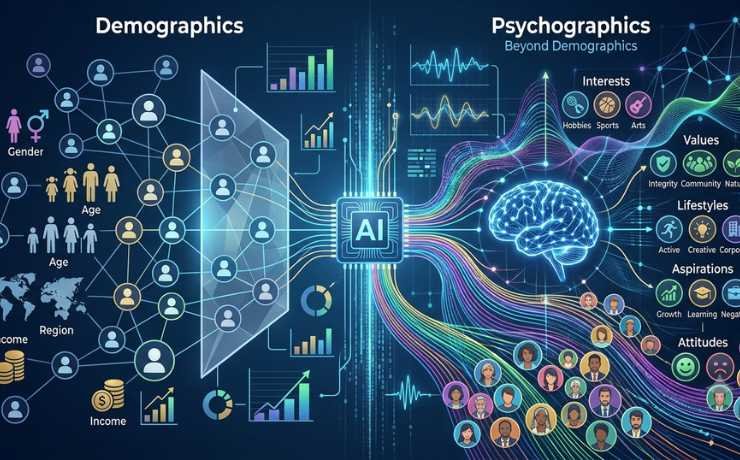
For most of the history of modern advertising, audience segmentation was a blunt instrument dressed up in the language of precision. Age, gender, geography, household income — these were the levers that media planners pulled when deciding who should see a brand’s message and who should not. The logic was intuitive: a thirty-five-year-old woman living in Mumbai with a household income above a certain threshold was statistically more likely to buy a particular category of product than a twenty-two-year-old man in a smaller city. Demographics gave advertisers a way to concentrate spend toward probable buyers and away from improbable ones. It was imprecise, but it was systematically imprecise, which made it manageable.
The problem was never that demographics were useless. The problem was that they were being asked to do work they were never designed for. Two people who are identical on every demographic variable — same age, same city, same income bracket, same gender — can hold entirely different attitudes toward risk, status, novelty, health, family, and ambition. They can be motivated by completely different emotional drivers and repelled by completely different creative approaches. Demographics describe the container. They say almost nothing about what is inside it. And for brands whose differentiation is built on emotional resonance rather than functional superiority, knowing the container was never enough.
What Psychographic Segmentation Actually Means
Psychographic segmentation attempts to classify audiences not by who they are in a census sense but by how they think, what they value, and what motivates their behaviour. The classic psychographic frameworks — values, attitudes, interests, lifestyles, personality traits — have existed in market research for decades. Brand strategists have long used them to develop consumer archetypes and creative territories. The limitation was always one of scale and operationalisation. You could develop a rich psychographic portrait of your target consumer in a research debrief. You could not use that portrait to actually buy media against a psychographically defined audience at any meaningful scale, because the data infrastructure to do so simply did not exist.
Artificial intelligence has fundamentally changed that equation. The combination of machine learning models, large-scale behavioural data, natural language processing, and real-time signal processing has made it possible to infer psychographic attributes from observable digital behaviour at a scale and speed that no human research process could match. A person’s content consumption patterns, the language they use in social media posts, the sequence of topics they search for, the categories they browse without purchasing, the time of day they engage with different types of content — all of these signals, individually weak and individually ambiguous, become collectively powerful predictors of the psychological attributes that drive purchasing behaviour when processed through the right models.
How AI Constructs Psychographic Profiles at Scale
The mechanics of AI-driven psychographic segmentation vary by platform and vendor, but the underlying logic follows a consistent pattern. Large language models and embedding techniques are used to analyse text-based signals — search queries, social content, review behaviour, comment patterns — and map them onto a latent psychological space. Behavioural clustering algorithms then group users who occupy similar positions in that space, regardless of whether they share any demographic characteristics. The result is audience segments defined by inferred psychological similarity rather than observed demographic coincidence.
What makes this approach genuinely different from earlier attempts at psychographic media targeting is the dynamic nature of the profiles it generates. Traditional psychographic segmentation produced static segments — you belonged to a particular lifestyle category based on a survey you completed at a single point in time. AI-driven psychographic profiling is continuous and adaptive. A person who has recently started consuming content related to financial independence and career transitions is exhibiting signals of a psychological shift that a static demographic profile would be entirely blind to. An AI model processing their behaviour in something approaching real time can detect that shift and adjust the audience classification accordingly — meaning brands can reach people at psychologically relevant moments rather than simply at demographically predicted ones.
“Demographics tell you who showed up. Psychographics tell you why they came and what they are ready to hear.”
In the Indian context, this capability has particular relevance given the country’s extraordinary demographic complexity. India is not one consumer market but several dozen overlapping ones, differentiated not just by language and geography but by deeply varied value systems, family structures, aspirational frameworks, and relationships with modernity and tradition. A demographic segment like “urban millennial male” encompasses within it an enormous range of psychological profiles — the first-generation professional navigating new money and old family obligations, the startup founder optimising for independence, the salaried employee prioritising security. These are not minor variations on a single archetype. They are meaningfully different psychological profiles that respond to different creative approaches, different brand values, and different messaging architectures.
The Role of First-Party Data in Psychographic AI
The quality of any AI-driven psychographic segmentation system is directly proportional to the quality and depth of the data it is trained on — which is why first-party data has become the most strategically valuable asset in the modern marketer’s toolkit. Brands that have built rich first-party data ecosystems — through loyalty programmes, app engagement, CRM histories, website behaviour, and direct consumer interactions — are in a fundamentally stronger position to leverage AI psychographic modelling than those who remain dependent on third-party data sources.
First-party data carries a signal quality that third-party data cannot replicate. When a consumer interacts directly with a brand’s owned properties, the behavioural signals generated are specific, verified, and contextually rich. An e-commerce platform that knows not just what a user purchased but what they browsed at length without buying, what price points they filtered for, which product descriptions they read in full, and which categories they return to repeatedly has a psychographic dataset of considerable depth. When AI models are applied to that data, the resulting audience segments reflect genuine psychological differentiation rather than inferred approximations from probabilistic third-party profiles.
The impending deprecation of third-party cookies across the open web, combined with growing platform restrictions on cross-app data sharing, has accelerated the strategic importance of first-party psychographic intelligence. Brands that invested early in building direct consumer relationships and the data infrastructure to learn from them are discovering that those investments now constitute a meaningful competitive moat in their ability to deploy AI-driven audience segmentation at scale.
Creative Implications of Psychographic Precision
One of the less discussed but most consequential implications of AI-driven psychographic segmentation is what it demands of creative strategy. A media plan built on demographic segments can be served adequately by a single creative execution — or perhaps a small handful of variations tailored to broad audience groups. A media plan built on psychographic segments creates an expectation of creative specificity that most brand organisations are not currently set up to meet.
If your audience segmentation model has identified seven psychographically distinct clusters within your target market — each with different values, different emotional triggers, and different relationships to your category — then serving all seven clusters the same creative execution negates much of the targeting advantage you have paid for. The promise of psychographic precision is that you can speak to each cluster in the language that resonates most deeply with its specific psychological profile. Delivering on that promise requires a creative production capability that can generate meaningful variation at scale — which is precisely where AI-assisted creative tools are beginning to close the gap.
The convergence of AI audience segmentation and AI creative generation is not a coincidence. They are two sides of the same capability shift, and the brands that will extract the most value from psychographic targeting are those that develop both simultaneously — using the same models that understand audience psychology to inform the creative decisions that audiences will ultimately experience.
Ethical Boundaries and the Consent Question
The power of AI-driven psychographic profiling raises ethical questions that the advertising industry has been slower to confront than the capabilities have developed. Inferring psychological attributes from behavioural data — particularly attributes related to emotional vulnerabilities, financial stress, health anxieties, or relationship instability — creates the potential for targeting approaches that exploit rather than serve the consumer. The line between relevance and manipulation is not always clear in psychographic advertising, and the absence of industry-wide standards for what constitutes acceptable psychographic inference has left that line largely undefined.
In India, the Digital Personal Data Protection Act introduces a framework of consent and data principal rights that will increasingly govern how behavioural data can be collected, processed, and used for targeting purposes. Brands and platforms building psychographic AI capabilities will need to ensure that their data practices are not only technically compliant with the letter of the regulation but genuinely respectful of the spirit of consumer consent — meaning that people understand, in meaningful terms, that their behaviour is being used to infer things about their psychology and to serve them accordingly targeted communications.
The brands that will build lasting equity in the AI-driven segmentation era are not those that push hardest against the ethical boundaries of what the technology makes possible. They are those that use psychographic precision in service of genuine relevance — reaching people with messages that actually speak to where they are, what they care about, and what they are ready to consider. That is what segmentation was always supposed to do. AI has simply given the industry the tools to do it honestly, at scale, for the first time.
