














Podcast Creators in India — The Monetisation Models That Are Finally Working

For the longest time, Indian podcasting existed in a state of optimistic limbo. Creators were building audiences, listeners were showing up in growing numbers, and platforms were reporting year-on-year consumption growth — yet the money rarely followed in any meaningful, sustainable way. Brand deals were sporadic. Ad rates were a fraction of what Western podcasters commanded. And the infrastructure for audience-direct monetisation was either unavailable or too nascent to depend on. The result was a generation of Indian podcast creators who were, in effect, running media businesses with no viable business model attached to them.
That picture has changed considerably over the last two years. Not dramatically, not uniformly across every format and language — but in ways that are structurally significant enough to suggest that Indian podcasting has crossed a threshold. The monetisation models that are finally working are not borrowed wholesale from the American playbook. They have been adapted, sometimes invented from scratch, to fit the specific dynamics of Indian audiences, Indian brand relationships, and the Indian creator economy’s particular constraints and opportunities.
Host-Read Advertising Grows Up
The most established monetisation route for Indian podcasters remains host-read advertising, but the nature of those deals has matured considerably. In the early years of Indian podcasting, brand integrations tended to be one-off arrangements — a single episode sponsorship or a brief mention that was treated by both parties as an experiment. Renewal rates were low, accountability was minimal, and most creators had no standardised way to present their audience data to potential advertisers.
What has changed is the emergence of a more professionalised middle layer. Podcast-specific talent management firms and creator economy agencies have begun representing Indian podcasters in brand conversations, bringing with them audience decks, download analytics, listener demographic profiles, and rate cards that allow brands to evaluate a podcast buy with some of the same rigour they would apply to a digital media placement. This intermediary infrastructure has made it possible for brands to commit to multi-episode or full-season partnerships rather than one-off trials — and multi-episode deals are where podcast advertising actually begins to perform at the brand metrics level.
The categories spending meaningfully on Indian podcast advertising have also broadened. Fintech and edtech brands were the early movers, drawn by the relatively affluent, aspirational listener profiles of English-language business and self-improvement podcasts. They have since been joined by mutual fund houses, insurance brands, consumer health companies, D2C founders targeting educated urban audiences, and increasingly by automobile and real estate brands testing the medium for considered purchase categories. Each of these represents a brand team that has made a deliberate choice to allocate budget to podcasting — which is a different, more durable signal than experimental spend.
The Subscription and Membership Model Takes Hold
Perhaps the most significant structural shift in Indian podcast monetisation has been the gradual normalisation of audience-direct revenue — specifically, subscription and membership models where listeners pay creators directly for access to premium content, ad-free listening, or community benefits. This was, until recently, a model that Indian creators approached with deep scepticism, largely because the Indian internet audience had been conditioned by years of free content to resist paying for digital media.
The scepticism has not disappeared entirely, but the evidence is beginning to accumulate that a subset of deeply engaged Indian podcast listeners will pay, provided the value proposition is articulated clearly and the creator has built sufficient trust over time. Platforms like Patreon, which has seen growing adoption among Indian creators, and homegrown alternatives including Razorpay Thirdwatch integrations and direct UPI-based membership setups have made the mechanics of paid communities accessible even to independent creators without technical resources.
“The listeners who pay are not a different audience — they are the same audience, just at a different depth of relationship with the creator.”
What tends to work in the Indian subscription context is not simply a paywall on existing content but a meaningful tier structure where free listeners receive the core show and paying members receive additional access — extended conversations, unedited interviews, listener Q&A episodes, research documents referenced in episodes, or access to a private community channel where the creator is genuinely present and responsive. The community dimension is particularly important. Indian podcast audiences that convert to paying members are often motivated as much by a desire to be in proximity to the creator and to each other as they are by any specific piece of premium content.
The absolute numbers remain modest by global standards. A mid-tier Indian podcast with fifty thousand monthly listeners converting two to three percent of that audience at a membership price of Rs. 199 to Rs. 499 per month generates meaningful supplemental income rather than a full operating budget. But for creators who have built that listener base organically over several years, the recurring nature of subscription revenue represents a stability that no single brand deal can replicate.
Live Events as a Revenue Engine
One monetisation model that has surprised even seasoned observers with its performance in the Indian market is the live event. Several podcast creators who had built loyal audiences through long-form audio content have discovered that a meaningful proportion of their listeners will pay to be in the same physical room as the host — and that the economics of even modestly attended live events can be substantially better than an equivalent investment in content production.
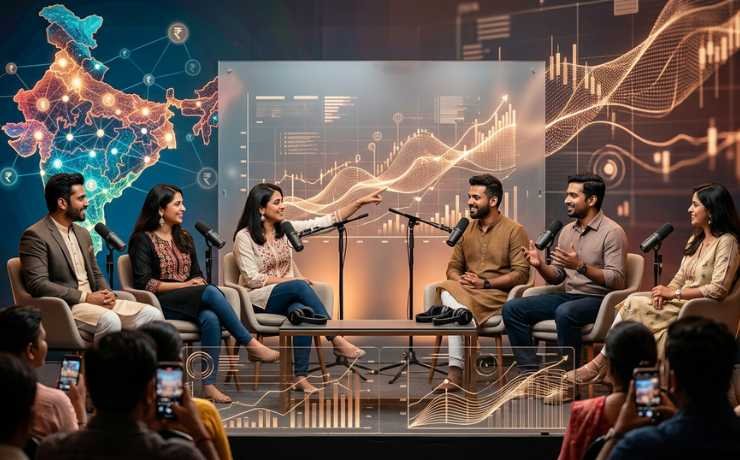
The live podcast format — a recorded conversation performed in front of a ticketed audience, typically at an intimate venue capacity of two hundred to eight hundred people — has been successfully executed by creators across genres including business, comedy, true crime, and culture. Mumbai, Delhi, and Bengaluru have been the primary markets, though creators with strong regional language followings have found equally enthusiastic audiences in cities like Pune, Hyderabad, and Ahmedabad. The ticket pricing typically ranges from Rs. 499 to Rs. 2,500 depending on the creator’s profile and the venue, with premium front-row or meet-and-greet add-ons extending the average transaction value further.
Beyond ticket revenue, live events create adjacent monetisation opportunities. Sponsors who are reluctant to commit to audio-only deals are often more willing to attach their brand to a live event where logo placement, stage mentions, and on-ground sampling are part of the package. Merchandise — notebooks, tote bags, branded apparel — sells at live events in a way that it rarely does through links in episode descriptions. And the content captured at live events — audience reactions, the energy of a full room, the spontaneity of a live conversation — tends to generate the kind of shareable social clips that extend a creator’s organic reach in ways that studio-recorded episodes rarely do.
Intellectual Property and Licensing
A quieter but increasingly consequential revenue stream for established Indian podcast creators is the licensing and repurposing of their intellectual property. A podcast that has built an archive of several hundred episodes on a specific subject — investing, mental health, Indian history, startup culture — is sitting on a body of content that has value beyond its original audio format. Publishers, edtech platforms, and corporate learning and development teams have begun approaching podcast creators to licence that content for use in courses, books, newsletters, and internal training programmes.
Several Indian podcasters have also moved in the reverse direction — using their show as the research and audience-validation engine for a book or course, and then using the book or course as a revenue-generating extension of the podcast brand. This flywheel model, where the podcast is the top-of-funnel awareness and trust-building vehicle and the book or course is the monetisation layer, has been successfully executed by creators in the personal finance, productivity, and entrepreneurship genres. The podcast audience becomes the first-buyer base, the most vocal advocates, and the social proof engine for any product the creator launches — making the show itself a distribution asset of considerable commercial value.
The Language Opportunity
One dimension of Indian podcast monetisation that remains significantly underdeveloped relative to its audience potential is regional language content. Hindi podcasting has made meaningful progress in attracting brand spend, particularly from brands targeting mass-market consumers in north and central India. But Tamil, Telugu, Kannada, Malayalam, Marathi, and Bengali podcast creators are largely operating without the intermediary infrastructure — the agencies, the standardised rate cards, the brand relationships — that English and Hindi creators have begun to access.
This is a gap that represents both a challenge and an opportunity. The brands best positioned to spend in regional language podcast environments are those with genuine mass-market distribution ambitions — FMCG companies, regional banks and NBFCs, state-level real estate developers, and consumer durables brands targeting tier-two and tier-three markets. These are not categories that have historically been sophisticated digital media buyers, but the combination of growing regional podcast audiences and the post-cookie pressure to find brand-safe, contextually relevant environments for digital spend creates conditions where regional podcast advertising could grow more quickly than the English-language market did.
What Indian podcast creators have learned, through years of building in an environment that offered neither the infrastructure nor the cultural permission to charge for their work, is that sustainable monetisation is not a single model but a portfolio. The creators who are making it work financially are not those who found the one right revenue stream — they are those who built multiple streams simultaneously, each reinforcing the others, each serving a different segment of the relationship they have built with their audience. That lesson, hard-won and specific to the Indian context, is one the global podcasting industry is still catching up to.
