














The Rise of Attention Metrics: Beyond Viewability in Indian Digital Advertising

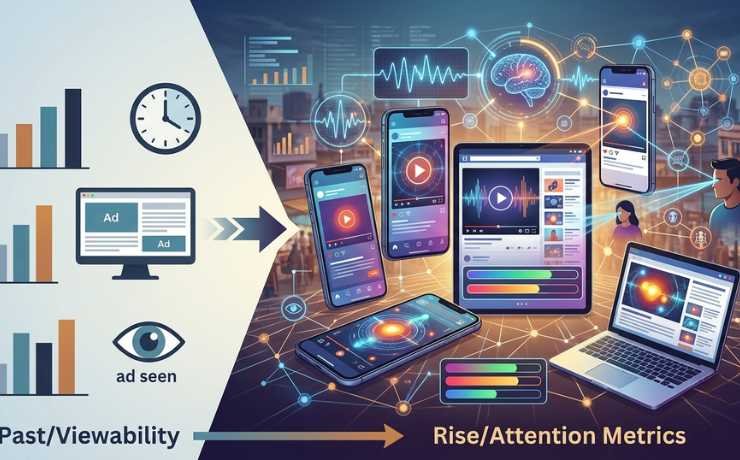
For years, viewability was the metric that Indian digital advertisers leaned on as their primary proof of performance. A 50% pixel threshold held in view for one second — the minimum standard set by the Media Rating Council — became the currency through which campaigns were bought, sold, and justified. It was a practical starting point in the early years of programmatic growth, when the industry simply needed a reliable signal that an ad had not been buried below the fold or served to a bot. But as the Indian digital advertising market matures into one of the fastest-growing in Asia-Pacific, that floor has begun to feel less like a performance benchmark and more like a participation trophy.
The conversation has shifted. Across agency trading desks, brand planning teams, and adtech platforms operating in India, attention metrics are increasingly being discussed not as a future aspiration but as an immediate operational need. The shift reflects a broader reckoning: that an ad being technically visible on screen says almost nothing about whether a human being actually processed it, felt something about it, or retained any memory of it afterward.
Why Viewability Alone No Longer Suffices
To understand why the industry is moving beyond viewability, it helps to understand what viewability actually measures — and what it does not. A display ad can be 100% in view for the required second and still exist at the very bottom of a page that a user is scrolling past at high speed. A video pre-roll can play through entirely while a user opens another tab or picks up their phone. In both cases, viewability registers as met. Attention does not.
This gap has real consequences for Indian advertisers, particularly those spending heavily on performance campaigns and brand-building exercises simultaneously. The country’s digital ad spend is projected to cross Rs. 55,000 crore by 2026, with mobile accounting for the dominant share of impressions. But high impression volumes delivered at CPMs optimised purely for viewability compliance have repeatedly produced underwhelming brand recall scores, leading clients to question whether their reach is translating into any meaningful consumer engagement at all.
“Viewability tells you the door was open. Attention tells you whether anyone walked through it.”
The criticism is not simply philosophical. Multiple studies from global attention research firms — some of which are now partnering with Indian publishers and data companies — have demonstrated that the correlation between standard viewability and actual brand outcomes such as recall, consideration lift, and purchase intent is weak at best. What correlates far more strongly is dwell time, scroll velocity, interaction signals, and audio engagement — precisely the inputs that attention measurement frameworks are designed to capture.
What Attention Metrics Actually Measure
Attention measurement in digital advertising is not a single number but a composite framework that aggregates several proxy signals to estimate the cognitive engagement a consumer has with an ad. These signals vary by format and environment, but the core inputs typically include time-in-view (the actual duration an ad remains on screen, not just whether it crosses the one-second mark), viewport position (whether the ad is in the centre of the screen versus a peripheral corner), scroll behaviour around the ad, cursor proximity on desktop, audio exposure in video formats, and interaction rates such as hover, tap, or swipe events.
Some platforms go further, using panel-based eye-tracking studies to build predictive models that can assign an attention probability score to a given placement based on historical human gaze data. Others use on-device signals from opted-in mobile users to understand how long a person’s active gaze remained on a creative unit before moving on. The result is a richer, if more complex, picture of how an ad is actually experienced — and one that starts to bridge the longstanding gap between media measurement and brand effectiveness research.
In the Indian context, this complexity is compounded by the diversity of the audience and the environments in which they consume digital content. A user watching a short-form video on a budget Android handset over a 4G connection in a tier-two city behaves very differently from an affluent metropolitan user browsing editorial content on a laptop. Attention measurement frameworks that were calibrated on Western panels need significant localisation before they can be applied with confidence to Indian inventory — a challenge that domestic adtech players and publishers are only beginning to address systematically.
The Publisher and Platform Landscape in India
Among Indian publishers, the conversation around attention is still largely nascent but is gaining momentum in specific verticals. Premium news publishers, OTT platforms, and digital-first content brands have been the earliest movers, motivated partly by the opportunity to justify higher CPMs against advertisers who are otherwise inclined to chase scale at the lowest available cost. If a premium placement on a quality editorial environment demonstrably generates three times the attention of a remnant programmatic impression, the argument for paying a premium for that placement becomes considerably stronger — and measurable in a way that viewability alone could never achieve.
OTT platforms in particular are well positioned to benefit from the shift toward attention metrics. Connected TV and mobile video inventory on platforms with logged-in user bases and full-screen ad formats naturally generate higher attention scores, and the shift away from third-party cookies makes first-party attention signals an increasingly valuable asset. Platforms that can demonstrate attention quality alongside reach will have a compelling proposition for brand advertisers looking to move beyond pure GRP equivalents in their video planning.
On the agency side, several large holding company networks operating in India have begun integrating attention measurement tools into their planning and reporting workflows, primarily for large global and domestic brand clients with sophisticated measurement requirements. Independent media agencies are following more cautiously, often citing the absence of standardised industry frameworks and the additional cost of attention measurement vendors as barriers to broader adoption.
Challenges to Standardisation in the Indian Market
The single largest obstacle to the widespread adoption of attention metrics in India is the absence of a standardised, industry-wide definition of what constitutes an attention impression — and who gets to certify it. In markets like the United Kingdom and Australia, industry bodies have made meaningful progress toward common frameworks that allow buyers and sellers to transact on attention with shared assumptions. India has no equivalent body currently driving that work with sufficient urgency, and the fragmentation of the local adtech ecosystem makes consensus-building difficult.
There is also the question of measurement methodology itself. Different attention vendors use different proxy signals, different panel compositions, and different modelling assumptions to arrive at their scores. Without cross-vendor comparability, advertisers risk optimising toward the metric that a specific vendor’s model happens to reward rather than toward genuine consumer engagement. This is not a hypothetical concern — it is a structural risk that the Indian industry will need to address through transparency requirements and third-party validation if attention metrics are to earn the same transactional trust that viewability eventually achieved.
Data privacy is an additional consideration. Several attention measurement approaches depend on the collection of behavioural signals at the device level, and the regulatory environment around digital data in India is evolving with the implementation of the Digital Personal Data Protection Act. Measurement vendors and platforms will need to ensure that their attention data collection practices are compliant and that consent frameworks are robust enough to withstand scrutiny — not just at launch, but as enforcement matures.
The Road Ahead for Indian Advertisers
Despite these challenges, the direction of travel is clear. The brands, agencies, and platforms that begin investing in attention measurement frameworks now — even imperfect, exploratory ones — will be substantially better positioned as the market matures than those who wait for a perfect standard to arrive. The history of digital measurement in India, from impressions to clicks to viewability, has consistently rewarded early movers who were willing to build institutional knowledge around emerging metrics before they became table stakes.
For brand marketers, the practical starting point is to begin asking attention-related questions of their media partners, even before formal measurement is in place. What is the average time-in-view of this placement? What is the scroll velocity in this editorial section? What does the completion rate curve look like for this video format beyond the first five seconds? These questions do not require a formal attention metric to be useful — they push planning conversations toward quality signals and away from the reflexive optimisation toward volume and technical compliance that has dominated programmatic buying in India for too long.
The shift from viewability to attention is, at its core, a shift in ambition. Viewability asked whether an ad had the opportunity to be seen. Attention asks whether it was actually worth seeing — and whether the person who encountered it came away changed in any meaningful way. For an industry that ultimately exists to influence human behaviour at scale, that is a far more honest question to be asking. The Indian digital advertising market, for all its complexity and diversity, is ready to start answering it.
