












Why Kannada, Marathi and Odia Creators Are Outgrowing Hindi and English Ones

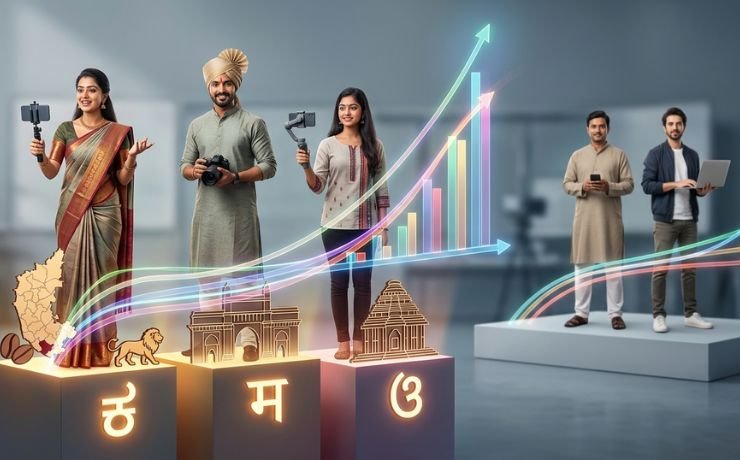
Here’s a number that should unsettle anyone still building creator briefs around Hindi and English as the default: brand searches for creators outside India’s top eight metros more than doubled year-on-year in the first half of 2026, and inside that surge, discovery for Kannada, Marathi and Odia creators grew faster than discovery for creators working in either of the two languages the industry has spent thirty years treating as the only ones that mattered. Not comparable. Faster. The two languages built to be understood everywhere are losing ground, in relative terms, to three that were never meant to travel beyond their own states.
The instinct is to file this under the broader vernacular-content story that’s been circulating for years — India is multilingual, therefore regional content matters, therefore brands should diversify. That framing isn’t wrong, but it’s too broad to explain why these three languages specifically, and it flattens what are actually three separate, quite different stories that happen to be arriving at the same moment.
Kannada: a wealthy audience, spoken to in the wrong language
Bengaluru is India’s tech capital, its startup capital, and increasingly its OTT production capital, which means Kannada content creators sit inside one of the country’s highest-disposable-income media markets while still writing and speaking in a language the national ad industry has historically ignored in favour of the city’s English-speaking corporate veneer. That gap — a wealthy, digitally fluent audience being served almost entirely in a language that isn’t their first — was always going to close once brands figured out it existed. What’s changed recently isn’t the audience. It’s that discovery tools finally let a brand find a Kannada food creator in Jayanagar as easily as they can find an English-speaking one, instead of relying on an agency’s personal contact book, which rarely extended past a handful of names anyone had heard of.
Marathi: scale that was hiding in the agencies’ own backyard
Maharashtra is India’s second most populous state and its wealthiest by gross state product, with Mumbai and Pune both functioning as major media and marketing hubs in their own right — which means Marathi isn’t a niche regional language competing for scraps of ad budget. It’s a language with enough native speakers, enough disposable income and enough existing entertainment infrastructure, from Marathi cinema to Marathi television, to support a genuinely large creator economy on its own terms. What held it back for years wasn’t audience size. It was a marketing industry headquartered in Mumbai that nonetheless briefed almost everything in Hindi or English by default, treating Marathi as a dubbing afterthought for a market its own offices sat inside of. Brands are only now correcting an inefficiency that was always sitting there, unaddressed, in the same city as the agencies that created it.
Odia: growth by white space, not by size
Odia is the strangest and, in some ways, the most instructive case, because it isn’t a story about a large, underserved market at all — Odisha is a comparatively smaller state with a fraction of Maharashtra’s population. What’s driving Odia creator growth is closer to white space economics: almost no national brand had built any vernacular presence there, competition for attention was close to zero, and the handful of creators who started producing consistent Odia-language content found themselves with an entire state’s digital attention and no rival brand campaigns competing for it. In a market this uncontested, even modest production quality converts at a rate a Mumbai or Bengaluru creator, competing against hundreds of well-funded peers for the same eyeballs, simply cannot match.
The arithmetic brands can no longer ignore
Regional micro-influencers are now delivering engagement rates roughly two to three times higher than metro-based macro-influencers, at something in the range of a tenth of the cost per post. That isn’t a marginal efficiency gain a performance marketer might chase for an incremental few points of ROAS. It’s a different order of return, the kind that used to only show up when a genuinely new channel opened up before the rest of the industry noticed it existed. Two years ago, a typical consumer brand was putting seventy to eighty percent of its creator budget behind a short roster of metro-based macro-influencers speaking English or Hindi. Today, that same budget increasingly gets split across dozens, sometimes hundreds, of regional creators with followings in the tens of thousands rather than the millions — a shift from concentration to distribution that mirrors, almost exactly, what happened to television budgets when digital first fragmented attention away from a handful of prime-time slots.
What made this shift practically possible, rather than just theoretically attractive, is worth dwelling on, because the constraint was never really about audience appetite. India crossed roughly nine hundred million active internet users by 2025, and the overwhelming majority of that growth has come from users who consume content almost entirely in Indic languages — on YouTube alone, over ninety-five percent of what gets watched in India is in a regional language, not English or Hindi. That audience has existed for years. The bottleneck was discovery: no agency’s contact book covers four thousand towns, and finding a credible Odia lifestyle creator with real local following used to take a research team three weeks of cold-calling and guesswork. Verified creator databases that let a brand filter by city, language, category and engagement quality — the way a recruiter filters a job portal — have collapsed that three-week search into an afternoon. The audience was always there. What’s new is that brands can finally see it.
Four categories, four different playbooks
The brand strategies emerging around this are already distinct enough to be worth naming individually, because “go regional” is doing far too much work as a strategy on its own.
- Festive electronics and fashion — built entire Diwali pushes around Bhojpuri and Kannada creators specifically, on the logic that festive purchase decisions are emotional and relational in a way a national English-language spot struggles to replicate at the family level.
- Streaming and entertainment — localised major releases through regional creator partnerships in the language a given market actually watches in, rather than dubbing a single English or Hindi campaign and hoping it lands the same way everywhere.
- D2C personal care — used Marathi creators specifically for hyperlocal promotions, treating the language less as a translation exercise and more as a distinct market with its own trust signals and purchase triggers.
- BFSI and edtech — categories that depend on genuine comprehension, not just attention, are testing vernacular creator campaigns at a scale that would have seemed commercially unjustifiable three years ago, on the theory that a financial product explained in a language someone doesn’t fully process is a product they were never going to trust.
What this isn’t
None of which means the shift is complete, or that Hindi and English creators are becoming irrelevant — that would be its own kind of overcorrection, mistaking a growth-rate story for a total-volume one. English and Hindi still command the largest absolute creator economies in India by a wide margin; what’s changing is the rate at which that lead is closing, not who currently holds it. There’s also a quality-consistency problem the industry hasn’t fully solved: a database that surfaces a hundred Odia creators doesn’t guarantee a hundred creators capable of executing a brand-safe, on-message campaign without heavy hands-on management, and brands used to working with a small, vetted roster of metro talent are discovering that scaling across languages also means scaling the operational overhead of managing far more relationships, each with its own quirks, at far smaller individual budgets. Some of that overhead is being absorbed by regional talent agencies and MCNs that didn’t exist in a meaningful way five years ago; some of it is still landing, unglamorously, on brand teams learning the hard way that “regional” isn’t one strategy but a dozen different local ones stitched together.
The deeper reframe, for any brand marketer still treating this as a budget-allocation question, is that language in India was never really the barrier vernacular marketing decks have spent a decade describing it as. It was always a proxy for something more specific: whether a brand was willing to be found in the terms an audience actually thinks and speaks in, rather than the terms a Mumbai or Delhi head office happened to default to. Kannada, Marathi and Odia creators aren’t outgrowing Hindi and English ones because their languages suddenly became more valuable. They’re outgrowing them because brands finally started looking at markets that had been sitting there, fully formed and fully attentive, waiting for someone to speak to them in their own words.
