














92% of Business Leaders Say They Use AI Personalisation — But Do Indian Consumers

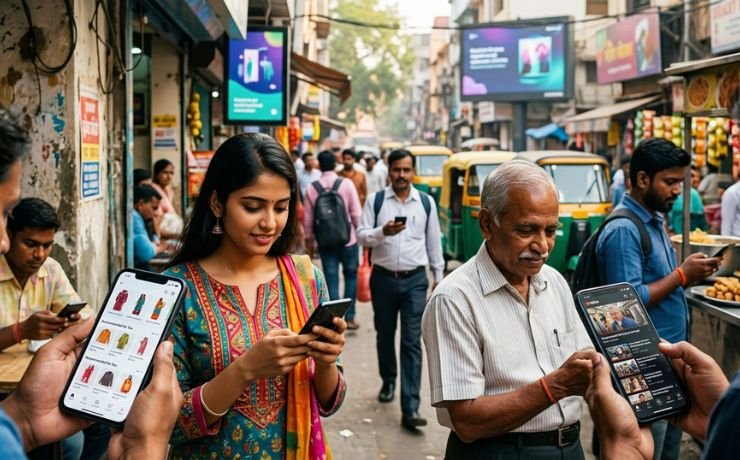
At a marketing leadership offsite earlier this year, a CMO from a large Indian D2C brand put up a slide that drew appreciative nods around the room: engagement up 34 percent, click-throughs up 22 percent, a personalisation engine that had, in her words, “finally learned to think like our customer.” The room applauded. Nobody asked the harder question sitting just beneath the applause — whether the customer had actually asked to be thought about quite so intimately.
That gap, between how confidently business leaders talk about AI personalisation and how warily consumers actually experience it, is no longer a footnote in industry conversation. It is fast becoming the defining tension of India’s AI-marketing moment. Globally, Twilio Segment’s State of Personalization report found that 92 percent of businesses now use AI-driven personalisation to fuel growth, with over 60 percent of leaders citing it as their most effective lever for both retention and acquisition. Set that beside the same report’s consumer-side finding — that barely four in ten shoppers say they are comfortable with companies using AI to personalise their experience — and the picture stops looking like adoption. It starts looking like a mismatch of confidence.
India complicates the story further, because on paper, Indian consumers look like the most AI-receptive audience in the region. Adobe’s 2026 AI and Digital Trends Report placed India at the top of Asia Pacific for appetite around agentic AI, with 60 percent of respondents interested in building a personal AI agent of their own, 65 percent already using AI for product recommendations, and well over half open to a fully AI-run customer service journey. Separately, Assurant’s Tech Sentiment Index put Indian trust in AI at 85 percent, comfortably ahead of the global average. Read only these numbers, and the Indian market looks primed for exactly the kind of aggressive, always-on personalisation that boardrooms are currently investing in.
But sentiment toward AI in the abstract and comfort with a brand’s AI reading your behaviour in real time are not the same thing, and Indian data increasingly draws a sharp line between the two. Canva’s 2026 State of Marketing and AI report, run with the Harris Poll across seven markets including India, found that 58 percent of consumers actively did not want brands using AI to anticipate their needs before they had expressed them. More than half said it felt unsettling when an ad seemed to know what they were about to buy before they had searched for it. The Optimove Marketing Fatigue Report went a step further, finding that 22 percent of consumers now describe personalisation not as intrusive or excessive, but specifically as “creepy” — a word that signals something closer to violation than mere irritation.
The Indian consumer isn’t rejecting AI. She is rejecting brands that mistake surveillance for service — and increasingly, she can tell the difference.
This is the paradox marketers now have to sit with: an Indian audience that is simultaneously the most open in the region to AI agents acting on its behalf, and among the most wary of brand-side AI acting on it without invitation. The distinction isn’t subtle once you look closely. Consumers who welcome a personal AI agent are welcoming a tool they control, one that answers to them, that they can switch off, redirect, or interrogate. What Canva’s respondents were pushing back on is the mirror image of that — a brand’s AI quietly modelling them from the outside, converting browsing history and dwell time into predictions they never consented to and often cannot see. Agentic AI, in other words, is being embraced as an extension of consumer agency. Predictive personalisation, when it isn’t explained, is being experienced as its erosion.
Indian marketers have historically treated personalisation as a purely technical achievement — a data pipeline problem, solved once the recommendation engine gets accurate enough. That framing made sense in the early recommendation-engine era, when the ceiling on personalisation was computational: how much data could be processed, how quickly, how precisely. AI has dissolved that ceiling almost completely. Systems can now infer purchase intent, emotional state, even life-stage transitions from browsing patterns most users don’t realise they’re leaving behind. The industry solved the technical problem faster than it solved the trust problem, and the resulting gap is exactly what shows up in the consumer surveys — accuracy racing ahead of permission.
Consider quick commerce, one of the most aggressively personalised verticals in the Indian market today. Dark-store algorithms now anticipate reorders before a consumer opens the app, nudge purchases based on weather, cycle-track replenishment timing, and cluster micro-segments down to a neighbourhood’s income band and festival calendar. The efficiency gains are real and well documented. But efficiency for the platform and comfort for the user are separate metrics, and the industry has largely reported on the former while assuming the latter. When a consumer receives a notification for a product she hasn’t searched for but has only thought about, or when an ad references a life event she hasn’t publicly shared, the platform experiences that as a personalisation win. She experiences it as being watched.
Fintech and D2C brands report a similar split. Recommendation accuracy has become table stakes; what increasingly differentiates brands in consumer research isn’t how well the AI predicts, but how transparently it explains itself. Adobe’s own India data backs this into relief: when Indian consumers were asked what would make them more comfortable interacting with an AI agent, the single most cited factor — ahead of speed, ahead of accuracy — was clear labelling of when AI was involved at all. A close second was simply the ability to reach a human at any point. Consumers are not asking brands to personalise less. They are asking to be told when, how, and on what basis they are being read.
This has real implications for how Indian marketing organisations should be structuring their AI investment through the rest of this cycle. The instinct, understandably, is to pour resources into model sophistication — better inference, tighter segmentation, faster real-time decisioning. But the consumer data suggests the return on that investment is beginning to plateau, while the return on trust infrastructure — visible AI disclosure, opt-in personalisation tiers, clean human-handoff points, transparent data use explanations — is climbing. Zero-party data, information consumers hand over willingly in exchange for a clearly stated benefit, is emerging as the more durable currency than the third-party inference brands have relied on for a decade. It is slower to collect and less exhaustive, but it comes pre-loaded with the one thing inferred data structurally lacks: permission.
There is also a sequencing problem worth naming plainly. Many Indian brands have treated transparency as a governance checkbox to be ticked after the personalisation system is already live — a privacy policy update, a small AI disclosure line in the footer, a consent toggle buried three menus deep. The research suggests this sequencing is backwards, and that transparency bolted on after the fact reads to consumers not as reassurance but as confirmation of exactly how much modelling has been happening without their knowledge. Trust, in other words, cannot be retrofitted onto a system consumers already suspect of overreach. It has to be architected into the personalisation strategy from the first line of the brief.
None of this argues against AI personalisation itself, and the consumer data is careful not to. Indian shoppers overwhelmingly still value relevant recommendations, faster service, and experiences that don’t waste their time — Accenture’s latest Consumer Pulse survey found the majority of Indian consumers willing to let generative AI influence a significant share of their spending decisions, hardly the profile of a market retreating from AI-assisted commerce. What the data draws instead is a boundary, and a increasingly well-articulated one: personalisation earns trust when it visibly serves the consumer’s stated interest, and forfeits it the moment it reveals inference the consumer never authorised. The line between “how did they know exactly what I wanted” as delight and as discomfort is thinner than most personalisation roadmaps currently account for, and which side of that line a brand lands on has far less to do with model accuracy than with how honestly it explains itself.
The boardroom slide with the engagement numbers wasn’t wrong, exactly. The system had, technically, learned to predict the customer with impressive precision. What it hadn’t learned — because nobody had asked it to — was when prediction stops feeling like service and starts feeling like surveillance. That is the gap 92 percent of business leaders are currently building strategy around without measuring. Closing it will decide, over the next few years, which brands convert India’s AI enthusiasm into loyalty, and which ones simply confirm what a growing share of Indian consumers already suspect.
