














Inside a Quick Commerce Brand’s 10-Minute-Delivery-Radius Creator Strategy

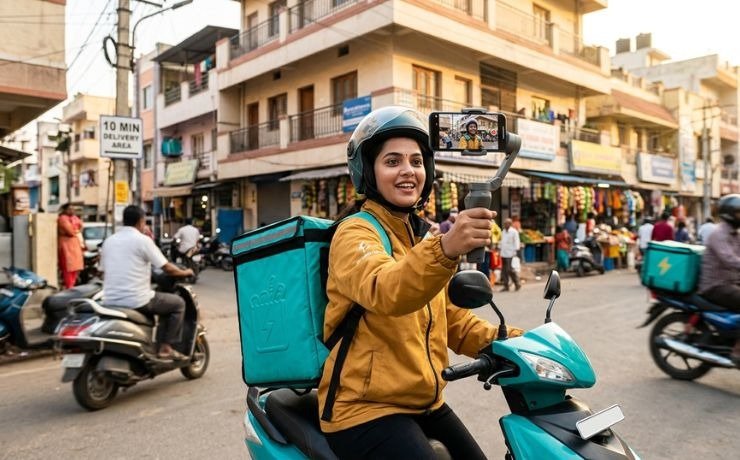
The creator is filming in a one-bedroom kitchen in Indiranagar, eight hundred metres from a dark store that started stocking a new instant-noodle SKU forty minutes ago. She doesn’t know the SKU exists anywhere else in Bengaluru, because it doesn’t — not yet, not in this batch, not until the platform’s replenishment algorithm decides another catchment deserves it too. The video she posts in the next hour will be seen almost entirely by people who live inside a three-kilometre circle drawn around that one store. If it works, the SKU sells out there by dinner. If it doesn’t, nobody outside that circle will ever know the campaign happened at all. This is what marketing looks like when the unit of distribution stops being a city and starts being a radius.
It’s a strange thing to build a strategy around, because it inverts almost everything brand marketing has spent a century optimising for. National reach used to be the entire point — one film, one jingle, one message, pushed as wide as the media budget allowed, on the theory that awareness compounds regardless of where the viewer happens to live. Quick commerce doesn’t just weaken that logic. It makes it actively wasteful. A brand that isn’t physically stocked in the dark store serving a viewer’s pincode has just paid to build desire for a product that viewer cannot buy in the ten minutes the entire category has trained them to expect. The ad worked. The distribution didn’t show up to meet it. And on a platform built entirely around instant gratification, that gap is where the customer’s patience — and the brand’s money — quietly evaporates.
To understand why this forces marketing into a genuinely different shape, it helps to understand what a dark store actually is, because the term gets used loosely. It isn’t a warehouse in the traditional sense. It’s a small, densely packed fulfilment point, typically stocking somewhere between three thousand and forty-five thousand SKUs depending on the platform and the city, laid out for picking speed rather than browsing, and designed to serve a tight radius — most operators work to something in the two-to-three-kilometre range — beyond which the ten-minute promise simply stops being physically possible. Crucially, no two dark stores carry the same catalogue. What a store stocks is a localised subset of the full range, shaped by that neighbourhood’s actual buying history, and platforms don’t hand brands a clean dashboard showing exactly where their products sit. A brand can have full national listing and still be functionally invisible in forty percent of its target pincodes on any given day, simply because a specific store ran out, deprioritised the SKU for low local velocity, or never carried it to begin with.
That single fact — that availability is a pincode-by-pincode question, not a market-by-market one — is what turns creator strategy from a content decision into something closer to a logistics decision wearing a content decision’s clothes. A brand running a quick-commerce-first creator programme has to know, in near real time, which dark stores are actually holding stock before it can responsibly brief a creator to promote anything, because a beautifully shot recipe video pointing viewers toward an empty shelf doesn’t just fail to convert — it teaches the platform’s algorithm, and the viewer, that this brand can’t be trusted to be there when the app says it will be.
So the actual choreography looks less like a media plan and more like an operations calendar with a creative layer bolted onto it. A commercial team tracks which stores in which catchments are carrying which SKUs, at what stock depth, on which day. A creator or a small bench of local creators — usually people who already live and shoot inside that specific catchment, not macro-influencers parachuted in for the day — gets briefed only once the stock position is confirmed, often with a live-fire window measured in hours rather than the weeks a traditional campaign calendar allows. The content itself skews deliberately unglamorous: a home cook demonstrating a snack pairing in her own kitchen, a college student doing a “what I ordered at 1am” video, the aesthetic of someone genuinely showing their neighbours something rather than a brand performing at them. It reads as local because it is local, and on a platform where trust in immediate availability is the entire product promise, that authenticity isn’t a stylistic choice — it’s doing real commercial work.
Weather and local events slot into the same logic. A cold snap in Pune becomes the trigger for a wave of soup and chai-adjacent content briefed to creators in Pune specifically, timed to land while the dark stores in that city are actually holding the relevant stock and the platform’s own app is nudging users toward warm-drink categories. A local festival, a cricket match at a nearby stadium, even a spell of heavy rain — each becomes a legitimate creative brief rather than a coincidence, because the entire system is now instrumented to notice these signals and route both inventory and content toward them inside the same few-hour window. It’s a level of responsiveness traditional FMCG marketing was never built to sustain, mostly because it never needed to be; a national TV spot doesn’t care whether it’s raining in Kothrud.
The economics work differently too, and not always in the direction brands expect. A single macro-influencer commanding a premium fee to reach two million followers scattered across the country is, for this specific use case, close to the wrong tool entirely — most of that reach sits outside any dark store’s serving radius and converts nothing. A bench of forty or fifty hyperlocal creators, each commanding a modest fee and each genuinely embedded in one catchment, costs comparably little in aggregate and produces something the macro deal structurally cannot: content that maps one-to-one onto where the product can actually be bought, at the moment it can be bought there. Attribution gets cleaner too, if messier in a different way — quick commerce platforms can often trace a spike in orders at a specific dark store back to a specific piece of local content within the same day, a feedback loop traditional brand advertising has spent decades trying and mostly failing to build.
None of which makes this an easy strategy to run well, and the honest version of this story includes the friction. Managing forty or fifty hyperlocal creators is an operational load an order of magnitude heavier than managing three national ones — more contracts, more briefs, more inconsistent quality, more moments where a creator’s personal style pulls against brand guidelines that were written with a single unified voice in mind. Stock-position data is genuinely hard to get; platforms guard it, dashboards are partial, and a marketing team without a mature data pipeline is often reduced to manually opening the app from different addresses to check availability, which does not scale past a handful of pincodes. And there’s a subtler risk sitting underneath the whole model: a brand that becomes very good at hyperlocal, stock-synced creator content can quietly lose the muscle for the kind of broad, emotionally resonant brand-building that made people want the product in the first place. Precision targeting sells what’s in stock today. It doesn’t, on its own, build the kind of brand equity that survives a stockout, a competitor’s discount, or a platform’s algorithm deciding to deprioritise the category next quarter.
There’s a governance question underneath all of this that most brands haven’t fully worked out yet, and it’s worth naming plainly: who actually owns a hyperlocal creator relationship once it exists at scale? A national brand team briefing fifty creators across a dozen cities can no longer personally review every piece of content before it goes live inside a four-hour stock window — the timeline doesn’t allow it. That means trusting local agency partners, or the creators themselves, with a degree of on-brand judgment that centralised marketing teams have historically been reluctant to hand over. The brands managing this well have generally solved it not with more approval layers, which kill the speed the strategy depends on, but with tighter creative guardrails set once — tone, claims that can and can’t be made, a visual anchor that has to appear somewhere in frame — and then genuine trust in the execution. The brands managing it badly are the ones still trying to route every video through a Mumbai marketing head’s inbox, and wondering why the stock sells out before the approval email gets a reply.
What’s emerging as the more durable answer, among brands that have been doing this long enough to learn from their own mistakes, is a kind of split strategy: a thin layer of national brand-building running above the noise, unchanged in logic from what FMCG marketing has always done, paired with a genuinely local, inventory-aware creator layer running beneath it, treated less like a campaign and more like a live operations function that happens to produce content. The two layers report to different rhythms — one measured in quarters, the other in hours — and increasingly, in the brands doing this well, to different teams altogether, because asking one marketing function to think in both timescales at once tends to produce mediocre versions of each.
The bigger implication, for the creator economy as much as for brands, is that “hyperlocal creator” is quietly becoming its own specialisation, distinct from the influencer marketing category it grew out of. It rewards a different skill set — familiarity with one’s own neighbourhood, comfort filming on short notice, willingness to be briefed against a stock position rather than a creative concept — and it’s producing a tier of creators who may never have a large following but have something quick commerce brands are learning to value more: they’re simply, provably, there.
