












Roll-Ups: Why influencer agencies are merging

Influencer marketing was once an industry built around individual relationships. A brand approached an agency, the agency identified suitable creators, negotiated commercials, coordinated content and reported campaign performance. The model was relatively straightforward, often dependent on personal networks and the ability to deliver campaigns within a given budget.
That business is changing. As influencer marketing moves from an experimental marketing activity to a regular part of brand investment, agencies are facing a different set of expectations. Clients want access to larger creator networks, stronger technology, integrated content capabilities, measurable outcomes and the ability to execute campaigns across markets. Meeting these expectations is becoming increasingly difficult for smaller, independent agencies operating with limited resources.
This is creating an interesting development in the industry: influencer agency roll-ups. Independent agencies are merging, acquiring complementary businesses or becoming part of larger marketing groups to build capabilities that would be difficult to develop individually.
The objective is not simply to become bigger. It is to bring together creator relationships, technology, production, talent management, data and distribution under a more connected business model. For an industry that has grown through fragmentation, consolidation could become the next defining phase of its evolution.
Why the Influencer Agency Business Is Reaching a Turning Point
The growth of creator-led marketing has changed the role of influencer agencies. What began as a specialised service involving creator discovery and campaign coordination has developed into a wider business covering strategy, content production, social media management, talent representation, commerce and performance marketing.
Brands are no longer approaching creators only for visibility or product endorsements. They are using them to build communities, introduce products, generate consideration, support launches and influence purchasing decisions. Creators are increasingly treated as an extension of a brand’s content and media strategy.
This expansion has increased the operational demands on agencies. A campaign involving a handful of creators can be managed through relationships and manual coordination. A national campaign involving hundreds of creators across languages, regions and platforms requires a different infrastructure altogether.
Agencies need systems for creator discovery, audience analysis, campaign tracking, content approvals, payments, usage rights and performance measurement. They also need teams that understand brand strategy, platform behaviour, production and media distribution.
For independent agencies, developing all these capabilities simultaneously can be expensive. Merging with another specialist business offers an alternative: access to complementary expertise without having to build every function from the beginning.
Scale Is Becoming a Business Requirement
One of the strongest reasons behind influencer agency consolidation is the growing importance of scale. Large advertisers increasingly work across multiple product categories, markets and consumer segments. Their influencer requirements reflect this complexity.
A brand may need celebrity associations for a product launch, regional creators for market penetration, niche experts for credibility and micro-influencers for community engagement. It may also require content in multiple languages, platform-specific formats and ongoing creator relationships rather than one-time collaborations.
Agencies with limited creator networks or geographical reach may struggle to deliver this consistently. A larger combined network can offer access to a wider range of creators, specialised teams and established relationships across markets.
Scale also improves the ability to manage large campaigns. Centralised account management, production resources and campaign operations can reduce duplication and create more consistent delivery standards. For clients, this can mean fewer agency relationships to manage and a more coordinated approach to influencer investment.
However, scale should not be confused with the number of creators listed in a database. A large network has little value if its creators are inactive, audiences are poorly understood or engagement lacks relevance to the brand. The real advantage comes from combining reach with creator quality, category expertise and the ability to execute campaigns effectively.
Technology Is Changing the Economics of Consolidation
Technology is another important driver behind the roll-up model. Influencer marketing has traditionally relied heavily on manual processes, from identifying creators and negotiating fees to collecting content links and compiling campaign reports. As campaign volumes increase, these processes become difficult to manage efficiently.
Technology platforms can automate several parts of the workflow. Creator discovery tools help agencies identify relevant profiles, audience analytics provide information about follower demographics and engagement, while campaign management systems support tracking, approvals and reporting.
Artificial intelligence is adding further possibilities. Agencies can use AI-assisted tools to analyse creator content, identify audience patterns, evaluate brand suitability and organise large volumes of campaign data. These capabilities can improve the speed of decision-making, although human judgement remains essential when assessing cultural relevance, authenticity and creative quality.
For an agency looking to expand, acquiring a business with an established technology platform can be more efficient than developing its own infrastructure. Similarly, a technology-led influencer platform may benefit from acquiring an agency with strong creator relationships and client access.
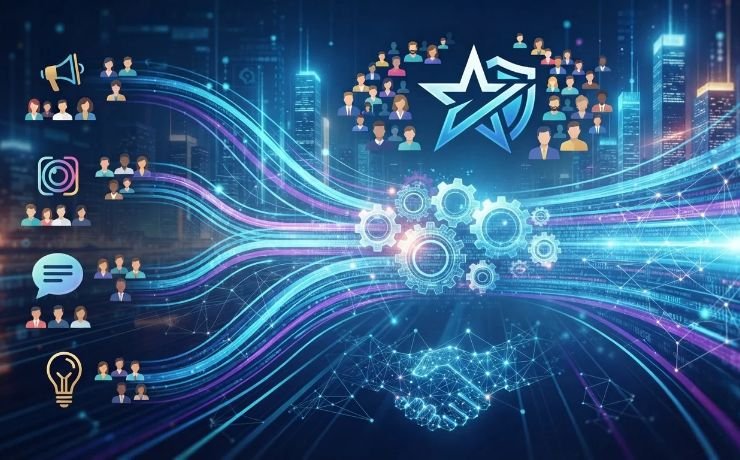
This creates opportunities for businesses operating at different points in the value chain to combine their strengths. One may bring the technology, another the talent network, and a third the creative and production capabilities. Together, they can offer a more complete service to advertisers.
From Creator Networks to Integrated Marketing Businesses
Influencer agencies are also recognising that creator access alone may not be enough to sustain long-term differentiation. As more businesses enter the category, brands have a growing choice of agencies offering broadly similar services.
The next competitive advantage may lie in what an agency can build around its creator network. Creative strategy, video production, social listening, community management, talent representation, affiliate marketing and commerce capabilities can make the offering more valuable.
This is where roll-ups become strategically relevant. An influencer agency can combine with a creative production house to strengthen content development. It can bring in a talent management business to deepen creator relationships or acquire a technology company to improve campaign intelligence and measurement.
The result is a business that can participate in more stages of the marketing process. Rather than simply identifying creators and executing collaborations, it can contribute to campaign strategy, develop content, manage distribution and evaluate commercial performance.
For brands, this integrated model can simplify execution. Instead of coordinating separate partners for influencer selection, production, social amplification and reporting, they can work with a connected agency group that manages these functions together.
For agencies, the model creates opportunities to increase the range of services offered to existing clients and build longer-term commercial relationships.
What Recent Deals Reveal About the Roll-Up Opportunity
Developments in India and international markets indicate that consolidation is already taking different forms.
In March 2024, global influencer marketing agency YKONE acquired a 70% stake in Indian influencer and content marketing agency BarCode. The transaction gave YKONE an established presence in India while bringing BarCode into a wider international network. It demonstrated how an established local agency could become a strategic entry point for a global influencer marketing business.
In January 2026, YKONE and creative production company Mirror Mirror came together to form an integrated group called One. The combined structure brought together YKONE’s international influencer operations, BarCode’s Indian business, Mirror Mirror’s creative and production expertise, talent management firm Bold and data platform Campaygn. The move reflects a shift towards combining different creator-economy capabilities within one operating ecosystem.
India has also seen consolidation driven by marketing technology businesses. In September 2024, Wondrlab acquired influencer marketing platform OPA, marking its second acquisition in the influencer marketing category. The transaction added access to OPA’s creator network and technology-led campaign capabilities, strengthening Wondrlab’s position in the creator economy.
Internationally, larger agency groups have been making similar moves. WPP acquired The Goat Agency in 2023, strengthening its influencer marketing capabilities. Publicis Groupe announced its acquisition of Influential in July 2024, combining the company’s creator network and AI-powered technology with Publicis’ data and marketing infrastructure. In February 2025, Publicis also announced its acquisition of Brazil-based BR Media Group.
These transactions are not all identical in structure or intent. Some are acquisitions, others are strategic combinations or broader capability integrations. But they point towards a common direction: influencer marketing is becoming an important part of larger marketing businesses, and access to specialised creator capabilities is increasingly being treated as a strategic investment.
The Commercial Case: Better Margins and More Revenue Opportunities
Beyond operational efficiency, roll-ups offer a commercial opportunity. Independent agencies often depend on a relatively narrow set of services or clients. This can make revenue vulnerable to changes in marketing budgets, campaign cycles and client relationships.
A combined business can diversify its revenue streams. An agency focused on influencer campaigns may add production retainers, talent management commissions, technology subscriptions, social media services or performance-linked offerings through acquisitions.
There may also be opportunities to improve operating efficiency. Shared finance, administration, technology, production resources and account management systems can reduce overlapping costs. Larger businesses may have greater negotiating leverage with technology vendors and production partners.
However, these benefits depend on how effectively the businesses are integrated. Combining two agencies does not automatically reduce costs or improve margins. Different pricing structures, compensation models, working practices and client expectations can create additional complexity.
The strongest commercial case emerges when the businesses complement each other rather than simply duplicate the same services. The objective should be to create new value through shared capabilities, not just combine existing revenue figures.
What Brands Stand to Gain
For advertisers, agency consolidation could bring greater consistency and access to a wider range of capabilities. A larger agency group may be able to support campaigns across categories, regions and platforms while offering a common approach to planning and reporting.
It can also help brands connect influencer marketing with their broader media investments. Creator content can be adapted for paid social, incorporated into digital campaigns, used in commerce initiatives or amplified through other media channels, subject to the necessary usage rights and platform permissions.
Measurement is another potential advantage. As influencer marketing receives a larger share of marketing budgets, advertisers increasingly want to understand what their investments deliver. Reach and engagement remain useful indicators, but they do not always explain whether a campaign has influenced consideration, generated qualified traffic or contributed to sales.
An agency with stronger data and technology capabilities may be better positioned to connect campaign activity with business objectives. It can help brands evaluate creator performance, compare campaign outcomes and identify opportunities for optimisation.
Yet, a larger agency structure does not automatically guarantee better results. Brands will continue to value the relevance of creator recommendations, quality of content and strength of audience connections. The consolidation of agencies must improve these fundamentals rather than replace them with operational scale.
The Risk of Losing What Made Independent Agencies Valuable
Despite the opportunities, roll-ups come with a significant challenge: preserving the qualities that made smaller agencies successful in the first place.
Independent influencer agencies often build their reputations through close creator relationships, specialised category knowledge and the ability to respond quickly to cultural developments. Their operating models may be less layered, allowing teams to make decisions and adapt campaigns without navigating multiple levels of approval.
When these agencies become part of larger groups, there is a risk that additional processes and reporting structures can slow down execution. Founders may lose operational independence, specialist teams may experience changes in leadership and creators may become uncertain about the continuity of their relationships.
There is also the risk of cultural mismatch. A creative-led agency and a technology-driven business may approach clients, talent and campaign development differently. Without a clear understanding of these differences, integration can become difficult.
Successful roll-ups therefore require more than financial planning. They need a clear operating vision, defined leadership responsibilities and a strategy for retaining the talent and relationships that contribute to the acquired business’s value.
Will Consolidation Make the Influencer Agency Market Less Fragmented?
Not entirely. Even as larger agency groups expand, independent specialist businesses are likely to remain important. The creator ecosystem is too diverse for a single operating model to address every requirement.
Smaller agencies can retain an advantage in niche categories, regional markets, emerging platforms and specialised creator communities. Their proximity to creators and audiences can offer a level of cultural understanding that larger organisations may find difficult to replicate across every market.
There will also be opportunities for specialist agencies to work with larger networks as partners rather than become acquisition targets. Technology providers, production companies and creator management businesses may continue to operate independently while supporting larger campaigns through partnerships.
In this sense, the future may not be a market dominated entirely by a handful of large agencies. It may instead develop into a more structured ecosystem where larger groups provide integrated capabilities and smaller specialists bring depth, flexibility and category expertise.
From Agency Consolidation to Creator Economy Infrastructure
The influencer agency roll-up trend reflects a broader change in how the creator economy is being organised. As creators become an established part of brand communication, the businesses supporting them are also evolving. They are moving from relationship-led campaign execution towards more structured operations built around technology, content, data and commerce.
For agencies, the opportunity lies in building businesses that can offer more than access to creators. For investors and larger marketing groups, the appeal lies in bringing together capabilities that can serve a wider set of client requirements. For brands, the expectation will remain straightforward: better strategy, relevant creators, effective content and measurable outcomes.
But consolidation will only create lasting value if it improves the quality of the work. A larger creator database, a wider office network or a longer list of services cannot substitute for cultural understanding and strong creative thinking.
The agencies that emerge strongest from this phase will be those that understand what to combine and what to preserve. Because in influencer marketing, scale may open the door to larger opportunities, but trust, relevance and the ability to connect with audiences will continue to determine whether the work makes an impact.
