














When the Brief Writes Itself: Inside India’s First Fully AI-Native Advertising Operating Systems

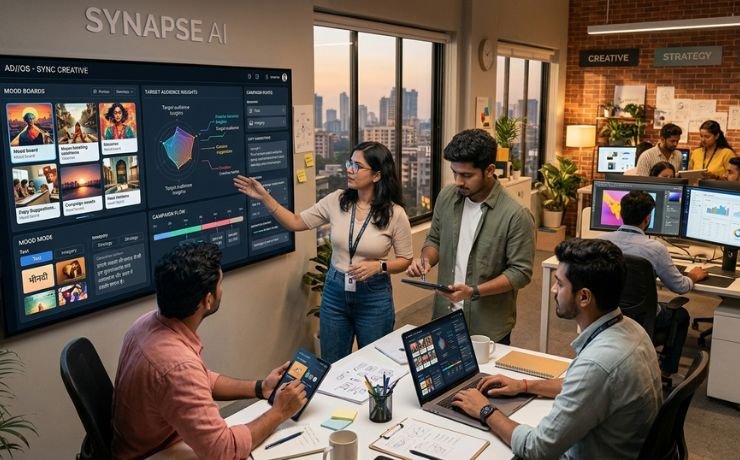
Somewhere in a Navi Mumbai office, a brief is being written right now — and no one is typing it. An algorithm is reading last quarter’s performance data, scanning a client’s brand guidelines, drafting three script variants, and queuing them for a synthetic avatar to shoot. By the time a human opens their laptop, the ad is already halfway to done.
This is not a hypothetical. It is, increasingly, how a slice of India’s advertising industry works. The country is watching a new category of company take shape — one that does not merely use AI as a faster Photoshop or a smarter spellcheck, but builds its entire operating model around it. The industry has taken to calling these companies “AI-native,” and 2026 is the year the label stopped being a pitch-deck flourish and started being a genuine operational split.
01. AI-Assisted vs. AI-Native — A Distinction That Actually Matters
For the past two years, almost every agency in India has claimed some version of an AI story. Most of it amounts to the same thing: a generative tool bolted onto an existing workflow. A copywriter uses a chatbot to draft faster. A media planner runs a dashboard with better visualisations. The underlying structure — how a brief travels from client to output — stays exactly as it was.
Industry leaders are increasingly drawing a sharper line between this kind of tooling and something more structural. Agency executives describe the difference as one of architecture rather than adoption — whether AI sits inside a shared intelligence layer connecting strategy, execution and optimisation into a single workflow, or whether it simply sits on top of the same old one. Under that definition, very few Indian agencies currently qualify as truly AI-native. Most are, by their own admission, still “layering.”
02. The Brief That Writes Itself
What makes the AI-native promise different is where it starts. Traditional advertising technology automated the back half of the funnel — media buying, ad delivery, reporting. The newer generation of Indian platforms is going after the front half: the brief itself, the script, the storyboard, the first cut of the creative.
A clutch of homegrown startups is leading this charge. A Navi Mumbai-based company has built what it calls an AI-native advertising operating system that unifies ad creation, campaign management and optimisation across platforms, using agentic workflows to cut through the fragmentation that has long made multi-platform campaigns a management headache. A Bengaluru-based counterpart uses generative AI to produce ecommerce-style user-generated-content videos at a fraction of traditional production cost and turnaround time, aiming squarely at a market that has historically depended on creators and full-service agencies. A Gurugram-based player is applying similar workflow automation specifically to performance marketing.
The common thread across all three: the system does not wait for a human to open a brief document. It generates the first version, tests it, and hands back something closer to a finished ad than a starting point.
03. Why This Is an Organisational Problem, Not a Technology One
Ask agency leaders what is actually slowing the shift down, and the answer rarely points to the models themselves. It points to org charts. The parts of marketing already seeing the deepest structural change are analytics, media buying, and increasingly planning, where AI can combine audience signals, market context and cultural trends in near real time. But rebuilding a creative department around a system that writes its own first draft means rethinking who signs off on what, who is accountable when a machine-generated line misfires, and what a “senior” role even means when the junior grunt work — the first ten scripts, the first round of edits — no longer exists.
That is the uncomfortable part of the AI-native pitch. It is not really selling speed. It is selling a different shape of team.
04. Where the Machine Still Hits a Wall
None of this means creativity is being written out of the process — but its position in the process has shifted. In many reshaped agency environments, creative thinking no longer leads; it enters after the system has already defined the constraints. That is a meaningful inversion of how Indian advertising has traditionally worked, where the idea came first and the media plan was built to serve it.
The counter-argument, made by several senior creative leaders, is that the instinct to genuinely surprise an audience — to make work that moves people rather than merely reaches them — remains stubbornly resistant to automation. Campaigns built on cultural insight and emotional truth are still outperforming mechanically efficient, algorithmically optimised content, even as that content scales faster and cheaper than anything a human team could produce alone. The lesson many are drawing is not AI versus creativity, but AI handling the multiplication and humans handling the spark that gets multiplied.
05. What Brands Actually Care About
For all the industry debate over what “AI-native” precisely means, brands themselves appear far less interested in the label. What they are watching is outcomes — whether a campaign moves faster, costs less, and performs better, regardless of what the agency calls its process internally. That pragmatism may end up being the real filter. Agencies that can demonstrate a brief-to-output cycle genuinely compressed by AI, with measurable lifts in speed or performance, will pull ahead. Agencies using the phrase as a badge without the underlying architecture to back it will eventually be found out — by the work, not the pitch.
06. The Road Ahead for India’s AdTech Stack
India’s advertising industry has a peculiar advantage in this shift: it is young enough, and fragmented enough, that there is no deeply entrenched legacy stack to dismantle before rebuilding. Where markets with decades of established agency infrastructure face genuine friction in going AI-native, a newer generation of Indian startups is essentially building the operating system from a blank page. That is precisely why the country’s most interesting experiments in this space are coming not from the holding-company giants, but from smaller, founder-led platforms willing to bet their entire architecture on AI from day one.
Whether that bet pays off will depend on the same thing it always has in advertising: not how clever the machine is, but how well the humans running it know what to ask for. The brief may increasingly write itself. Deciding what makes that brief worth writing is still, for now, a human job.
