














India’s AdTech Funding Slowdown — What a 76% YoY Drop Means for the Sector’s Next Phase

For much of the last decade, India’s AdTech sector told a fairly consistent story to the venture capital community: a billion-plus internet population, a digital ad market compounding at double digits, and a fragmented, under-built measurement-and-delivery layer that someone, eventually, would have to own. It was a pitch that practically wrote itself. Capital agreed, and it arrived in waves — funding programmatic exchanges, attribution start-ups, influencer-marketing platforms, and CTV ad-serving layers that promised to do for Indian streaming what The Trade Desk had done in the West.
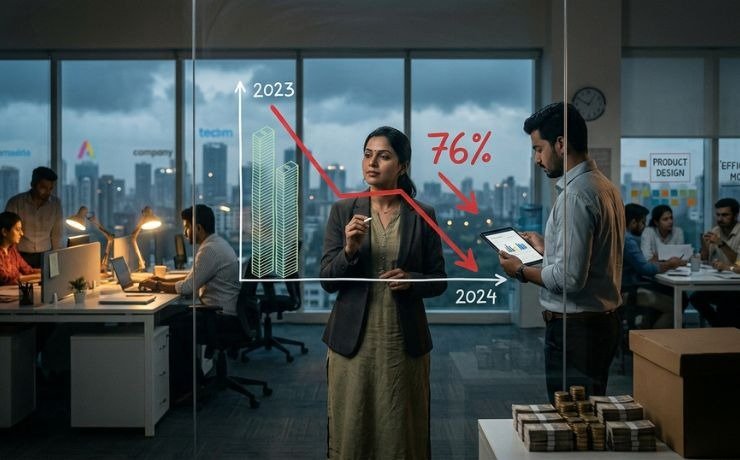
That story is now being rewritten, and not gently. Early estimates for the sector put India’s AdTech funding down roughly 76% year-on-year, a contraction sharp enough to separate this moment from the routine “correction” language that has cushioned most of the broader startup funding slowdown narrative over the past two years. Where overall Indian tech funding has been described in the language of resets and recalibrations — down double digits, but still counted in billions — AdTech’s decline reads more like a sector-specific reckoning. The question worth asking isn’t simply why the money slowed. It’s what kind of AdTech business is actually built to survive what comes after.
A Category That Grew Faster Than Its Own Proof of Value
To understand the scale of the pullback, it helps to remember how the category was funded in the first place. AdTech, as a venture category, was underwritten on a promise of infrastructure economics — the idea that whoever built the pipes connecting advertiser demand to publisher supply in India’s chaotic, multi-platform digital ecosystem would collect a durable toll on every rupee that flowed through it. That thesis attracted capital allocators who understood the SaaS-style multiples that global AdTech leaders had commanded, and who were willing to underwrite India-specific versions of the same bet years before the underlying market had matured to support them.
What got funded, in practice, was often thinner than the thesis suggested. A wave of companies built dashboards, wrappers, and optimisation layers sitting on top of Google’s and Meta’s ad infrastructure rather than genuinely new plumbing. Their differentiation was real in a pitch deck and much harder to defend once a brand’s in-house data science team, or a large agency’s own trading desk, decided it could replicate the same function without paying an external platform fee. In a capital-abundant market, that fragility was easy to overlook. Growth covered for it. In a capital-scarce one, it becomes the first thing scrutinised in due diligence.
That shift in scrutiny is really the story beneath the 76% number. It isn’t that investors have stopped believing India’s digital advertising market will keep growing — every reasonable projection still points upward, propelled by falling data costs, expanding regional-language internet use, and a retail and quick-commerce boom hungry for performance marketing. It’s that investors have stopped rewarding proximity to that growth story and started demanding a defensible position inside it.
Late-Stage Capital Left First
Consistent with the pattern playing out across Indian tech more broadly, the AdTech pullback has not been evenly distributed across stages. Late-stage rounds — the $30 million-plus growth cheques that once validated a company’s path to scale — have all but disappeared for AdTech specifically, even in periods when late-stage capital elsewhere in Indian tech has shown pockets of resilience around AI and fintech. Growth-stage investors, chastened by markdowns on earlier AdTech bets that never converted revenue multiples into profitable unit economics, are demanding proof of gross margin discipline and customer retention that many category leaders simply cannot show yet.
Seed and early-stage capital has held up in relative terms, but even that resilience comes with a catch: it is increasingly directed at a narrower definition of what counts as fundable AdTech. Pure-play programmatic exchanges and generic attribution tools — the categories that absorbed much of the last cycle’s capital — are struggling to raise. What is attracting cheques instead sits closer to applied AI: creative-generation and testing tools, fraud and bot-detection layers built on newer detection models, and retail-media enablement platforms that plug directly into the quick-commerce and e-commerce infrastructure that is currently the most reliably growing part of Indian digital spend.
One senior media investor tracking the space put it bluntly in a recent industry conversation: the market isn’t punishing AdTech, it’s punishing horizontal AdTech. Vertical-specific tools that solve one expensive, measurable problem for one category of buyer are still finding capital. Horizontal platforms betting on being everything to every advertiser are the ones being repriced out of relevance.
What the Slowdown Is Actually Filtering For
It would be easy to read a 76% decline as evidence that India’s AdTech opportunity has been overstated all along. That reading doesn’t survive contact with what is actually happening on the demand side. Ad spend on connected TV continues to climb as OTT platforms expand outside metro markets. Retail media — brands paying quick-commerce and e-commerce platforms directly for placement — is arguably the single fastest-growing pocket of Indian digital advertising right now, and it is creating exactly the kind of new, unowned infrastructure layer that AdTech start-ups were originally meant to build. Regional-language content consumption keeps opening new inventory that existing global ad platforms serve imperfectly. The demand for genuinely differentiated AdTech has not gone away. What has gone away is patience for companies whose differentiation lives only in their pitch deck.
Investors are, in effect, running a filter that the market itself has been asking for since the first funding boom: does this company own a data asset, a distribution relationship, or a technical capability that a well-resourced competitor — Google, Meta, Amazon, or a large agency holding company building its own trading desk — cannot simply replicate in a quarter? Companies that pass that filter are still raising, in some cases at valuations that look entirely reasonable against revenue. Companies that cannot answer the question convincingly are the ones contributing most heavily to the 76% figure, because they are not being funded at all, rather than being funded at a discount.
This is consistent with what has happened in India’s broader startup funding environment through 2025 and into 2026: overall dollar volume down, but deal counts and early-stage activity holding up far better than the headline decline suggests, because capital has rotated rather than retreated. Fintech and AI-native applications have absorbed much of what left categories like generic SaaS tooling and, evidently, horizontal AdTech. The AdTech slowdown looks less like an isolated collapse and more like the sharpest visible edge of a market-wide repricing exercise that has been underway for two years.
The Consolidation Nobody Wanted to Say Out Loud
A funding contraction of this size inside a single category rarely resolves cleanly. The most likely near-term outcome is consolidation — well-capitalised players acquiring smaller AdTech companies for a specific capability (a fraud-detection model, a CTV integration, a retail-media data pipe) rather than for the whole business, effectively stripping start-ups for parts at valuations well below what their founders and early investors had modelled. Agency holding companies and larger martech platforms, sitting on more patient balance sheets, are natural buyers in this environment, and several have already been quietly acquisitive in adjacent categories like creator-commerce infrastructure and marketing automation.
For founders still operating in the space, the practical implication is a change in what a viable growth plan looks like. The playbook that worked from roughly 2019 through 2022 — raise aggressively, build category breadth, use funding rounds themselves as a signal of market leadership — is no longer available. What is replacing it looks closer to the discipline that has always characterised profitable services and infrastructure businesses: narrow the wedge, prove unit economics on a small number of large customers, and treat every subsequent funding round as optional rather than existential.
What the Next Phase Actually Requires
The uncomfortable truth for India’s AdTech sector is that a 76% funding decline is not, by itself, a crisis for the market it serves. Advertisers still need better measurement. Publishers still need better yield. Brands entering retail media and CTV for the first time still need tools that make that spend accountable. The crisis, such as it is, belongs specifically to the generation of companies that were capitalised for a growth rate the underlying infrastructure could not yet support, and whose differentiation depended on capital abundance rather than technical or data moats.
What the next phase of Indian AdTech will likely reward is narrower, less glamorous, and considerably harder to fake: proprietary data relationships that competitors cannot buy their way into, applied AI capabilities built for problems specific to the Indian market rather than adapted from a Western playbook, and integration deep enough into a high-growth channel like retail media or CTV that switching costs become real rather than theoretical. That is a smaller, more demanding category than the one that raised money so freely a few years ago. It is also, on the evidence of where capital is still flowing even amid the broader pullback, a category that investors remain genuinely willing to fund — provided the company in front of them can answer the one question the market has decided actually matters: why can’t someone bigger just build this instead.
