














Live Commerce Goes Mainstream: What Amazon and Flipkart’s Livestream Shopping Bets Mean for Brands

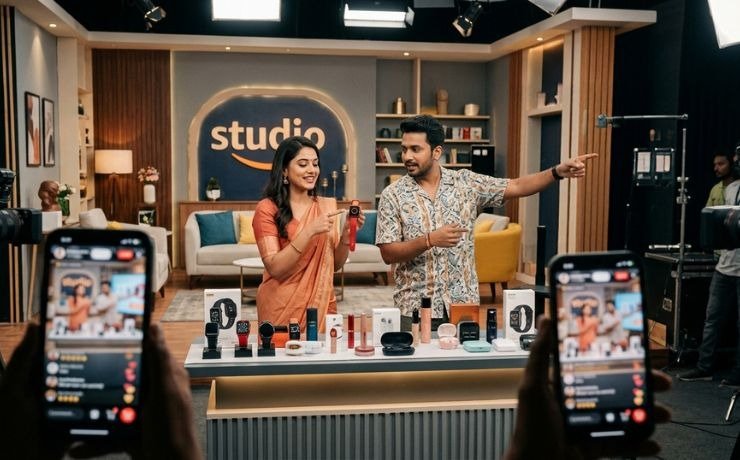
For years, live commerce in India has carried the whiff of a technology in search of a market — a format that consultants loved to cite in decks, borrowing China’s staggering numbers to justify Indian ambition, while the ground reality told a quieter story of muted adoption and shuttered startups. That story is now being rewritten, and this time the authors are not scrappy Series A ventures but the two heavyweights of Indian e-commerce: Amazon and Flipkart. Both are pouring fresh capital, creator partnerships, and platform real estate into livestream shopping, betting that the format’s moment in India has finally arrived. For brands and marketers watching from the sidelines, the question is no longer whether live commerce deserves attention, but how quickly they need to build the muscle to use it well.
A Format That Refused to Die
The skepticism around live commerce in India was never unfounded. A wave of dedicated live-shopping startups — Bulbul, GlowRoad and several others — attempted to import the Taobao Live and Douyin playbook wholesale, only to discover that Indian consumer behaviour, internet infrastructure and trust dynamics did not map neatly onto the Chinese template. Most of that first generation of startups have either shut down or been folded into larger players at valuations far below their early promise, having collectively raised close to ninety million dollars with little to show in sustainable unit economics.
What is different this time is who is doing the betting. Amazon and Flipkart are not experimenting with live commerce as a standalone business; they are embedding it into platforms that already command hundreds of millions of monthly users, deep catalogue depth, and — crucially — existing trust with Indian shoppers. That distinction matters enormously. Live commerce’s biggest historical hurdle in India was never technological; it was the credibility gap between an unfamiliar app hosting an unfamiliar creator and a consumer’s willingness to pull out a card. Amazon and Flipkart don’t have to build that trust from zero.
Flipkart’s Video-First Playbook
Flipkart’s approach has been the more aggressive of the two, and the numbers inside the company tell a compelling story of momentum. According to senior Flipkart executives, the volume of users engaging with video content on the platform has grown many times over in a short span, a shift the company attributes directly to changing consumption habits among India’s mobile-first, video-native shoppers. Neha Agrahari, Senior Director at Flipkart, has pointed to a simple behavioural insight driving this strategy: users increasingly prefer to watch a video before making a purchase decision, which has pushed the company to make video and livestream content central to its digital storefront.
Flipkart’s most consequential move, however, has been architectural rather than merely promotional. Rather than treating live commerce as a feature bolted onto its own app, the company struck a partnership with Moj, the homegrown short-video platform, to embed shoppable video and live commerce experiences directly within Moj’s ecosystem. The tie-up was framed by Flipkart as a way to reach the next 200 million e-commerce customers, tapping into Moj’s substantial user base to bring first-time online shoppers into the fold through an in-app integration that lets viewers purchase tagged products without leaving the video screen. The logic here is sound: rather than fighting for attention on a shopping app, meet consumers where their attention already lives — inside a short-video feed they are scrolling anyway.
This dual-channel approach — live commerce native to the Flipkart app, plus a parallel presence within a partner’s short-video ecosystem — expands reach considerably, though it is not without its own friction. Running commerce across two distinct product experiences raises legitimate questions about audience fragmentation and whether a brand’s storytelling stays consistent when its livestream lives on someone else’s platform and someone else’s algorithm. Flipkart appears to have calculated that the reach dividend outweighs that risk, particularly for the discovery-stage, first-time online shopper it is chasing through this format. Alongside this, the company has continued to build out Flipkart Live within its own marketplace, giving sellers the ability to run product demonstrations, Q&A sessions and flash sales directly on the app — a capability that has quietly become a meaningful sales lever for sellers willing to invest in the format.
Amazon’s Engagement-First Bet
Amazon’s entry into Indian live commerce, through Amazon Live, has been notable for what the company has chosen not to prioritise. Rather than leading with a hard sales pitch, Amazon has been explicit that its early emphasis is on driving customer engagement through livestreams rather than optimising immediately for conversion. The company has been candid that influencers are given significant latitude over what they discuss during their streams, and that sellers themselves could evolve into influencers on the platform over time, with Amazon working to make that pathway accessible even to small businesses and individual sellers who understand their product category deeply.
This engagement-first posture reflects a maturing understanding of what live commerce actually does well. Unlike a banner ad or a sponsored search result, a livestream is a sustained, interactive format — closer to television shopping than to performance marketing, but layered with real-time chat, product demonstrations and the parasocial credibility of a familiar face. Amazon’s willingness to treat this as a relationship-building exercise first and a sales channel second is, in some ways, an acknowledgment that Indian consumers still need to be taught how to shop this way before they can be expected to convert at scale.
At launch, Amazon onboarded more than 150 content creators to host livestreams and showcase products, running a punishing schedule of streams through much of the day in a deliberate push to build engagement and habit around the format. That scale of creator commitment signals a platform willing to treat live commerce as a long-term infrastructure investment rather than a seasonal marketing gimmick tied to a single sale event.
Why Now — And Why It Might Actually Work
Several structural shifts explain why this second wave of live commerce has a genuinely better shot than the first. India’s short-video consumption has exploded, with a substantial majority of the country’s internet users now habitual consumers of short-form video content — an audience that platforms like Moj, Instagram Reels and YouTube Shorts have spent years conditioning to watch, engage and, increasingly, transact. That behavioural runway simply did not exist when the first generation of live commerce startups launched.
The global backdrop has also shifted expectations. Industry projections have suggested that live stream commerce could account for as much as a fifth of all global e-commerce, a figure that has effectively given platforms strategic license to invest ahead of proven mass-market adoption in India rather than waiting for demand to prove itself first. China remains the reference point that everyone in this conversation eventually returns to, and for good reason — the country’s live commerce market has grown from roughly fifty-seven billion dollars in 2019 to figures approaching the trillion-dollar mark by the middle of this decade, with platforms like Douyin and Taobao Live commanding hundreds of millions of monthly active users each. No market analyst seriously expects India to replicate those numbers in the near term, but the directional signal — that live, interactive, creator-led shopping can become a durable retail channel rather than a novelty — is one that Amazon and Flipkart are clearly taking seriously.
There is also a distinctly Indian dimension to why live commerce could succeed this time: trust. Both Amazon Live and Flipkart’s live commerce push are explicitly counting on the ability of local, relatable influencers to build trust among new online shoppers, particularly those in smaller towns and cities who remain wary of online shopping’s abstractions — the inability to touch fabric, judge fit, or verify authenticity from a static product photo. A livestream, especially one hosted in a regional language by a creator who looks and sounds like the audience watching, closes that trust gap in a way a product listing never can. This is precisely why categories like fashion, beauty, and home decor — where texture, drape and visual nuance matter enormously — have emerged as the natural early beachheads for the format.
What This Means for Brands
For marketers and brand teams, the platforms’ investment in live commerce infrastructure changes the calculus around what deserves budget and creative attention over the next year. A few implications stand out.
First, live commerce is no longer a channel brands can treat as experimental or optional at the margins. When both dominant marketplaces are building dedicated infrastructure, creator networks and in-app real estate around the format, the brands that move early will have first pick of the most credible creators, the best slotting within platform-curated events, and the learning curve advantage over competitors who wait for the format to “prove itself” before committing spend.
Second, the creative discipline required for live commerce is genuinely different from static or even video advertising. A livestream succeeds or fails on the strength of hosting talent, the rhythm of product demonstration, and the ability to handle real-time audience questions with authenticity rather than a scripted sales pitch. Brands accustomed to controlling every frame of their advertising will need to get comfortable ceding some of that control to creators and hosts — the same tension that has always existed in influencer marketing, now compressed into real time and tied directly to a checkout button.
Third, category fit matters enormously. Fashion, beauty, home and kitchen categories — where visual demonstration genuinely aids the purchase decision — are likely to see disproportionate returns from live commerce investment compared to categories where the buying decision is largely specification-driven, such as electronics accessories or commodity household goods. Brands should resist the temptation to force every product line into a livestream format simply because the infrastructure now exists.
Finally, the fragmentation of live commerce across platforms — Flipkart’s own app, its Moj integration, Amazon Live, and the continuing presence of Myntra’s M-Live and other verticals — means brands will need a genuine multi-platform strategy rather than a single hero campaign. The winners in this next phase will likely be brands that treat live commerce not as a one-off event tied to a sale calendar, but as a recurring content and commerce discipline, built with the same rigor as any other always-on marketing channel.
The Road Ahead
Live commerce in India is not suddenly a solved problem, and the graveyard of earlier startups is a useful reminder that platform muscle and creator scale do not automatically translate into consumer habit. But the difference this time is structural rather than cosmetic. Amazon and Flipkart are not testing a feature; they are building infrastructure, striking distribution partnerships, and committing to the kind of sustained creator investment that habit formation actually requires. For brands willing to learn the format early — and to bring genuine hosting talent, not just product catalogues, to the stream — the next eighteen months look like the window in which live commerce in India stops being a slide in someone’s strategy deck and starts being a line item that actually moves revenue.
