














Regional OTT’s Ad Yield Problem — Why Vernacular Platforms Still Get Undervalued CPMs

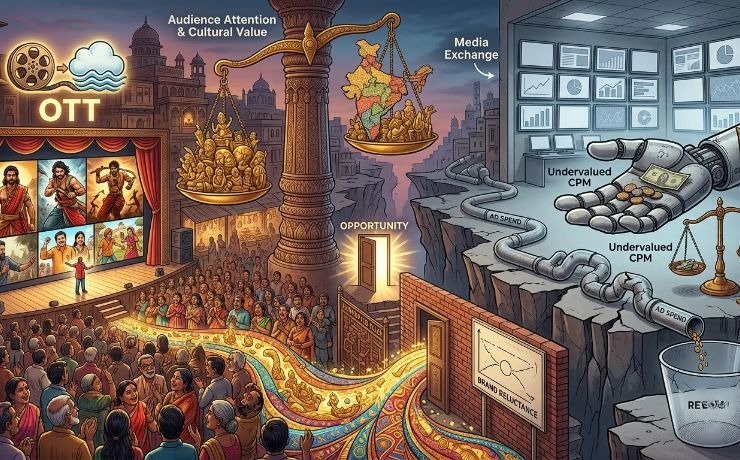
Ask a media planner which streaming platform has the most engaged audience in India and the answer will often come with a language attached. A Tamil thriller that trends for a week. A Bengali original that quietly becomes the reason a household subscribes. A Telugu film that draws viewers back to the app every Friday. Regional OTT has spent the better part of five years proving that it commands loyalty. What it has not yet proved, at least to the people who hold the budgets, is that this loyalty deserves a price.
That is the uncomfortable centre of the vernacular streaming business today. Audiences are growing, content quality has improved dramatically and advertisers say all the right things about reaching Bharat. Yet the CPMs that regional platforms realise on their ad inventory continue to trail those of their Hindi and English counterparts, often by a margin that no amount of audience data seems able to close. The gap is not a rounding error. It is a structural feature of how the market buys, measures and thinks.
A Discount Built on Assumptions
The first thing worth understanding is that the undervaluation is rarely the result of a single decision. It is the accumulated effect of many small assumptions, each of which feels reasonable in isolation. Planners have historically equated language with income tier, and income tier with advertiser appeal. A Hindi or English audience on a metro-skewed platform is assumed to carry higher purchasing power, so it commands a premium. A Kannada or Malayalam audience is assumed to be more price-sensitive, so it is bought as reach.
This logic has always been shaky, and it is becoming shakier. India’s regional language markets include some of its most affluent and digitally mature consumers. Kerala, Tamil Nadu, Karnataka and Maharashtra are home to dense urban clusters, high smartphone penetration and strong categories in automobiles, consumer durables, financial services and education. Treating a vernacular viewer as a lower-value impression ignores the economic reality of the very states that anchor large parts of the country’s consumption.
Yet the assumption persists, partly because it is convenient. It lets buying teams apply a default discount without interrogating the audience underneath. And once a discount becomes the norm, it hardens into the price that publishers must push against every quarter.
The Measurement Gap
If assumptions explain the discount, measurement explains why it survives. Premium CPMs are built on proof, and proof is precisely what regional platforms find hardest to supply at the standard advertisers expect.
Third-party audience measurement in Indian streaming remains patchy. Large, general-entertainment platforms benefit from being tracked, panelled and discussed. Regional services, many of them subscription-led with modest ad inventory, often sit outside the frameworks that agencies rely on to justify a plan to a client. When a planner cannot point to an independent number that validates reach, frequency and demographic composition, the safest move is to lean on the platforms that have such numbers, regardless of whether the regional alternative would perform better.
Language adds a further layer of complication. Audience panels were designed around a world of national, Hindi-and-English-led viewing. Capturing the nuances of a Telugu household that streams on a connected TV in the evening and a phone during the commute is harder, more expensive and less standardised. The data exists inside the platforms, but first-party numbers are discounted by buyers who, quite reasonably, want verification they can trust. The result is a vicious circle in which the lack of independent measurement depresses pricing, and depressed pricing reduces the revenue available to invest in measurement.
Fragmentation Is a Seller’s Problem Too
It would be convenient to blame buyers alone, but regional OTT has its own structural handicaps. The most obvious is fragmentation. A national advertiser who wants meaningful presence across four southern languages must negotiate with a patchwork of platforms, each with its own sales team, inventory formats, reporting standards and minimum commitments. For a planner working to a tight timeline, that is friction. And in advertising, friction is a cost that gets priced into the buy.
Scale is the related issue. Many vernacular platforms deliver high engagement from relatively small audiences. That is a strength when the brief calls for depth, but it is a weakness when the buyer needs a single line item that moves the needle on reach. Agencies tend to favour partners who can absorb large budgets without operational strain, and a platform that can offer only a modest slice of the plan will usually be treated as a supplement, not a priority.
There is also the question of ad load and inventory discipline. Subscription-first services are understandably protective of the viewing experience, which limits the volume of ad inventory they can offer. That scarcity should, in theory, support higher prices. In practice, the absence of scale and standard reporting offsets the benefit, and the platform ends up with neither the volume of a mass service nor the pricing power of a premium one.
The Programmatic Blind Spot
Programmatic buying was supposed to be the great equaliser, a mechanism through which any quality impression could find its best price regardless of who was selling it. For regional OTT, that promise has been only partly realised.
The plumbing for streaming ads, particularly in connected TV, is still maturing in India. Server-side ad insertion, deal-based transactions and standardised content metadata are all in various stages of adoption. Where metadata is thin, a Malayalam drama and a Hindi reality show can look identical in the bid stream, stripped of the contextual signals that would let a buyer value them differently. Language, genre, viewing context and device are exactly the attributes that make regional inventory distinctive, and they are frequently the attributes that fail to travel cleanly through the supply chain.
Without that richness, buyers fall back on blunt tools. Targeting by geography and broad demographic bands treats vernacular inventory as a commodity, and commodity inventory is priced by the lowest common denominator. A more sophisticated approach, one that allows advertisers to buy against language affinity, content genre and household context, would let regional platforms demonstrate why a viewer in Coimbatore watching a Tamil thriller is not interchangeable with a viewer anywhere else. That capability is emerging, but unevenly, and it is not yet embedded in the default workflow of most buying teams.
The Creative Problem Nobody Mentions
One reason vernacular CPMs underperform is that the advertising running on them is often not built for the audience. A significant share of brand campaigns on regional platforms are simple dubs or subtitled adaptations of national creatives. The cultural reference points, the humour, the music and the product framing remain tied to a Hindi-speaking or metropolitan sensibility.
When those campaigns underdeliver, as ill-fitted creative usually does, the conclusion drawn is that the platform failed to perform, not that the message failed to resonate. This feeds back into pricing. If advertisers believe regional audiences convert poorly, they pay less for access to them. The platform is penalised for an outcome it did not control.
The brands that have approached regional markets with genuinely local creative tend to report a different experience. A campaign written in the idiom of its audience, using local talent and cultural touchpoints, behaves like a premium product in a premium environment. The lesson is not that regional OTT is a magic channel. It is that undervaluation is partly self-fulfilling, and the people best placed to break the loop are the advertisers who have the most to gain from doing so.
What Regional Platforms Can Do Differently
The burden of change does not rest solely with buyers. Regional platforms have a considerable amount within their own control, and the most successful ones are beginning to act on it.
Evidence is the starting point. Platforms that invest in credible, independently validated audience studies, covering reach, repeat viewing, household composition and category affinity, give planners something concrete to defend in a pitch. Outcome data matters even more. A case study showing sales uplift, store visits or app installs from a regional campaign is worth more than any amount of positioning language about engagement.
Aggregation is the second lever. Whether through marketplaces, shared sales arrangements or partnerships with ad-tech platforms that bundle regional supply, collective offerings can solve the fragmentation problem. A buyer who can reach multiple vernacular audiences through a single, transparent transaction has far less reason to treat regional as an afterthought. Scale built through partnership is less glamorous than scale built through acquisition, but it is considerably faster.
Third, platforms should treat their content catalogue as a data asset. Rich, consistent metadata around language, genre, theme and viewer context allows buyers to find precisely the environment they want. A well-tagged library of regional content is not just an archive; it is the foundation of a contextual product that can command a premium on its own terms.
Finally, there is the question of packaging. Regional publishers that sell sponsorship of marquee releases, integrated brand storytelling and premium sports or event rights are moving the conversation away from per-thousand pricing and toward value. When the sale is built around an audience moment and not an impression count, the CPM stops being the only number on the table.
What Advertisers and Agencies Owe the Market
Agencies and brands have their own work to do. The first step is to retire the lazy equation between language and value. Planning should begin with the consumer a brand actually wants, defined by category behaviour, income, intent and location, and only then ask which languages and platforms reach them best. Many advertisers will discover that the audience they are paying a premium to reach in English is no more valuable than the one they are discounting in Tamil or Bengali.
Buyers should also be willing to test. A modest, well-designed experiment in which a brand runs localised creative on a regional platform and measures outcomes against a comparable national buy is the most persuasive argument available. If the results are strong, the budget follows. If they are not, the brand learns something useful about its creative or its category. Either way, the decision rests on data rather than inherited habit.
There is a case, too, for treating regional inventory as strategic rather than tactical. Advertisers who build early relationships with vernacular platforms will secure better placements, more flexible terms and deeper insight before the market corrects its pricing. The window in which regional audiences are cheap relative to their engagement will not stay open indefinitely.
A Correction Waiting to Happen
Markets tend to correct mispricing eventually, but eventually can be a long time. The forces that will narrow the gap are already visible: better measurement, maturing programmatic infrastructure, growing advertiser confidence in regional consumers and a steady stream of case studies that contradict the old assumptions. None of them will deliver parity overnight. Together, they point in one direction.
The platforms that benefit most will be those that prepare for the correction rather than wait for it. They will have the audited numbers, the clean metadata, the outcome stories and the packaged propositions ready when buyers finally come looking. The advertisers who benefit most will be those who stopped treating language as a discount long before their competitors did.
Regional OTT does not have an audience problem. It has a translation problem, in the oldest sense of the word: the value that exists on the screen has not yet been carried across into the price on the rate card. Closing that distance is the defining commercial task for vernacular streaming, and for the advertisers wise enough to meet it halfway.
