













Beyond Search Keywords: What Happens to Paid Search When Consumers Start Asking AI for Recommendations?

For more than two decades, paid search has operated on a relatively straightforward premise: consumers express what they want through keywords, advertisers bid on those keywords, and search engines connect the two through sponsored results. A person looking for a smartphone, insurance policy or holiday destination would type a query into Google, scan the available links and decide where to click. The process was familiar, measurable and central to digital advertising budgets.
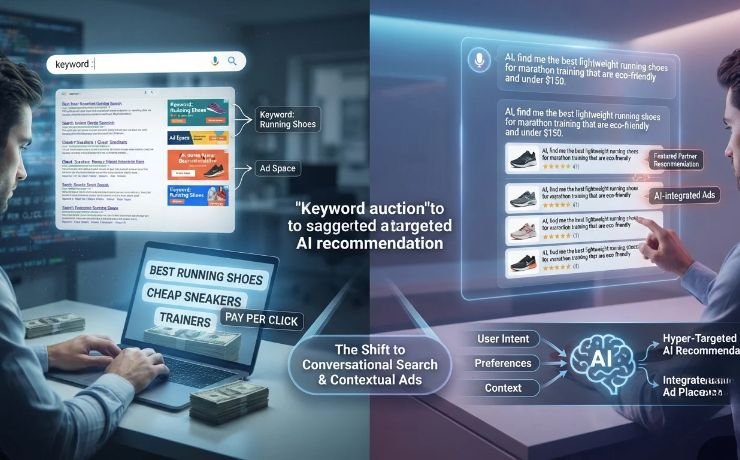
That relationship is beginning to change. Consumers are increasingly turning to artificial intelligence platforms such as ChatGPT, Google Gemini and Microsoft Copilot to ask questions, compare products and seek recommendations. Instead of searching for ‘best smartphone under ₹30,000’, a consumer might ask an AI assistant to recommend a phone with a good camera, reliable battery life and strong performance for everyday use. The platform interprets the requirements, evaluates available information and presents a response that may include a shortlist of products.
This changes the nature of search. Consumers are no longer simply looking for a list of websites containing relevant information. They are asking for an answer, an explanation or a recommendation. For advertisers, the implications extend beyond search engine optimisation. Paid search, one of digital advertising’s most established performance channels, is entering a period of structural change.
The question for marketers is not whether consumers will stop searching for products and services. It is where those searches will take place, how commercial recommendations will be delivered and whether brands will need to compete for visibility in an entirely different environment.
From keyword matching to recommendation-led discovery
Traditional paid search is built around the relationship between a search query and an advertiser’s keyword strategy. Brands identify the terms consumers are likely to use, organise them into campaigns, establish bidding strategies and develop advertisements that respond to specific search intent.
Although search engines have gradually introduced automation, broad match targeting and machine-learning-based bidding, keywords have remained an important foundation of campaign planning.
AI-powered search introduces a different interaction model. Consumers can describe a problem in considerable detail, add multiple conditions and continue asking follow-up questions without restarting the search process. An AI assistant can interpret the context of the conversation rather than relying exclusively on the precise words entered into a search box.
Consider someone planning to purchase a family car. A traditional search journey might involve separate searches for SUVs under ₹15 lakh, fuel-efficient cars, safety ratings and available financing options. An AI-led interaction can bring these requirements together in one conversation. The consumer can ask for recommendations, reject options that do not meet their needs and request comparisons based on specific features.
This creates a shift from keyword-led discovery towards intent-led recommendations. The advertising opportunity is no longer limited to identifying which product category a consumer has searched for. It increasingly involves understanding the requirements, preferences and circumstances behind the request.
Google’s leadership has acknowledged this change in consumer behaviour. At Google Marketing Live 2026, Nick Fox, the company’s Senior Vice President overseeing Search, Maps, Commerce and Ads, described how consumers are moving towards more detailed interactions.
“People are looking for nuanced, highly personalized answers to their questions.”
For advertisers, this means that the ability to interpret context and respond to a consumer’s actual need could become as important as securing visibility against a high-volume keyword.
Google is bringing advertising into AI-powered search
The transition does not necessarily mean that traditional search advertising will disappear. Instead, search platforms are adapting their advertising models to accommodate conversational experiences.
Google has begun introducing sponsored placements within its AI-powered search experiences, including AI Overviews and AI Mode. These advertisements can appear when a consumer’s question has commercial relevance, allowing brands to reach users while they explore products, compare options or look for solutions.
Google’s approach also introduces contextual matching. For instance, someone asking how to improve the air quality inside a home may receive an AI-generated explanation covering ventilation, filtration and air purification. Relevant sponsored advertisements for air purifiers or related products may appear alongside the response, even if the original query did not mention a specific brand or product.
In October 2026, Google announced the expansion of advertisements in AI Mode to additional markets, including India. The development is significant because it brings commercial placements closer to the conversational discovery process rather than restricting them to conventional search results pages.
The announcement also highlighted a change in query behaviour. According to Google, searches in AI Mode are, on average, three times longer than traditional searches. The company believes that the additional context helps its systems understand what consumers are looking for and connect them with relevant businesses and services.
“In AI Mode, queries are, on average, three times longer than traditional searches.”
Google has also been developing advertising formats designed for AI-led interactions. These include product-focused advertisements and experiments with placements that can respond to the context of a conversation. The objective is to bring commercial information into the decision-making process without separating it entirely from the consumer’s search experience.
However, the introduction of these formats does not make conventional search campaigns redundant. Existing Search campaigns and AI-powered products such as AI Max continue to form part of Google’s advertising ecosystem. The difference lies in the additional opportunities to reach consumers as they explore more complex requirements.
What happens to the value of keywords?
One of the biggest questions surrounding AI-led discovery is whether keywords will lose their importance in paid search. The more realistic possibility is that their role will change.
Keywords have traditionally provided advertisers with a way to identify demand and establish control over where their advertisements appear. They also offer useful insights into consumer behaviour. Searches for specific products, locations, price ranges and features help marketers understand what potential customers are looking for.
However, conversational AI makes the relationship between a query and a product less direct. A consumer may begin with a broad question, provide additional information and gradually arrive at a purchase decision. The commercial opportunity might emerge several interactions after the original question.
In this environment, advertisers need to look beyond individual search terms and consider broader intent categories. Instead of focusing only on ‘best running shoes’, a sportswear brand may need to understand related requirements such as shoes for marathon training, running on uneven surfaces, beginners returning to fitness or long-distance running on a budget.
These searches may represent different consumer needs even when they lead to the same product category. Understanding those distinctions can help brands develop more relevant advertising messages and landing pages.
It does not make keyword research redundant. Search terms continue to reveal demand, inform campaign structure and help marketers identify emerging interests. What changes is the need to interpret keywords as part of a wider context rather than treating every query as an isolated advertising opportunity.
The new competition: Being recommended, not just being visible
In traditional search advertising, brands compete for positions on a results page. Higher bids, relevant advertisements, landing page experience and other auction signals influence whether an advertiser secures visibility.
AI recommendations introduce another layer of competition. When a consumer asks an AI platform to recommend a product, the platform may present a limited selection of options rather than a long list of websites. Being included in that shortlist can become an important discovery opportunity.
This creates a distinction between being searchable and being recommendable. A brand may have a strong paid search presence but still have limited visibility in AI-generated recommendations if the platform does not encounter sufficient relevant information about its products, positioning or credibility.
AI assistants can draw on multiple sources when constructing responses, including websites, product information, reviews, editorial content and other publicly available information. The quality, consistency and accessibility of a brand’s digital information therefore become important considerations.
For advertisers, this means that paid search cannot operate independently of broader brand visibility. Product descriptions, technical specifications, customer reviews, comparison content and third-party references all contribute to the information environment in which consumers evaluate brands.
There is also an important distinction between organic recommendations and paid placements. Advertising within an AI-powered search experience may offer a commercial visibility opportunity, but purchasing an advertisement does not automatically guarantee that a brand will be included in an AI-generated organic recommendation. Google has clarified that paid advertising does not influence the organic responses generated by its AI search systems.
Brands will therefore need to manage two related but separate objectives: securing paid visibility and ensuring that their products and information are sufficiently discoverable across the wider digital ecosystem.
Why advertising creative will need to become more contextual
Traditional search advertisements are often designed around a specific query. A consumer searching for a particular product may see an advertisement highlighting its price, discount, availability or primary feature.
Conversational discovery creates opportunities to respond to more detailed requirements. An advertisement can become more relevant when it addresses the particular problem a consumer is trying to solve rather than repeating a generic product claim.
For example, a financial services brand targeting consumers looking for home loans could develop messaging around different stages of the decision-making process. Someone exploring eligibility requirements may respond to information about documentation and qualification criteria, while someone comparing loan options may be more interested in interest rates, repayment flexibility and processing fees.
The product remains the same, but the communication needs to reflect the consumer’s immediate requirement.
This makes creative flexibility increasingly important. Advertisers will need to develop messaging frameworks that can accommodate different intents, product benefits and decision-making stages. Landing pages must also provide information that directly addresses the questions raised in the advertisement.
Microsoft Advertising has similarly been exploring ways to connect sponsored content with conversational search experiences through Copilot. In a discussion about generative AI and advertising, Nicole Schumacher, a Microsoft Advertising executive, described the approach to placements within these interactions:
“Fewer, more personalized placements designed to be natural and helpful to the conversation.”
The emphasis on relevance is important. Consumers using an AI assistant are generally looking for assistance with a decision, not necessarily another advertisement. Commercial messages that respond to the context of the interaction are more likely to fit naturally into that experience.
AI-powered campaign tools can help automate aspects of this process by adapting headlines, descriptions and targeting signals. However, automation cannot replace a clear understanding of the brand’s proposition. Without accurate product information and meaningful creative inputs, automated systems risk producing messages that are technically relevant but commercially unconvincing.
The measurement problem: What happens when the click disappears?
Paid search has historically been one of the most measurable digital advertising channels. Impressions, clicks, cost per click, conversions and return on ad spend have provided marketers with a relatively direct framework for evaluating campaign performance.
AI-led discovery complicates this model. Consumers may receive useful information, compare alternatives and develop a preference within an AI conversation without immediately visiting a brand’s website. The eventual purchase could happen through a retailer, a mobile application, a physical store or a later direct search.
This creates a measurement gap between the initial recommendation and the final transaction.
Traditional last-click attribution may struggle to capture the influence of these interactions. If a consumer discovers a brand through an AI recommendation but completes the purchase after clicking a branded search advertisement several days later, the final click may receive most of the conversion credit.
The earlier discovery interaction, despite influencing the purchase decision, may remain invisible in the reporting framework.
Advertisers will therefore need to examine a wider range of performance indicators. Branded search growth, assisted conversions, direct traffic, qualified website visits, product consideration and incremental sales can help provide a more complete picture of how discovery contributes to business outcomes.
First-party data will also become increasingly important. Connecting website interactions, CRM information, offline sales and conversion events can help marketers understand how consumers move between different discovery and purchase environments.
Marketing mix modelling and incrementality testing can offer additional ways to assess the contribution of channels that do not generate an easily traceable click. The objective is to move towards a measurement framework that recognises the influence of multiple interactions rather than assigning disproportionate value to the final touchpoint.
What this shift means for India’s digital advertising market
India presents an interesting environment for the evolution of AI-led search. Consumers are already accustomed to using digital platforms to compare prices, research products and seek recommendations before making purchase decisions. The growing adoption of conversational AI adds another layer to this behaviour.
For brands operating across categories such as electronics, automobiles, financial services, travel, healthcare and e-commerce, the potential applications are significant. These are categories where purchases often involve multiple considerations, comparisons and questions.
A consumer choosing a health insurance policy, for example, may want to understand waiting periods, hospital networks, exclusions, premiums and claim settlement processes. An AI assistant can help organise these considerations into a conversation, potentially influencing which providers the consumer evaluates further.
Similarly, an automobile buyer may use AI to compare vehicle specifications, safety features, ownership costs and financing options before visiting a dealership.
There is also an opportunity for brands to address India’s linguistic diversity. Consumers may increasingly expect to interact with AI platforms in natural language rather than adapting their questions to the vocabulary of search engines. As multilingual AI experiences develop, advertisers will need to consider how product information, campaign messaging and landing pages serve audiences across different languages.
However, adoption will not be uniform. Search engines, marketplaces, social platforms, messaging applications and AI assistants will continue to coexist. Consumer behaviour will vary according to category, age, digital familiarity and purchase complexity.
For marketers, the challenge is to understand where AI recommendations are influencing decisions rather than assuming that every consumer journey is moving away from traditional search.
How advertisers should prepare for the next phase of paid search
The transition towards AI-powered discovery requires advertisers to strengthen their existing search foundations while preparing for new forms of commercial visibility.
1. Move from isolated keywords to intent clusters: Campaign planning should account for the different questions consumers ask before making a purchase. Organising search strategies around broader intent themes can help brands address exploratory, comparative and transactional requirements.
2. Strengthen product and website information: AI systems need reliable information to understand what a business offers. Clear product descriptions, updated specifications, transparent pricing, structured data and relevant landing pages can improve the accessibility and usefulness of brand information.
3. Invest in first-party data and conversion tracking: As consumer journeys become less linear, accurate conversion signals are essential. Advertisers should strengthen their CRM integrations, conversion tracking and offline sales reporting to improve campaign optimisation and measurement.
4. Experiment with AI-powered campaign formats: Advertisers should assess emerging search products and formats as they become available in their markets. Google’s AI Max for Search, for example, uses AI-driven targeting and creative capabilities to help campaigns respond to a wider range of search intent. Testing these tools with clear performance benchmarks can help brands understand their incremental value.
5. Develop content that answers real consumer questions: Comparison guides, product explainers, frequently asked questions and detailed category information can help brands address the questions consumers bring to AI platforms. Content should prioritise usefulness and accuracy rather than simply repeating high-volume keywords.
6. Rethink performance measurement: Search performance should not be evaluated through clicks and last-click conversions alone. Advertisers need to examine assisted conversions, brand demand, customer acquisition quality and incremental business outcomes to understand the wider contribution of AI-led discovery.
Paid search is changing, but its commercial purpose remains
The rise of AI recommendations does not signal the end of paid search. It signals a change in how consumers express intent and how advertising platforms respond to it.
Search engines are moving beyond lists of links towards experiences that interpret questions, organise information and help consumers make decisions. Advertising is following that evolution, with sponsored placements increasingly finding space within AI-powered discovery environments.
For marketers, the implications are significant. Keyword strategies will need to account for broader intent, creative will need to respond to more specific requirements, and measurement will need to recognise interactions that may not produce an immediate click. Brand visibility will also depend on the quality and consistency of information available across the digital ecosystem.
Yet the fundamental objective of paid search remains unchanged: connecting a business with a consumer at a moment when its product or service can meet a genuine need.
The difference is that this moment may no longer begin with a keyword. It could begin with a question, develop through a conversation and end with a recommendation. Brands that understand this shift will be better positioned to compete for consumer attention, not just on search results pages, but across the expanding landscape of AI-led discovery.
