














The Return of Long-Form — Why Podcasts and YouTube Essays Are Pulling Premium Sponsorships Back

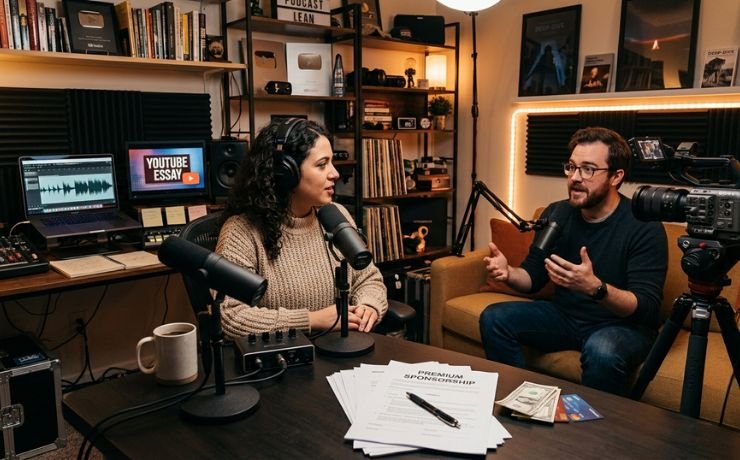
For years, the advertising industry treated attention as something that had to be compressed. Short-form video became the default language of digital consumption. Six-second bumpers, 15-second reels, snackable explainers and quick product integrations were built around the assumption that audiences had little patience and even less time.
But the market is beginning to reveal a more complicated truth: audiences may not have lost their appetite for long-form content. They have simply become more selective about what deserves their time.
The renewed strength of podcasts and long-form YouTube essays points to that shift. Across categories, creators are building audiences around conversations that can run for an hour, documentaries that take 30 minutes to unpack an idea, and video essays that ask viewers to stay with a subject rather than swipe past it. For advertisers, this is creating a different kind of opportunity.
Premium sponsorships are returning to environments where the audience is not merely present, but invested.
The appeal is not nostalgia for long-form media. It is economics. When a creator can hold attention for 45 minutes, build trust over hundreds of episodes and attract an audience around a defined interest, a sponsorship can become more than an inserted advertisement. It can become part of the content ecosystem.
That is changing how brands think about creator partnerships, audio advertising and YouTube. The next phase of the creator economy may not be defined by who can produce the most content. It could be defined by who can command the most meaningful attention for the longest period.
The Short-Form Era Created a Long-Form Opportunity
Short-form video has fundamentally changed digital behaviour. Platforms have trained audiences to discover content quickly, consume it rapidly and move on without friction. The format has been exceptionally effective for reach, cultural relevance and frequent brand exposure.
But reach and attention are not the same thing.
A viewer may watch several short videos in a session without developing a strong connection with any of them. Long-form content operates differently. It asks for commitment at the beginning and, if successful, rewards that commitment with depth.
This is particularly valuable for creators whose propositions are built around expertise, personality or storytelling. A finance creator can spend 40 minutes unpacking an investment theme. A technology channel can take apart a new product. A filmmaker can investigate a cultural phenomenon. A business podcast can spend an hour with a founder.
The content becomes difficult to reduce to a single short clip because the value lies in the accumulation of information, context and personality.
For brands, that creates something increasingly scarce in advertising: time spent with a message.
Why Podcasts Are Becoming Premium Media Properties
Podcasts have been moving steadily from the margins of digital media into mainstream advertising plans. Their growth is not simply a consequence of more people listening to audio. It is also about the relationship between host and audience.
A strong podcast creates a recurring habit. Listeners return to familiar hosts, formats and subjects. Over time, that familiarity can translate into trust.
This makes host-read advertising particularly powerful.
Instead of a brand message arriving as an interruption, the host can introduce the product in their own voice, explain why it matters and connect it to the broader conversation. The distinction may appear subtle, but commercially it is significant. The advertisement inherits some of the credibility and familiarity that the creator has built with the audience.
This is one reason premium podcast sponsorships increasingly resemble partnerships rather than conventional media buys.
A financial services brand sponsoring a business podcast, for example, is not simply buying audio impressions. It is buying association with a particular audience mindset. A productivity platform sponsoring a technology or entrepreneurship show can become part of the listener’s professional routine. A premium consumer brand can use a cultural podcast to position itself within a particular community.
The value lies in contextual fit.
YouTube Essays Are Building Another Kind of Premium Inventory
YouTube complicates the traditional distinction between television, social media and creator content. The platform can accommodate everything from a 20-second meme to a two-hour documentary.
That flexibility has allowed a new generation of creators to build long-form formats that increasingly resemble independent media properties.
Video essays are a strong example. They combine research, commentary, narrative structure, visual storytelling and personality. Subjects can range from technology and economics to pop culture, politics, design, history and business.
The important point for advertisers is that these channels are not necessarily competing for attention through frequency. They are competing through depth.
A viewer who spends 30 minutes watching a creator analyse a subject has made a stronger commitment than someone who watches a 20-second clip. That does not automatically make the longer format more effective for every campaign, but it creates a different environment for brand communication.
For premium brands, that environment can be valuable.
The Sponsorship Is Becoming Part of the Story
The most interesting development is not that long-form creators are carrying advertisements. It is that the best sponsorships are increasingly designed around the format.
Traditional digital advertising tends to separate content and advertising. A video plays, an ad appears, and the viewer returns to the content.
Long-form creator sponsorships can work differently.
A creator might spend several minutes discussing a product, demonstrate how they use it, integrate it into the episode’s narrative or build a recurring sponsorship segment. The brand becomes visible without necessarily feeling detached from the programme.
This is particularly effective when the product has a natural relationship with the creator’s subject matter.
Consider a long-form technology channel sponsored by a software company. The creator can demonstrate the product within an actual workflow rather than simply announcing its features. A travel creator can integrate a luggage or financial services brand into a journey. A business podcast can use a productivity platform as part of the host’s working routine.
The strongest integrations answer a simple question: why does this brand belong here?
When that answer is convincing, sponsorship becomes less disruptive and more useful.
Premium Sponsorships Are Also About Brand Safety
There is another reason long-form creator content is becoming attractive to premium advertisers: greater control over context.
Programmatic advertising offers scale, but scale can sometimes come with limited control over the environment in which an impression appears. A sponsorship around a specific podcast or YouTube channel gives the advertiser a clearer understanding of the creator, editorial tone and audience.
This does not eliminate risk. Creators remain individuals, and their opinions or behaviour can affect brand associations. But a direct partnership gives advertisers greater visibility into the relationship.
For some categories, that can be particularly important.
Financial services, technology, automotive, education and premium consumer brands often need more than mass awareness. They need credibility and context. A carefully selected creator can provide both.
Attention Quality Is Becoming a Media Metric
The resurgence of long-form content also reflects a broader change in the advertising industry’s understanding of attention.
For years, digital media measurement largely revolved around impressions, clicks, views and completion rates. These metrics remain important, but they do not always explain whether an audience was genuinely engaged.
Long-form content makes attention easier to conceptualise.
If a viewer willingly spends 50 minutes with a creator, the advertiser can reasonably infer a degree of engagement that is difficult to capture through a simple impression count. The challenge is converting that engagement into a measurable commercial outcome.
That is where the next stage of podcast and YouTube measurement will become important.
Advertisers will increasingly want to understand not just how many people watched or listened, but how deeply they engaged, whether sponsorship recall increased, whether brand consideration moved and whether the partnership drove action.
As measurement improves, long-form sponsorships may become easier to justify within larger media plans.
The Rise of Creator-Led Media Buying
The creator economy is also changing how agencies think about media planning.
Creators were once primarily considered an influencer marketing channel. A brand would identify a personality, negotiate a fee and commission a post or video.
That model is evolving.
Established podcasts and YouTube channels increasingly operate like media properties. They have recurring audiences, editorial formats, production teams, distribution strategies and commercial inventory.
That means agencies can begin evaluating them using some of the same principles applied to other media environments: audience composition, reach, frequency, engagement, contextual relevance, brand fit and commercial outcomes.
The creator is still central, but the product being bought is increasingly the audience relationship.
This shift could also lead to more sophisticated sponsorship structures. Instead of a one-off integration, brands may negotiate seasonal partnerships, multi-episode packages, category exclusivity, branded series or co-created formats.
Not Every Long-Form Creator Is Premium Inventory
The return of long-form should not be mistaken for a blanket shift away from short-form.
Long videos are not valuable simply because they are long.
A poorly structured 60-minute podcast does not automatically create more value than a well-made 30-second video. Length without attention is simply more content.
Premium sponsorships will therefore concentrate around creators who can demonstrate sustained audience behaviour. Consistency matters. Editorial quality matters. Audience trust matters. The ability to create a recognisable format matters.
Advertisers will also need to distinguish between inflated view counts and genuine communities.
A creator with a smaller but highly engaged audience can be more commercially valuable than a large channel where viewers arrive primarily through algorithmic discovery and leave quickly.
This is where creator selection is becoming more strategic. The question is no longer simply, “How many followers does this creator have?” It is, “What relationship does this creator have with those followers?”
India’s Opportunity Is Particularly Interesting
India’s digital market provides fertile ground for this trend because the creator ecosystem is expanding across languages, regions and interest categories.
Long-form content can serve audiences that are too specialised for traditional mass media but large enough to support commercial communities. Business, finance, technology, automobiles, gaming, education, food, travel and culture are all capable of producing deep-interest audiences.
Regional-language creators add another layer.
A brand that wants to build credibility beyond India’s largest metros can potentially partner with creators who understand the language, cultural references and consumer realities of specific markets. In that environment, long-form storytelling can provide the context that a short advertisement cannot.
For advertisers, this opens a route between mass television and fragmented social content: creator-led media with strong contextual relevance and measurable digital distribution.
The New Premium May Be Time
The advertising industry’s relationship with long-form is ultimately a story about scarcity.
There is no shortage of content. There is no shortage of impressions. There is no shortage of short videos competing for a viewer’s next few seconds.
What is increasingly scarce is sustained attention.
A creator who can convince an audience to stay for 30, 45 or 60 minutes is therefore offering something that cannot be measured purely through reach. They are offering an environment in which a brand can have a longer conversation with the consumer.
That does not make long-form universally superior. Short-form will remain essential for discovery, cultural participation and scale. But the two formats can play different roles.
Short-form can win the first few seconds. Long-form can earn the next hour.
For brands, the opportunity is to stop treating those formats as competing destinations and start designing journeys between them. A short clip can create discovery. A podcast episode can build familiarity. A long-form YouTube essay can deepen understanding. A community can then turn that attention into action.
From Influencer Deals to Media Partnerships
The return of long-form is therefore not really a return to an older media model. It is the emergence of something new.
Podcasts and YouTube essays are creating media environments where creators can combine personality, expertise, storytelling and distribution. Advertisers are beginning to recognise that the commercial value of these properties lies not only in their audience size but in the depth of the relationship they have built with that audience.
The premium sponsorship of the future may consequently look less like an ad placement and more like a media partnership.
The brands that understand this early will not simply ask creators to insert products into content. They will work with them to build ideas that belong in the content, fit the audience and reward attention.
After years of compressing every message into a few seconds, advertising is rediscovering the value of taking its time.
And in an economy where attention is increasingly difficult to earn, the ability to hold an audience may become one of the most premium media assets of all.
