












After the Final Whistle: What brands learned advertising around the FIFA World Cup 2026

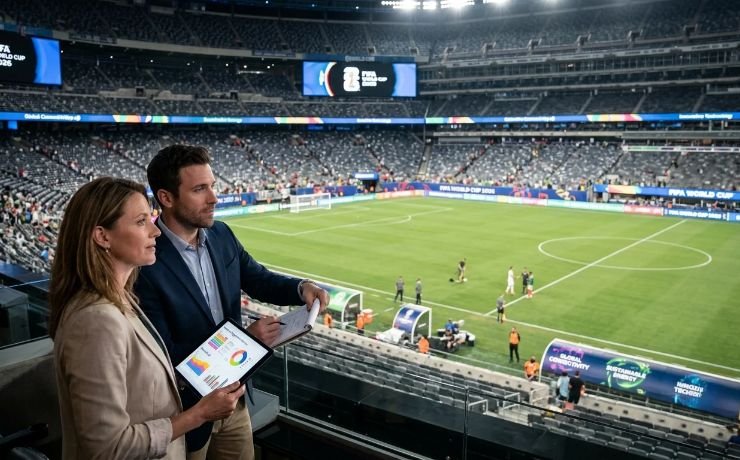
When Spain’s players lifted the trophy at MetLife Stadium on 19 July, the tournament ended for the fans. For marketers, it did not. The final whistle simply moved the contest from the pitch to the boardroom, where chief marketing officers, and the finance heads who sign off their budgets, have spent the months since asking one blunt question: what did all that money actually buy?
It is a fair question, and the numbers behind it are enormous. According to WARC Media estimates reported by Adweek, the 2026 FIFA World Cup drew more than $10 billion in global advertising spend, on top of the roughly $2.8 billion FIFA collected from its 20 official sponsors. Add the non-sponsor brands that piled in without paying for rights, and the tournament became a six-week fight for the attention of a potential audience of six billion people, spread across 48 teams, 104 matches, three host nations and 16 cities.
Three months on, the picture is not a tidy ledger of winners and losers. It is something more useful: a record of which strategic instincts held up under pressure and which quietly cracked. For an industry that will keep pouring money into global sport, the lessons are worth reading closely.
Reach is not the same as return
The most striking post-tournament story belongs to McDonald’s, which has chosen to end its FIFA World Cup sponsorship after 32 years. The decision followed what the company itself described as its biggest-ever World Cup campaign, created by Wieden+Kennedy New York and rolled out across more than 110 countries. On its second-quarter earnings call, chief financial officer Ian Borden said the push had lifted the business and generated real excitement within the system, but still fell short of the company’s expectations. Reporting around the exit points to a broader overhaul that moves the brand toward intellectual property it owns outright.
The logic is hard to argue with. A sponsorship is, at heart, rented attention. You pay for the rights, then pay again to be noticed, and when the contract ends you keep only what you managed to build in the meantime. McDonald’s has characters, rituals and menu items that keep earning long after any tournament is over, which is precisely why it can afford to walk away. Most brands do not have that luxury.
The takeaway is not that the World Cup does not work. It is that the sponsor badge, on its own, does not. Access to the biggest stage on earth is the entry fee, and what a brand builds on that stage determines whether it owns anything the morning after. Every marketing team that renewed a sports deal this year should be able to answer a simple question: what will we still own the day after this partnership ends?
Constraints can be creative raw material
If McDonald’s showed the limits of paying for presence, Levi’s showed the power of earning it. FIFA’s tournament rules required venues to strip or cover the branding of anyone who was not an official sponsor, so Levi’s Stadium in Santa Clara was temporarily renamed the San Francisco Bay Area Stadium, and its giant logo was wrapped in white fabric. The wrapping was fitted rather than generic, which meant the outline of the famous batwing mark was still unmistakable to anyone who knew it.
Levi’s did not hide from the moment. It posted a reel of the covered logo set to a viral social audio, welcoming the world to the “beautiful [redacted] stadium,” and changed its own Instagram profile picture to the wrapped version of its logo. A rule designed to protect paying sponsors ended up handing one of the tournament’s most talked-about brand moments to a company that had not paid for the privilege.
There is a craft lesson and a commercial one here. The craft lesson is speed and wit: the brand read the cultural mood and answered it in a tone that felt native to social media rather than imposed on it. The commercial lesson is more sobering. The idea only worked because Levi’s has spent more than a century building a distinctive visual asset that survives even when the name is removed. Distinctive brand assets are the quiet superpower of any marketer working around a restricted event. Since non-sponsors cannot use the tournament’s name or marks, the smartest plays are cultural rather than literal, and they depend entirely on how recognisable a brand already is.
AI is a tool, not an alibi
Few creative debates were as loud this summer as the one about artificial intelligence. Coca-Cola’s “Uncanned Emotions” film, which leaned on AI-generated shots of cans being tapped, opened, thrown and spilled, drew immediate criticism online as a production shortcut. Trade commentary noted it was the third consecutive year the company had faced a backlash of this kind, following its holiday campaigns in 2024 and 2025, which many viewers described as soulless.
Contrast that with Adidas, which used the technology to de-age three football legends and complete a nostalgic ensemble cast. The reception was markedly kinder. The difference was not the tool. It was the intent. In one case, AI was the means of realising an idea that could not otherwise have existed. In the other, it filled a production gap, and audiences could see the gap.
Viewers are not rejecting artificial intelligence as such. They are rejecting visible indifference. When a technology serves the story, it passes almost unnoticed. When it substitutes for craft, it becomes the story. For brands planning their next big-event films, the practical advice is unglamorous: show the work to someone outside the team that made it, and ask what they notice in the first two seconds. A polished internal review can miss what a fresh pair of eyes catches at once.
Emotion still outruns spectacle
Celebrity firepower was everywhere. Lionel Messi fronted work for Adidas, Michelob Ultra and Lay’s among others, and the pre-tournament creative landscape was dominated by fan-experience themes that mixed ordinary supporters with famous faces. When every brand has a star, however, the star stops being a differentiator.
The campaign that research firm DAIVID ranked highest before kickoff was not a celebrity parade at all. It was LEGO’s film, which recorded intense positive emotion in more than half of the viewers who watched it. It ended with a child finishing the build, reconnecting the spectacle to the thing the brand actually stands for. That final beat matters. The best work of the tournament did not borrow the emotion of football and hope some of it rubbed off. It translated that emotion into the brand’s own language.
The pace of the event added another layer of pressure. A tournament that moves from group-stage drama to knockout heartbreak in a matter of days punishes anything static. The brands that looked sharpest were those with a clear idea at the centre and the flexibility to respond to what was happening on the pitch, without losing their voice in the process.
India: a tournament without a home team
For Indian marketers, the World Cup posed a peculiar strategic puzzle. India has never qualified for the tournament, yet brands committed hundreds of crores to be part of it. Zee, the official broadcaster, signed more than a dozen advertisers, with names such as Mahindra, Diageo, Apple, Pernod Ricard and Mondelez reported among them, and said that around 95 per cent of its knockout-stage inventory had been sold by early July. Nielsen’s global sports research ranks football as India’s second most followed sport, an audience built largely on club competitions such as the Premier League and La Liga, and on international tournaments where fans choose a side to back.
Industry voices quoted by exchange4media offered a candid reading of the spending. Indian brands, one analyst argued, were not chasing global cultural relevance, since that would have pointed them to different markets. They were chasing a vast, simultaneous audience. Another observed that many treated the tournament like a large poster site: logo placements, match-break spots and presenter sponsorships. There was also a market-structure story underneath, with Zee picking up the football portfolio partly because the established sports media leaders had stepped back.
The contrast with cricket is instructive. JioStar has cited a world-record peak concurrency of 72.5 million on JioHotstar during India’s victory at the ICC T20 World Cup earlier this year. When the home team is playing, emotion is supplied free of charge and the brand’s job is to join the moment. Without a home team, that emotional hook has to be built. The Indian brands that earned more than impressions this summer were, in all likelihood, those that gave viewers a reason to care: a fan ritual, a rivalry, a watch-party culture, a piece of football knowledge worth sharing. Brands that simply bought the break and waited for football’s glow to settle on them probably bought reach without resonance.
It is worth saying plainly that the full commercial scorecard for Indian advertisers is not yet public, and the second half of the year will reveal far more than the sales announcements did. But the strategic question is already clear. In a market where the national team is absent, football is a fandom to be earned, not an audience to be rented.
What to carry into the next cycle
Pull these threads together and a handful of principles emerge, none of them especially new, all of them reinforced by the evidence of 2026.
First, treat the sponsorship as the start of the work rather than the work itself. The brands that benefit longest are those that convert borrowed attention into owned assets: a character, a ritual, a product moment, a community. Second, invest in distinctiveness long before the event arrives. Levi’s could turn a covered logo into a triumph because the logo was already iconic. A brand cannot build that recognition in the six weeks of a tournament.
Third, use new tools in service of ideas, not in place of them. The audience will forgive technology that serves a story and punish technology that replaces one. Fourth, localise the emotion. A global tournament is experienced through local identities, local rivalries and, in markets like India, local absence. A campaign that ignores this will read as a poster, however beautifully it is printed.
Finally, define success in the language of the business before the first ad airs. The most uncomfortable lesson of the summer may be that even the company with the longest and deepest relationship with the tournament could not make the numbers work to its own satisfaction. That should not scare marketers away from big moments. It should make them more rigorous about what they expect those moments to deliver, and more honest about what they measured afterwards.
The final whistle has long since blown, and Spain’s celebrations are a memory. The questions the tournament left behind are harder than the match was, and the brands that answer them honestly will be the ones best prepared when the next global stage comes around.
