














YouTube on the Living-Room Screen: The CTV giant planners still file under social

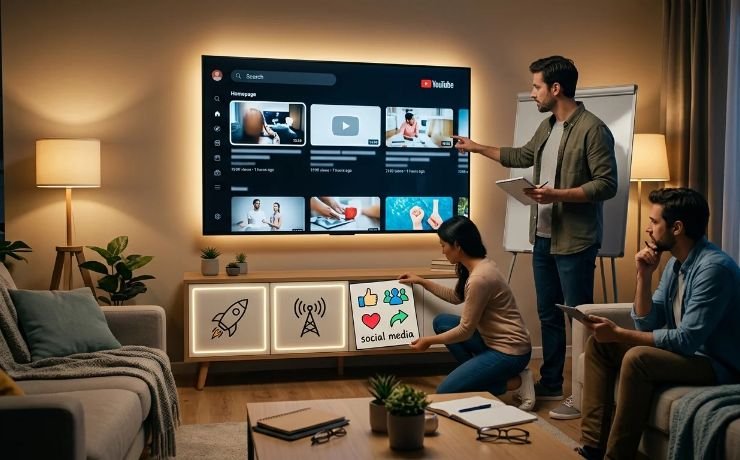
In August, Nielsen’s monthly Gauge recorded something that would have sounded absurd a decade ago. YouTube accounted for a record 15.8 per cent of all television viewing in the United States, more than double the share of Netflix, which ranked second at 7.7 per cent. Streaming as a whole reached 49.6 per cent of TV time that month. However the data is sliced, the single biggest destination on American television screens is not a broadcaster, a cable network or a subscription service. It is a video platform that many media plans still file under social.
That mismatch is one of the quieter planning problems of 2026. The audience has moved into the living room. In a surprising number of budgets, the money has either not followed or has followed in the wrong shape.
A television network by every measure except the one that sets budgets
The climb has been steady rather than sudden. Nielsen’s rankings put YouTube at 11.6 per cent of US television usage in February 2025, which was enough to overtake Disney at the time, and at 12.4 per cent that April. By April 2026 it had reached 13.4 per cent, then 14.2 per cent in July, when its lead in the media distributor ranking widened to five share points. The August figure of 15.8 per cent was a platform record.
The shift is driven largely by the screen itself. According to eMarketer data shared with TechCrunch, connected TVs accounted for more than 44 per cent of YouTube’s US watch time in 2026, up from about 41 per cent in 2022. This is lean-back, full-screen viewing, often with several people in the room, which is a very different proposition from a thumbnail glanced at on a commute.
Two caveats are worth keeping in mind. The Gauge measures viewing time, not the number of households reached, so a platform whose audience watches for long stretches can carry a bigger share than its reach alone would suggest. And August’s record partly reflects a shrinking denominator: overall television usage fell 4.4 per cent that month as the FIFA World Cup ended and students returned to school. The direction of travel is unmistakable, but a single month’s share should not be read as a permanent step change.
How a TV-sized channel ended up in the social column
The filing problem begins with definitions. The Interactive Advertising Bureau splits digital video into three buckets: connected TV, online video and social video, and it states that social video includes YouTube. Its May 2026 forecast put social video at $31.9 billion for the year, ahead of CTV at $29.3 billion and online video at $20.7 billion. Trade press examining the report has noted that the IAB’s public releases do not set out how YouTube viewing on television sets is allocated between those buckets.
The distinction matters because the categories are defined by different things. CTV is defined by the screen. Social video is defined by the platform. A YouTube ad watched on a television is therefore CTV by device and social video by the IAB’s platform grouping, and which label ends up on a media plan often depends on who happens to own the line item. When the headline claim is that social video has overtaken CTV, it is worth asking how much of that lead is YouTube viewing that happens on a television.
Organisational habit does the rest. Media commentator Mike Shields observed in 2024 that YouTube money tends to arrive from half a dozen vehicles: sometimes the TV budget, sometimes social video, sometimes creators, sometimes retail media or programmatic. When a channel has six funding sources, it often has no single owner, and nobody is accountable for planning it as a whole. Business Insider reported that many advertisers and agencies have long treated YouTube as online video or social media, separate from the TV plan. The platform’s own push to be seen as television has made the gap between how it is consumed and how it is bought more visible, not less.
What the filing error actually costs
The first cost is duplication. When linear TV, CTV and YouTube are planned in separate silos, the same household can be reached by all three with nobody counting the overlap. Planners who model incremental reach when CTV is layered on top of existing linear and digital activity can see where the waste sits. Those who do not are left with three reports that each look healthy and a total frequency nobody has seen.
The second is measurement. A view is not a view across platforms. YouTube qualifies engaged views at 10 seconds for skippable in-stream ads and five seconds for in-feed and Shorts formats, and from 24 August 2026 it counts a public view from the first frame in every format. Meta uses different thresholds again. Put a social-video cost-per-view next to a television cost-per-thousand and the comparison looks tidy while resting on incompatible definitions.
The third is safety and standards. User-generated feeds are harder to classify than professional programming, and the first Media Rating Council brand safety accreditation for short-form inventory went to YouTube Shorts only on 3 June 2026. That is a welcome step, but it is a reminder that the standards television buyers take for granted were, until very recently, still being built for parts of the platform now sitting on their screens.
The case the television purists make
It would be too easy to conclude that YouTube is simply television with a different logo, and the sceptics have a point. Lindsey Clay, chief executive of the UK marketing body Thinkbox, told Business Insider that while YouTube wants television’s reputation, the two media remain far apart for advertisers. Her argument is that TV content is regulated and vetted by humans before it airs, and that scam ads are not a problem there.
There are also questions about what time on screen really means. The Gauge counts minutes, and minutes are not attention. TechCrunch noted in April that engagement on the biggest screen has historically lagged mobile and desktop, because viewers do not interact with televisions the way they do with phones, and that whether YouTube can translate its dominance into more interactive viewing is unproven. Some of what plays on a living-room YouTube is background content that nobody is watching closely.
Even eMarketer’s case for treating YouTube as a must-buy CTV channel is a qualified one. It praises the combination of television-style reach with digital targeting and measurement, while advising agencies to keep budget available for linear television to maintain traditional reach. The sensible reading is that YouTube deserves a seat in the television conversation without being treated as a substitute for everything else in it.
India: a living room that is filling up
For Indian planners, the question is sharper still. A report from WPP Media and The Trade Desk, built on Ormax Media’s 2026 OTT audience study, estimates that connected TV in India reaches 207 million viewers across 62 to 65 million households, roughly three times the audience of 2022. It puts average daily CTV watch time at 2.9 hours and finds that in the more affluent NCCS A households that have CTV, only 40 per cent watch linear television regularly. Google has separately said that YouTube reached more than 75 million Indian adults on connected TV by April 2025, with over half of its watch time spent on content running 21 minutes or longer.
These are industry and platform figures, and should be read as such. Trade coverage of the WPP report pointed out that the audience number and the advertising spend do not yet match, which is either an opportunity for early movers or a sign that 207 million is generous relative to what advertisers can verify. Both readings can be true at once.
The report also suggests that one CTV impression reaches an average of 2.5 people, a household multiplier that personal-screen metrics were never designed to capture. If that figure is anywhere near right, a planner who files India’s most-watched streaming platform under social video, and judges it by per-device view counts, is likely to understate what the screen delivers and misjudge how it should be priced against television. Indian marketers also have the advantage of planning this early enough to avoid the habits that older markets are now unpicking.
How planners should file it instead
The fix is not to move YouTube from one column to another. It is to stop treating it as a single column at all. YouTube spans mobile, desktop and the television, and each surface does a different job. A completed view on a living-room screen and a swipe-stop on Shorts are different events and should carry different objectives, different creative and different benchmarks.
In practice, that means a few disciplines. Plan by screen and role rather than by platform, so that CTV viewing sits alongside television in the reach and frequency model, and Shorts sits with social and creator activity. Ask for device-level reporting so that television-screen delivery can be separated from everything else. Use a common reach metric across linear, CTV and YouTube before comparing costs. Brief creative for the room it will be watched in, which for a television means pacing and storytelling built for lean-back viewing rather than a vertical file stretched onto a larger screen.
Ownership matters too. Someone should be responsible for the total YouTube investment, wherever the money originates, so that the television, social and creator teams are not each optimising a slice. And finance leaders, who will be asked why a TV-sized audience is being bought with a social-sized measurement framework, deserve a clear answer. A modest controlled test, with agreed definitions and independent verification where possible, will be more persuasive than any claim about share.
The Gauge will keep publishing and YouTube’s number will keep moving. The harder question is whether the industry’s habits move with it. A channel that large cannot be planned well from a column built for something smaller, and the planners who redraw the map first will be the ones who know what their television budget is really buying.
