













From Awareness to Purchase in 48 Hours: Quick Commerce Campaign Case Studies

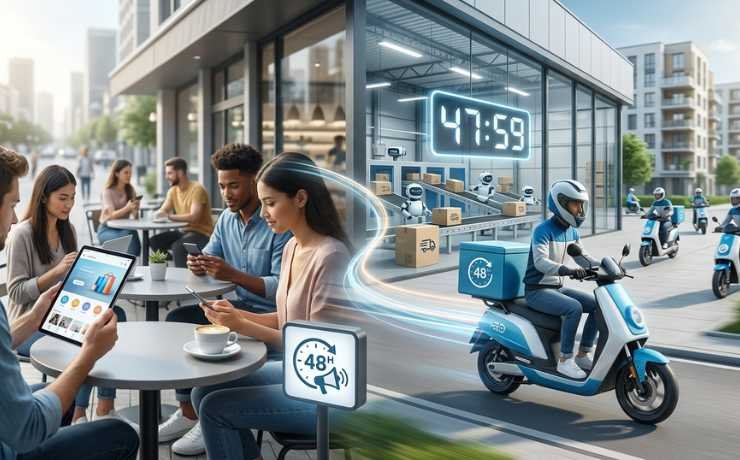
Eighteen months ago, a brand marketer planning a launch campaign would have built the funnel around a six-to-eight-week arc: awareness through video and display, consideration through retargeting and content, and conversion trickling in over weeks as consumers moved from noticing the product to actually buying it. Quick commerce has taken that arc and compressed it into something closer to two days. A consumer sees an ad on Instagram in the morning, opens Blinkit or Zepto out of curiosity by afternoon, and has the product delivered to their door within ten minutes of placing the order that evening. The entire journey from first impression to completed purchase can now happen inside a single 48-hour window, and for brands willing to build campaigns around that reality, it has become one of the sharpest performance channels in Indian advertising.
This shift is not simply about faster delivery logistics. It has fundamentally rewritten how marketers think about the awareness-to-purchase funnel, collapsing stages that used to be planned and measured separately into a single, tightly monitored sprint. Understanding how brands are actually structuring these compressed campaigns, and what is working, offers a useful blueprint for any performance marketer trying to make sense of this newly accelerated buying cycle.
Why 48 Hours Has Become the New Funnel
The compression is a direct consequence of how quick commerce platforms have restructured consumer behaviour. When delivery takes ten to fifteen minutes, the psychological gap between wanting something and having it shrinks to almost nothing. This changes what “consideration” even means. A shopper does not need to research a product for a week when it can simply be tried the same evening. Impulse and intent blur into a single moment of action, and that moment is increasingly happening on the quick commerce app itself rather than on a brand’s website or a marketplace listing.
For advertisers, this means the traditional separation between an “awareness campaign” running on social and video platforms and a “conversion campaign” running on performance channels has started to collapse. Increasingly, the two need to be planned as one continuous sequence, timed so that a consumer who sees the awareness creative on day one is served retargeting and quick commerce placements within hours, not days, while the initial impression is still fresh and the product is already sitting on a nearby dark store shelf.
The Anatomy of a Compressed Campaign
Campaigns built around this 48-hour arc tend to share a common structure, even across categories as different as personal care, snacking, and beverages. The first phase, typically running through the first twelve to eighteen hours, focuses purely on broad-reach awareness, usually through short-form video on Instagram Reels and YouTube Shorts, timed deliberately to coincide with peak quick commerce ordering windows in the evening and late morning. The creative in this phase is built for instant recall rather than deep storytelling, favouring bold packaging shots, a clear category cue, and a simple value proposition that a consumer can retain in the few seconds before switching apps.
The second phase overlaps almost immediately with the first. As soon as impressions start accumulating, brands layer in quick commerce-specific placements: sponsored search results and banner takeovers within the Blinkit, Zepto, or Swiggy Instamart apps themselves, timed to appear the moment a relevant category search happens. This is where the funnel genuinely compresses, because the same consumer who saw the awareness creative on social media is now encountering the brand again inside the exact app where the purchase decision gets made, often within the same browsing session.
The final phase, usually concentrated in the last six to twelve hours of the window, is built around urgency and social proof: limited-time discount tags, “trending now” badges, and bundle offers designed to convert lingering interest into an actual cart addition before the campaign’s paid media spend tapers off. Brands running these campaigns closely track a specific metric that barely existed in traditional media planning two years ago: time-to-purchase from first impression, often measured in hours rather than days.
What Makes These Campaigns Work
Several patterns consistently separate quick commerce campaigns that convert well from those that simply generate impressions. The first is category fit. Products with genuine impulse or replenishment triggers, snacks, beverages, personal care essentials, over-the-counter health products, perform disproportionately well because the purchase decision itself requires little deliberation. A shampoo running low or a craving for a specific snack translates almost directly into a quick commerce order, whereas considered purchases like appliances or higher-ticket beauty products see far weaker conversion inside a 48-hour window, regardless of how strong the awareness creative is.
The second is dayparting precision. Brands that map their awareness spend to actual quick commerce ordering peaks, typically late morning around breakfast restocking and evening between seven and ten as households plan dinner and snacking, see meaningfully tighter conversion windows than brands running awareness on a flat, always-on schedule disconnected from platform-level ordering behaviour.
The third, and increasingly the most decisive, is in-app visibility timing. A brand that only invests in social media awareness without corresponding sponsored placement inside the quick commerce app itself is relying on the consumer to remember the brand name unprompted during a category search, which is a much weaker mechanism than being visually present at the exact moment of search. The campaigns generating the sharpest awareness-to-purchase conversion consistently pair external reach with simultaneous in-app presence, rather than treating the two as sequential.
The Measurement Shift This Forces
Compressed funnels demand compressed measurement. Traditional multi-touch attribution models, built around week-long or month-long lookback windows, struggle to make sense of a journey that starts and ends within 48 hours. Brands running serious quick commerce campaigns have had to build tighter attribution windows into their reporting, often tracking impression-to-purchase lag in hourly buckets rather than daily ones, and treating any purchase outside a 72-hour window as effectively unattributed to that specific campaign push.
This has also changed how creative testing gets prioritised. With such a short window between launch and result, brands running quick commerce campaigns are increasingly front-loading creative testing into the first six to eight hours of a campaign, using early CTR and in-app click-through as a fast proxy signal to reallocate budget toward the stronger-performing variant well before the 48-hour window closes, rather than waiting for a full week of data the way a traditional performance campaign would.
Where Brands Are Still Getting It Wrong
Not every brand entering quick commerce advertising is seeing the returns the channel is capable of, and the failures tend to trace back to a small set of recurring mistakes. The most common is treating quick commerce placement as an afterthought bolted onto an existing social media plan, rather than designing the campaign around the compressed window from the outset. A campaign built with a traditional two-week awareness-then-conversion structure and simply extended into a quick commerce app rarely performs, because the pacing mismatch means awareness peaks long after the in-app placement has already run its course.
A second common misstep is underinvesting in the in-app creative itself. Many brands treat quick commerce banner placements as a lower-priority creative slot compared to their hero social content, when in reality this is the exact placement sitting closest to the actual purchase decision and arguably deserves equal creative investment. A third is ignoring category-specific ordering rhythms entirely and running flat, always-on spend, which dilutes budget across hours when almost no one is actively browsing that category on the platform.
What This Means Going Forward
As quick commerce penetration continues expanding beyond metro markets into tier-two cities, the 48-hour campaign structure is likely to become a standard planning template rather than an experimental format reserved for D2C challenger brands. Larger, more established FMCG and personal care players are already beginning to carve out dedicated quick commerce budgets, separate from their broader digital media plans, specifically because the compressed funnel behaves differently enough from traditional e-commerce or offline retail that it warrants its own strategy, its own creative approach, and its own measurement framework.
For performance marketers, the broader lesson sitting underneath these campaign patterns is that the funnel itself has not disappeared, it has simply been squeezed into a much smaller window, and the brands that treat this compression as a planning constraint rather than an inconvenience are the ones extracting real value from the channel. Building campaigns around the actual 48-hour behaviour of quick commerce shoppers, rather than adapting a slower funnel to fit a faster platform, is quickly becoming the difference between a channel that drives real incremental sales and one that simply adds another line item to the media plan without moving the needle.
