











How AI Avatar Creators Are Threatening (and Enabling) Human Influencers

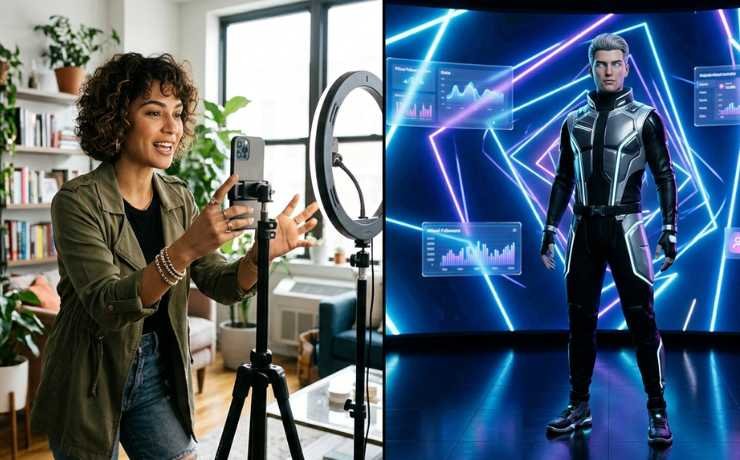
A creator in Mumbai films a single ten-minute take, feeds it into a generator, and by evening has a digital double that can speak Tamil, Telugu and Bengali without ever having learned a word of any of them. A few kilometres away, a brand manager scrolls through a catalogue of faces that have never existed, picking one for a festive campaign because it never asks for a fee revision, never gets tagged in a controversy, and never sleeps. Both scenes are happening right now, and they are really the same story told from opposite ends.
The rise of AI avatar creators — tools that generate photorealistic, fully animated digital humans from a few photos or a short video clip — has quietly become one of the more consequential shifts in influencer marketing this year. Platforms such as Synthesia, HeyGen, Captions and a growing cluster of India-built tools have moved avatar generation from a novelty into something marketers reach for on a Tuesday afternoon when a campaign needs to ship faster than a human shoot allows. For an industry that has spent the better part of a decade building its economics around the labour, likeness and trust of real people, that is not a small disruption.
The tension is best understood as two forces pulling in opposite directions at once. On one side, AI avatars are eating into the territory that human influencers used to own outright — localisation, volume content, brand-safe spokespeople, and the simple economics of producing more for less. On the other, the same tools are handing creators a way to multiply themselves, license their likeness while they sleep, and build a defensible commercial moat around a face and voice that used to disappear the moment the camera stopped rolling. Threat and opportunity are not sitting in separate corners of this story. They are sitting in the same line of code.
The economics that made avatars inevitable
To understand why brands have warmed to synthetic talent so quickly, it helps to look at what a real influencer campaign actually costs once everything is added up. A mid-tier creator shoot involves fees, travel, a content calendar, usage rights negotiations, reshoots when the product changes, and — increasingly — a contractual clause about what the creator can and cannot say about competitors. None of that disappears with AI avatars, but most of it shrinks dramatically. A digital spokesperson can be re-recorded in nineteen languages from the same script in an afternoon. It can be made to hold a product that did not exist when the original footage was shot, simply by regenerating the scene. It does not require a second round of approvals because its opinions never drift from the brand’s.
For categories that depend on constant content refresh — quick commerce, fintech explainer videos, regional FMCG campaigns that need a dozen language variants — this is not a marginal efficiency gain. It restructures the cost base of an entire content function. Several Indian D2C brands have already begun using avatar tools for onboarding videos, app walkthroughs and festive promotional content where a recognisable human face adds little beyond familiarity, and familiarity is exactly what a well-trained avatar can manufacture at scale.
Where the threat actually bites
It would be inaccurate to say AI avatars are coming for the influencer economy in some sweeping, undifferentiated way. The threat is concentrated, and it is worth being specific about where. The first and most obvious pressure point is the bottom and middle of the creator pyramid — the tier of influencers who built a following not on a singular, irreplaceable personality but on consistent, formulaic content: product unboxings, recipe reels, basic tutorial formats. This is precisely the kind of content an avatar can replicate convincingly, because the value was never really about the person; it was about the predictable format they delivered reliably.
The second pressure point is licensing leverage. Brands that once needed to renegotiate with a creator every time they wanted to repurpose content for a new market or platform can now, in some cases, license a digital double once and generate near-infinite variations without returning to the negotiating table. This shifts bargaining power away from the individual and toward whoever holds the rights to the underlying model — which is not always the creator themselves, depending on how the original contract was written. Industry watchers have flagged this as a quietly significant gap in how creator contracts are currently structured in India, where likeness and AI-replication rights are often bundled into vague “all rights” clauses that predate the technology being used against them.
The third, more unsettling pressure point is impersonation and unauthorised likeness use, which has already produced real casualties. Avatar and voice-cloning tools have been used to put words in creators’ mouths that they never said, including fabricated product endorsements that circulated before the original person even knew their likeness had been used. For an industry built on the premise that an influencer’s word carries personal credibility, this is a direct attack on the asset itself — trust — rather than merely the labour around it.
Where the same technology becomes a creator’s leverage
The flip side of this story is less discussed but arguably more interesting for anyone trying to predict where the creator economy goes next. The same avatar technology that threatens to commoditise influencer content is also giving established creators tools to scale themselves in ways that were previously impossible without a production team and a much larger budget.
Consider localisation. A creator with a strong following in Hindi-speaking markets has historically had no efficient way to reach Tamil or Kannada audiences without either learning the language or hiring a local proxy who dilutes the brand’s personal connection with the audience. Avatar and voice-cloning tools collapse that barrier. The creator’s own face and voice, regenerated in a regional language, lets them genuinely expand their addressable market while remaining, in a meaningful sense, still themselves. Several Indian creators with strong YouTube and Instagram followings have begun experimenting with exactly this — multilingual versions of the same video, recorded once and regenerated many times, rather than reshot.
There is also a licensing opportunity that flows in the creator’s favour rather than the brand’s, provided the contracts are written correctly. A creator can, in principle, license a controlled, brand-safe avatar of themselves for use in contexts they would never personally have time to show up for — a customer service chatbot, a product explainer video, a regional ad variant — while collecting a fee for each use without spending a single additional hour on set. This converts what used to be a purely time-bound business (a creator can only physically be in one place producing one piece of content at a time) into something closer to a royalty business. For creators with strong personal brands but limited production bandwidth, that is a genuinely new revenue line, not just an efficiency tweak.
And then there is the defensive use case: creators who proactively register, watermark or trademark their own AI likeness specifically so that no one else can train a model on their face without consent. A handful of larger creators and talent management agencies have started treating “digital likeness rights” as a standard clause in new contracts, mirroring conversations that have been happening in Hollywood since the 2023 SAG-AFTRA negotiations over AI replicas. The logic is straightforward: if avatars of you are going to exist regardless, the only real choice is whether you control the terms of their existence or someone else does.
What this means for brands and agencies right now
For agencies and brand teams reading this less as a philosophical question and more as a near-term operational one, a few practical shifts are already visible. First, disclosure expectations are tightening. Platforms and, increasingly, regulators in several markets are moving toward requiring clear labelling when content features a synthetic avatar rather than the genuine, unscripted appearance of a human creator — a distinction that matters enormously for trust-dependent categories like health, finance and parenting content. Agencies that have not yet built avatar-disclosure language into their campaign briefs are likely to find themselves retrofitting it under pressure rather than designing it in from the start.
Second, contract language needs an urgent refresh. Any agreement with a creator that does not explicitly address whether, how and for how long an AI-generated likeness of that creator can be used is a contract written for a world that no longer exists. This cuts both ways — brands need clarity on what they are licensing, and creators need clarity on what they are giving away, because “exclusive usage rights” written in 2022 was never drafted with avatar regeneration in mind.
Third, the calculus for choosing between a human creator and a synthetic one is shifting from a pure cost question to a trust-and-context question. For high-volume, low-stakes content — app tutorials, FAQ videos, regional product explainers — the efficiency case for avatars is becoming difficult to argue against. For anything where the audience’s emotional connection to a specific, known person is the entire point — a beauty creator’s skincare journey, a fitness influencer’s personal transformation story, a finance creator building credibility through perceived authenticity — synthetic substitution risks destroying the very thing the campaign was trying to borrow.
The road ahead
It is tempting to frame this as a binary contest — humans versus avatars, authenticity versus efficiency — but the more accurate read is that the influencer economy is bifurcating rather than being replaced wholesale. A layer of high-volume, utility-driven content is migrating toward synthetic talent because there was never much personal value being purchased there in the first place. Meanwhile, a smaller layer of creators with genuine, hard-to-replicate personal connection to their audience is finding that the same tools, used on their own terms, let them scale that connection further than manual production ever allowed.
The creators and agencies who come out ahead in this shift are unlikely to be the ones who treat AI avatars as either a pure threat to be resisted or a pure cost-saving hack to be exploited without limits. They will be the ones who move early to define ownership, disclosure and consent on their own terms — because in an industry where trust is the actual product being sold, the question was never really whether avatars would arrive. It is who gets to decide what they are allowed to say.
