













OEM vs OTT: The Battle for CTV Inventory in the Indian Market

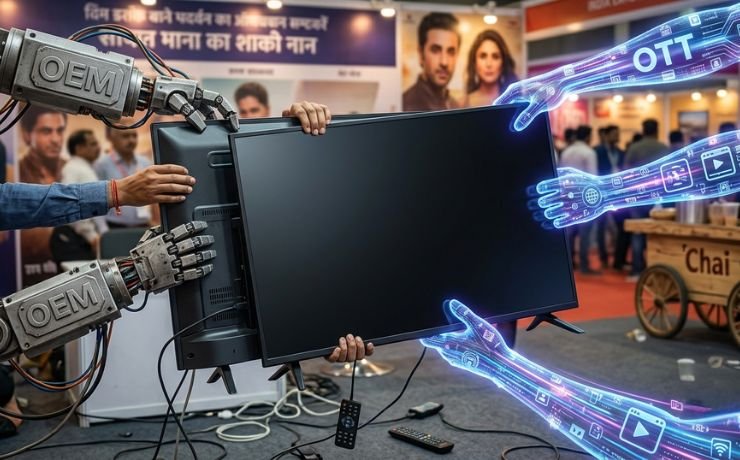
Somewhere between the moment a viewer picks up the remote and the moment the show actually starts, a quiet war is being fought over their attention. It isn’t between two streaming apps competing for a subscription. It is between the television itself and the software running inside it. In India’s connected TV ecosystem, smart TV manufacturers and streaming platforms are no longer just business partners sharing the same screen. They are increasingly rivals, each trying to claim the same inventory, the same viewer, and the same advertising rupee.
Two Owners, One Screen
Every connected TV impression in India passes through two distinct layers of ownership. The first is the device layer, controlled by original equipment manufacturers such as Samsung, LG, Xiaomi, TCL and the dozens of budget brands running Android TV or Google TV. This layer owns the home screen, the app launcher, the recommendation rail, and increasingly, ad slots that appear before a viewer has even opened an app. The second is the application layer, controlled by streaming platforms such as JioHotstar, YouTube, Zee5, SonyLIV and MX Player. This layer owns the in-content inventory: the pre-rolls, mid-rolls and pause screens that appear once a viewer has committed to a piece of content.
For years, these two layers coexisted without much friction. The OEM sold the hardware, the OTT platform sold the content and the ads within it, and nobody thought too hard about who owned the moments in between. That truce is unwinding. As smart TV margins shrink under intense price competition, hardware makers are treating advertising as a way to monetise a device long after the point of sale. A television that once generated revenue only once, at checkout, can now generate revenue every time its home screen is lit up.
Why OEMs Are Pushing Into Advertising
The economics are straightforward. Hardware manufacturing is a low-margin, high-volume business squeezed further every year by component costs and brutal price wars among Android TV OEMs. Advertising, by contrast, is a high-margin layer that requires no additional manufacturing cost once the software is built. A home screen banner, a sponsored tile in the app carousel, or a masthead placement ahead of content discovery costs the OEM nothing to produce repeatedly, unlike a physical television that must be built, shipped and sold at increasingly thin markups.
This has pushed platforms like Samsung’s Tizen and LG’s webOS to build out dedicated ad businesses, complete with automatic content recognition capabilities that let them see what is playing on a screen regardless of source, whether that is a streaming app, a set-top box or even linear cable. This data is a genuine differentiator. It gives OEMs a viewing signal that most app-only platforms simply do not have access to, since they can only see what happens inside their own walls.
India’s market complicates this picture in an interesting way. Android TV, licensed by Google to budget-friendly manufacturers, dominates the country’s smart TV base thanks to affordable entry-level sets bundled with the Play Store and pre-installed YouTube. This gives Google, rather than the hardware brand itself, significant reach and a first-party data layer across a large share of Indian living rooms. Samsung and LG, with their premium ACR-capable operating systems, hold a smaller but more monetisable slice of the market, since their audiences skew toward higher-income households and their homescreen advertising commands a premium.
Why OTT Platforms Are Not Giving Ground
Streaming platforms have no intention of ceding this territory. In-content inventory remains the most valuable real estate in Indian CTV advertising, and nothing illustrates this better than the numbers from marquee live sport. During the early matches of the IPL in 2026, JioHotstar alone accounted for the largest share of connected TV ad volumes by a wide margin, comfortably ahead of every other advertiser and platform combined. Live sport draws audiences who watch with sustained attention, cannot skip, and arrive already primed for a big-screen viewing occasion, which is precisely the environment advertisers pay a premium to reach.
OTT platforms also argue, correctly, that context matters more than device-level reach. A pre-roll that runs during a cricket match or a prestige drama carries brand safety, genre relevance and completion rates that a generic home screen banner cannot replicate. Advertisers targeting specific audience segments, whether by content genre, region or language, need the granularity that only an app with first-party viewing behaviour can offer. This is why platforms like JioHotstar, Zee5 and SonyLIV continue to sell a meaningful share of their inventory directly, bypassing the OEM layer entirely and building relationships straight with brands and agencies.
The Fragmentation Problem
The result of this tug-of-war is a fractured inventory landscape that is uniquely difficult to plan and buy against. A single Indian household might own an Android TV set that runs YouTube natively, a JioHotstar app layered on top, and a Chromecast dongle attached to an older television. Each of these surfaces sits inside a different auction, follows different frequency capping rules, and reports performance using different metrics. A media planner trying to build a unified reach and frequency model across OEM and OTT inventory in India is, in practice, stitching together several incompatible data sets by hand.
Industry standards bodies have tried to bring order to this chaos through frameworks like ads.txt and sellers.json, which at least make clear who is authorised to sell a given impression. But transparency around who can sell inventory is not the same as transparency around who owns the viewer relationship, and that ownership question is exactly what is being contested. OEMs want to own the home screen moment because it happens before any app is opened and therefore before any streaming platform can claim the impression. OTT platforms want to own the in-content moment because that is where genuine engagement and completion actually occur.
What This Means for Indian Advertisers
India’s CTV ad spend has been compounding fast, with industry estimates placing annual CAGR near 45 percent and full-year spend climbing toward the ₹3,000 crore mark as smart TV households cross the 80 million mark. That growth is precisely why the OEM-versus-OTT tension matters commercially rather than just academically. Advertisers chasing this growth need to make an active choice about where their budgets sit, and increasingly they are choosing both, but for different jobs.
Data from recent IPL coverage showed a growing set of brands advertising exclusively on connected TV rather than linear television, spanning categories like automobiles, fintech, astrology services and quick-service restaurants. These are largely urban, digitally native categories that value the targeting precision CTV offers over the blunt reach of traditional broadcast. Meanwhile, mass-market categories with broader demographic targets continue to lean on linear TV’s scale, treating CTV as a complementary layer rather than a replacement.
For agencies and brand marketers navigating this landscape, the practical takeaway is that OEM and OTT inventory are not substitutes for one another, even though procurement teams sometimes treat them that way. Home screen and OEM-level inventory work best for top-of-funnel awareness pushes, where scale and repeated exposure matter more than context. In-content OTT inventory works best for consideration and performance objectives, where genre relevance, completion rates and brand safety carry more weight. Buying only one layer means leaving a meaningful part of the connected TV opportunity on the table.
Who Wins the Battle
Neither side is likely to win outright, and that may be the most useful way to think about where this is heading. OEMs will keep expanding their advertising businesses because the underlying hardware economics leave them little choice. OTT platforms will keep defending in-content inventory because it remains the most differentiated, highest-performing asset they own. What is more likely to emerge is a layered market where advertisers deliberately buy across both surfaces, using OEM inventory for reach and OTT inventory for engagement, stitched together imperfectly by measurement partners until the industry eventually agrees on shared standards.
Until that happens, the battle for CTV inventory in India will keep playing out one home screen and one pre-roll at a time, with advertisers left to build their own bridges across a market that has yet to build one for them.
