










DSP vs Direct: How Indian Media Planners Are Rethinking Programmatic Buying

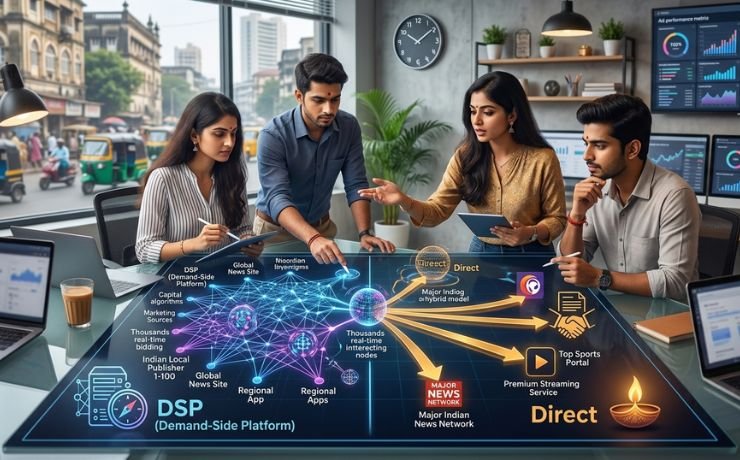
A decade ago, a media planner’s biggest decision was which publisher to call first. Today, that same planner opens a dashboard, sets an audience segment, and watches a DSP place millions of impressions before the coffee gets cold. Somewhere in between those two worlds, Indian media planning quietly rebuilt itself, and the old direct-versus-programmatic debate hasn’t caught up. Direct deals once meant picking up the phone, negotiating with a publisher’s sales team, and locking in guaranteed placements at a fixed rate. Programmatic meant handing targeting logic to an algorithm and letting real-time auctions do the work. For a long time, Indian planners treated these as separate budget lines with separate purposes. That separation is dissolving, and the reasons why say a lot about where programmatic buying in India is actually headed in 2026.
The Old Divide
The traditional case for each approach was straightforward. Direct buying offered certainty: a known publisher, a known placement, and a known price locked into an insertion order before a single impression served. It also carried brand safety guarantees that were hard to replicate elsewhere, since a negotiated placement in a specific section of a specific publication meant knowing exactly where an ad would appear. What direct buying lacked was scale and targeting precision. A media planner buying directly from a handful of premium publishers could not easily reach a data-defined audience segment wherever that audience happened to be browsing.
DSPs solved that problem by replacing publisher-by-publisher negotiation with automated, audience-first buying. Instead of purchasing a placement on a specific site, a planner using a DSP purchases access to an audience segment across thousands of potential placements simultaneously, with the platform’s real-time bidding engine competing for each impression as it becomes available. This gave Indian planners the ability to run campaigns across the open web and connected TV inventory at a scale direct relationships could never match, with granular targeting layered on top using first-party and third-party data signals.
Why the Line Is Blurring
What has changed is the emergence of formats that borrow strengths from both worlds. Programmatic guaranteed deals let a planner negotiate directly with a publisher on price and inventory reservation, exactly as they would in a traditional direct buy, while still executing delivery through a DSP. Private marketplace deals sit somewhere similar, offering curated access to premium inventory at negotiated floor prices without the unpredictability of the open auction. For Indian planners, this middle ground has become the default rather than the exception, because it captures the placement certainty that direct buying always offered alongside the reporting and optimisation tools that only a DSP provides.
This shift matters because it changes what a media plan actually looks like on paper. Rather than a binary split between a direct line item and a programmatic line item, agencies increasingly build layered plans: open auction programmatic for scalable reach, private marketplace deals for clean, brand-safe inventory, and a shrinking pool of pure direct deals reserved for genuinely irreplaceable placements, such as category exclusivity on a major publisher or a sponsorship integration that requires an editorial relationship no algorithm can negotiate.
The Cost Conversation Indian Planners Are Having
Part of what is pushing this rethink is a more honest conversation about what programmatic actually costs once every layer is accounted for. In the Indian market, programmatic display pricing typically runs on a two-layer model: a media cost paid to publishers through the DSP, and a service cost charged by the agency or trading desk managing the campaign. Media CPMs vary widely depending on inventory quality and targeting precision, and on top of that sits a DSP platform licence fee that is frequently bundled into agency service charges without being broken out clearly.
This lack of transparency has made supply path optimisation a genuine planning discipline rather than a technical afterthought. Indian media planners are increasingly asking how many intermediaries sit between their budget and the actual publisher, because every additional layer in the supply chain, whether it is a reseller, a verification vendor, or a secondary exchange, takes a cut before an impression ever gets served. A planner who once evaluated a DSP purely on its targeting capability now also evaluates it on how transparent its fee structure is and how short its path to the actual publisher runs.
Where Direct Still Wins
Despite the growth of programmatic infrastructure, direct buying has not become obsolete, and Indian planners are increasingly precise about when it is still the right call. Category exclusivity remains one clear case. If a brand wants to be the only telecom advertiser in a publisher’s technology vertical for a quarter, that kind of guarantee requires a negotiated relationship that an open auction simply cannot replicate. Premium editorial adjacency is another. A sponsorship integration with a well-known digital publication, a presenting slot on a popular newsletter, or a branded segment within a respected show requires a human relationship with an editorial or content team, not a bidding algorithm.
Brand safety sensitivity is a third factor that continues to favour direct deals for certain categories. In open exchange programmatic, even with blocklists and verification partners in place, there is always some residual risk of an ad appearing next to content that conflicts with a brand’s positioning. For categories like finance, pharmaceuticals, or children’s products, where reputational risk carries a higher cost than the efficiency gained from programmatic scale, many Indian planners still prefer the certainty of a direct relationship, even if it costs more per impression.
Where DSPs Are Winning the Argument
On measurement and speed, however, the case for programmatic has become difficult to argue against. A DSP delivers real-time impression, click, view, and conversion data continuously throughout a campaign, allowing a planner to shift budget mid-flight toward whatever is actually performing. Direct buys, by contrast, often still rely on post-campaign reporting from the publisher’s own ad operations team, with far less granularity and far less opportunity to course-correct while a campaign is live. For performance-driven categories especially, this real-time feedback loop has become close to non-negotiable.
Scale is the other clear advantage. A single DSP seat can access billions of daily impressions across the open web, connected TV, and mobile app inventory in one interface, something that would require managing dozens of separate publisher relationships to replicate through direct buying alone. For Indian planners running multi-market or multi-audience campaigns, particularly those layering in emerging formats like connected TV and programmatic digital out-of-home, the operational burden of scaling through direct relationships simply does not compare to what a well-managed DSP account can deliver.
The Planner’s New Job
What all of this means in practice is that the skillset expected of an Indian media planner has shifted. The job is no longer choosing between direct and programmatic as competing philosophies, but architecting a blended plan where each buying method is assigned to the objective it serves best. Reach and scale go through open auction programmatic. Brand-safe, premium environments go through private marketplace deals. Guaranteed placements and category exclusivity go through direct negotiation or programmatic guaranteed structures. Retargeting and performance-driven acquisition run through self-serve DSP execution with tight, continuous optimisation.
This also means agencies are increasingly expected to justify their fee structures with the same scrutiny they apply to media performance. Clients want to know exactly how much of their budget is media cost, how much is DSP licensing, and how much is agency margin, laid out separately rather than bundled into a single opaque percentage. Planners who can answer that question clearly, and who can explain why a particular placement sits in a direct deal rather than an open auction, are building more durable client relationships than those relying on the old assumption that programmatic is simply the modern replacement for direct buying.
The Road Ahead
As AI-driven optimisation becomes more embedded in DSP workflows, the operational side of media buying will likely continue shifting from manual execution toward strategic oversight, with planners spending less time trafficking campaigns and more time defining objectives and evaluating automated recommendations. But that shift only reinforces the core lesson Indian planners have already absorbed: DSP versus direct was never really the right question. The right question is which combination of both delivers the placement, the price transparency, and the measurement a specific campaign actually needs, and Indian media planning in 2026 is being rebuilt around answering that question deal by deal, rather than channel by channel.
