














How D2C Brands Like Boat and Mamaearth Turned Creator Loops Into Repeatable Growth Engines

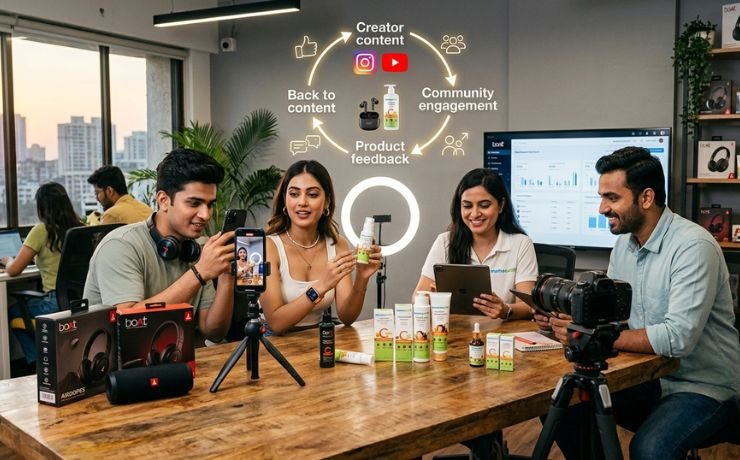
There was a time when a brand’s biggest campaign moment was a single television commercial, aired once, hoping to land. That era is long gone for India’s most aggressive D2C players. Today, the biggest campaign moment is not a moment at all — it is a loop. A creator posts, a customer buys, the customer becomes a reviewer, the review becomes an ad, and the ad finds the next creator. Two Indian brands have run this loop longer and harder than almost anyone else in the country: boAt and Mamaearth. Neither built its empire on a single viral hit. Both built it on repetition, engineered until it looked effortless.
What makes their stories worth studying in 2026 is not that they used influencers — every brand does that now. It’s that they turned influencer marketing into infrastructure. A system that runs, refines itself, and compounds, rather than a campaign that ends when the budget does.
The Loop, Explained
Strip away the branding and the mechanic is almost embarrassingly simple. It looks something like this:
1. Seed — the brand sends product to a wide base of micro and mid-tier creators, not just a handful of celebrities.
2. Surface — the strongest organic reactions get identified and amplified with paid spend behind the creator’s own handle.
3. Repurpose — the best-performing creator content is pulled into the brand’s own paid funnel as user-generated-style ads.
4. Recur — instead of a one-off collaboration, the same creators are brought back for the next launch, building recall over months, not days.
5. Repeat — the data from what worked feeds directly into who gets seeded next.
Neither boAt nor Mamaearth invented any single step in this chain. What set them apart was refusing to treat any one of these steps as optional, and refusing to stop after one cycle.
boAt: Turning Product Reviews Into a Distribution Channel
boAt’s rise in India’s crowded audio and wearables market was never going to be won on spec sheets alone — the category is too commoditised, and the price wars too brutal. What the brand understood early was that a Bluetooth earphone is not really sold through a 30-second ad; it’s sold through someone you trust holding it up to the camera and saying, unprompted, that the bass actually slaps.
So boAt built its growth engine around technology YouTubers and lifestyle creators, favouring detailed, honest product reviews over polished brand films. Crucially, the brand leaned on micro and macro creators rather than a small circle of A-list celebrities, spreading its bets across creators with smaller but hyper-engaged audiences. And it rarely treated any single collaboration as a one-time transaction — the same reviewers reappear launch after launch, which does something subtler than reach: it builds familiarity. An audience that has watched one creator unbox five successive boAt products starts to trust the brand by proxy, the way you’d trust a friend’s recurring recommendation over a stranger’s one-time praise.
The other quiet weapon in boAt’s playbook is whitelisting — running paid ads through a creator’s own handle rather than the brand’s. It’s a small technical choice with an outsized psychological effect: the ad shows up looking like a creator’s post, not a brand’s interruption, and it inherits all of that creator’s built-up credibility along the way.
Mamaearth: Trust, Built One Mom Blogger at a Time
If boAt’s loop runs on repetition and familiarity, Mamaearth’s runs on something harder to manufacture: trust in a category where trust is everything. Skincare and baby care are purchases people research obsessively, worry over, and rarely buy on impulse. Founders Ghazal and Varun Alagh built the brand out of their own anxiety as new parents unable to find toxin-free products they trusted — and that founding story became the seed of a marketing strategy built almost entirely on word-of-mouth, engineered at scale.
Rather than chasing a handful of top-tier influencers, Mamaearth went wide first: reportedly partnering with more than 500 mom bloggers across platforms to build credibility within a specific, high-intent community before ever spending big on mass awareness. Beauty creators and parenting influencers on Instagram and YouTube were used to walk audiences through actual skincare routines and product demonstrations, turning what could have been a sterile product launch into something that looked like a recommendation from a friend. Only once that grassroots layer of trust existed did the brand layer in mainstream reach, with actor and investor Shilpa Shetty becoming both shareholder and product ambassador — a celebrity endorsement built on top of an already-credible foundation, rather than a substitute for one.
Mamaearth’s loop had a second engine too: purpose-driven campaigns designed to be shared rather than merely watched. Its #PlantGoodness initiative, which planted a tree for every purchase and sent customers a geotagged photo of their tree, turned a transactional purchase into something customers wanted to post about unprompted. #BeautifulInMyOwnSkin did something similar for body positivity, giving the brand a message worth amplifying that had nothing to do with the product itself. Both campaigns functioned as creator-content generators in disguise — content people made because they wanted to, not because they were paid to.
The Real Difference: Recurrence Over Reach
It’s tempting to read both stories as “brand uses influencers, brand grows” — but that misses the actual mechanism. Countless Indian D2C brands have run influencer campaigns and seen a short-term spike followed by nothing. What boAt and Mamaearth did differently was refuse to let any collaboration be a one-time event.
Indian brands like boAt and Mamaearth increasingly favour recurring creator partnerships specifically because recall compounds. A single sponsored post is a transaction. Ten sponsored posts from the same creator over a year, each timed to a different launch or campaign moment, start to feel like a relationship — one the audience is watching unfold, whether they meant to or not. That repetition is what turns influencer marketing from a media line item into a genuine growth engine: it is cheaper per unit of trust built than constantly acquiring new creators from scratch, and it produces a content library the brand can keep repurposing across paid, organic and even offline channels.
What This Means for Brands Building Their Own Loop
For any Indian D2C brand trying to replicate this, the temptation is to skip straight to step three — the polished, repurposed ad — without doing the unglamorous work of steps one and two: seeding widely, and being patient enough to let the strongest organic reactions surface before spending behind them. boAt and Mamaearth both resisted that shortcut. They treated the loop as a system to be run continuously, not a campaign to be launched and archived.
The brands winning India’s creator economy in 2026 are not necessarily the ones with the biggest budgets or the most famous faces attached. They are the ones that figured out, early, that a single creator collaboration is marketing — but a hundred recurring ones, feeding data back into who gets picked next, is an engine. Building that engine takes longer than booking a celebrity for a quarter. But once it’s running, it doesn’t need a launch date to keep working.
