














Shoppable CTV Is Here — Is Anyone in India Actually Buying From Their TV Yet?

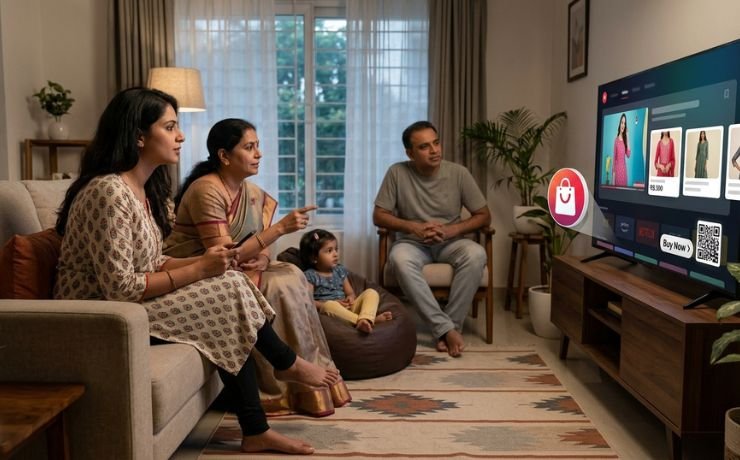
Picture the living room. The IPL final is on, the volume is up, and a QR code flashes across the bottom third of the screen during a timeout. Somewhere in that house, does a remote control just become a shopping cart? Not quite. What actually happens, nine times out of ten, is a phone comes out of a pocket, a code gets scanned, and the purchase — if it happens at all — finishes on a five-inch screen thirty seconds later, nowhere near the television that started it. The TV lit the match. It didn’t strike the deal.
That small, unglamorous detail is the whole story of shoppable CTV in India right now. Every platform pitch deck in 2026 carries the word like a badge of honour — QR overlays, pause-screen carousels, remote-activated carts — and none of it is vapourware. The formats exist, the reach is staggering, the engineering works. What nobody has quite proven is that the living room itself has become a point of sale. The channel is real. The “shop” part is still, mostly, borrowed from somewhere else.
1. The formats: dressed up for shopping, built for a handoff
Strip the marketing gloss off shoppable CTV and you’re left with a handful of formats Indian platforms have shipped in the last eighteen months, each cleverer than the last, and each quietly designed to end somewhere other than the TV. Pause ads slide in the moment a viewer hits stop — and because Indian audiences pause four to five times a day on average, JioHotstar has built an entire ad tier around that fleeting, captive second, with advertisers like Mondelez and Saffola reporting double-digit brand lift from creative that most viewers barely register as an ad. QR-overlay ads turn the phone into the real interface, a trick Kia leaned on during its IPL run to drive test-drive bookings rather than screen-side purchases. Shoppable carousels, now live inside JioHotstar’s ad manager, let a brand parade a row of products across the screen for what the platform diplomatically calls “product discovery” — window shopping, essentially, with a great view. And the newest arrival, “send to phone,” pioneered abroad on Amazon’s Prime Video inventory, skips the pretence entirely: it just fires a product link straight to a viewer’s mobile number and lets the smaller screen do what it’s always done better.
Line these formats up and a pattern snaps into focus. Almost none of them expect money to change hands on the television itself. The big screen is the stage; the phone is where the actual transaction quietly happens backstage. That isn’t a flaw platforms are trying to hide — it has become the whole design philosophy, hiding in plain sight behind the word “shoppable.”
2. The scale is not the question mark anymore
Whatever doubts linger about the “shoppable” half of the story, nobody is doubting the “CTV” half. India’s Connected TV households are on track to cross 60 million by the end of 2026, with ad spend projected between Rs 2,300 and Rs 2,500 crore — some forecasts now stretching toward Rs 3,000 crore. Sub-Rs-15,000 Android TVs have quietly dragged the category out of premium South Mumbai living rooms and into Tier 2 and Tier 3 India at a speed almost nobody modelled three years ago. Then came the tectonic move: the February 2025 merger of Disney+ Hotstar and JioCinema into JioHotstar, stitching together a platform with a reported 500 million-plus monthly users and a trophy cabinet of exclusive rights spanning the IPL, ICC tournaments, the ISL and the Premier League. It is, without much competition, the single largest pool of premium video inventory ever assembled under one Indian ad-sales roof.
That scale isn’t just a vanity metric — it’s the oxygen shoppable formats need to mean anything. A pause-ad test running against a few million impressions produces a shrug and a maybe. The same test running against JioHotstar’s combined base during an IPL final produces an actual signal, fast. Which is exactly why nearly every credible shoppable CTV success story coming out of India right now is tethered to a marquee sporting event, not a quiet Tuesday-night rerun.
3. So — is anyone actually buying?
Here’s where the story gets refreshingly honest. Globally, agencies tracking interactive and shoppable CTV spend place it at roughly 10 to 15 percent of a client’s total CTV budget, and some of the more aggressive buyers have scaled that share from 10 percent to 30 percent of partner spend within a single year. Those numbers describe conviction and appetite. What they do not describe is proof. A published, India-specific case study that says, plainly, “this many rupees of revenue traced directly back to a remote-based CTV transaction, fully attributed, zero hand-waving” — that document is still remarkably hard to find.
The gap is structural, not a failure of ambition. CTV measurement in India is sprinting to catch up with the formats it’s being asked to measure. Cross-device attribution — connecting a CTV ad exposure to a purchase that lands on a phone ten minutes later — needs identity-resolution plumbing that most brands and agencies simply haven’t finished laying. A viewer bouncing between JioHotstar on the smart TV and JioHotstar on the phone is, technically, two separate devices unless a platform has quietly stitched that identity together behind the scenes. Without that stitch, the honest answer to “did the shoppable ad actually work” is usually “we believe so, based on a lift study” — not “here’s the receipt.”
What the data does show, unambiguously, is a household habit: the phone never leaves reach. Indian CTV viewers watch with one eye on the big screen and one hand hovering near the small one, and nearly every recent shoppable innovation has been engineered around that habit rather than against it. QR codes exist because the phone is already there. Send-to-phone exists because platforms finally stopped pretending the sale was ever going to close through a D-pad. Call it what it really is: not a single-screen purchase journey, but a beautifully choreographed handoff from the big screen to the small one.
4. Why platforms are racing to build it anyway
If provable, attributable sales are still the exception, why is every platform sprinting toward shoppable formats regardless? Three reasons, and none of them require a completed transaction to justify the investment. First, interactivity simply wins on engagement — QR-overlay ads generate roughly 71 extra seconds of attention compared to a standard pre-roll spot, and in an economy where attention is the currency, that number pays its own way, sale or no sale. Second, shoppable formats have become the wedge platforms use to open premium video to advertisers who never had a TV budget before — Amazon’s location-based interactive formats abroad are explicitly pitched as a door-opener for local and regional businesses. Third, and most nakedly, every platform in India’s newly consolidated CTV landscape needs a growth story bigger than raw reach, because reach alone stopped being a differentiator the moment JioHotstar swallowed most of the premium inventory in the country. “Shoppable” is the fastest way to tell an advertiser that a CTV buy isn’t just an awareness spend — even while the industry is still working out, quietly and in the background, how to prove that in a spreadsheet.
5. What the rest of the world already learned
It helps to glance at markets a few years further down this road. In the US, Roku leans on QR overlays synced to user data, Amazon’s Freevee closes the loop inside its own commerce backbone so a purchase never has to leave the ecosystem, and Disney uses AI to decide exactly when an interactive prompt should surface so it reads as a moment, not an interruption. Netflix and Hulu go a step further, letting an algorithm shift the timing of an overlay to match the emotional beat of a scene. None of it arrived overnight — it took several advertising cycles before agencies trusted the format enough to move serious budget, and even today, in a far more mature market, interactive formats still claim a low-double-digit slice of CTV spend, not a majority.
India’s advantage is that it doesn’t have to relearn all of this the hard way. Platforms here can lift the format playbook wholesale — the pause moment, the QR handoff, the local-advertiser wedge — while building the measurement layer with the benefit of hindsight rather than trial and error. The disadvantage is that India’s identity-resolution puzzle is, if anything, more tangled than America’s, given the sheer sprawl of devices, operating systems and app ecosystems a single household might touch in one week. That complexity is precisely why the cautious, phone-handoff version of shoppable CTV has taken root here, rather than the more ambitious single-screen checkout experiments some platforms abroad have occasionally flirted with.
What this actually means for Indian brands
The sensible posture for a marketer weighing shoppable CTV in 2026 is neither starry-eyed nor dismissive. Treat it as an engagement and consideration tool first, and a direct-response channel a distant second — because that is genuinely what the current measurement infrastructure can support without brands lying to themselves in a quarterly review. Budget accordingly: a modest single-digit-to-low-teens slice of total CTV spend, tested against a big, attention-holding moment like a sports tentpole rather than an ordinary weeknight slot, where the sheer volume of eyeballs is large enough to produce a signal worth trusting. And design for the handoff on purpose. The shoppable creative earning its keep in India right now isn’t the one pretending the television is a checkout counter — it’s the one that treats the TV as the spark and the phone as the register, and builds the QR code, the send-to-phone link or the carousel around that reality instead of around the fantasy.
So no — shoppable CTV in India is not a myth. The formats are real, the platforms are investing with intent, and the engagement numbers hold up under scrutiny. But the honest translation of “shoppable” in the Indian context, for now, is “shoppable — on a different, smaller, more forgiving screen, a few seconds later.” Brands that build their plans around that nuance will get real value out of the format this year. The ones still waiting for someone to buy a mixer grinder with a remote control are going to have a long wait.
