












The AI Slop Problem: What a ₹38 Crore-a-Year AI Channel Says About the Future of “Content”

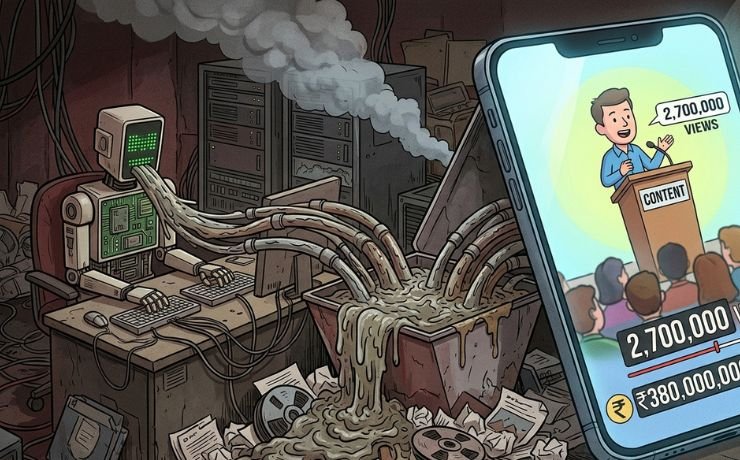
Somewhere on YouTube right now, a digitally rendered monkey is doing something absurd to a hyper-muscular, equally digital man, and roughly two billion views later, nobody involved has to explain why. There is no script to defend, no character arc to justify, no cultural nuance to translate. There is only motion, spectacle, and the algorithm’s approval — and, as it turns out, a business model generating an estimated ₹35–38 crore a year for its creators.
The channel is called Bandar Apna Dost. It is based in India. And according to a global study by video-editing platform Kapwing, which combed through 15,000 of the world’s most popular YouTube channels, it is now the single most-watched channel on the planet built entirely on AI-generated video. No live-action footage. No human performers. No writers’ room. Just a recurring cast of AI characters — most famously a monkey named Boltu Bandar and his oversized companion — dropped into looping, wordless, emotionally exaggerated scenarios that need no subtitles because they need no language at all.
The numbers are the kind that make marketers sit up mid-scroll. Bandar Apna Dost has crossed 2.07 billion views and more than 2.76 million subscribers, most of it accumulated within months rather than years. Kapwing’s broader study found 278 channels worldwide composed entirely of AI-generated content, together pulling in over 63 billion views and 221 million subscribers. Spain leads the pack on subscriber count, South Korea’s AI-slop channels have racked up 8.45 billion views between them, and a Spanish-language US channel, Cuentos Fascinantes, holds the highest individual subscriber tally in the category. But it is the Indian monkey who tops the global leaderboard on both reach and revenue — and that fact alone deserves more attention from this industry than a passing news cycle.
Because what Bandar Apna Dost represents isn’t really a story about one viral channel. It’s a stress test of everything the content and advertising business has assumed about what “good” content needs to do to win.
Slop, by design
The industry term for this genre — and it is now firmly a genre — is “AI slop.” It’s not a compliment. It describes content manufactured at volume, optimised purely for retention and click-through, with production values calibrated to satisfy an algorithm rather than an audience’s taste. There is no pretence of narrative ambition. A single operator using generative tools can produce dozens of videos in a day, at a fraction of the cost of even the leanest human production crew, and iterate relentlessly based on what the platform’s recommendation engine rewards.
Speaking to The Guardian, digital rights researcher Rohini Lakshane offered a fairly clean explanation for why this particular channel works as well as it does: the appeal lies in its absurd visuals and hyper-masculine, chaotic set-pieces, and crucially, in the total absence of a storyline. That absence isn’t a limitation — it’s the feature. A viewer in Manila, Madrid, or Manaus doesn’t need to understand Hindi or English to know what’s happening when a cartoon monkey gets flung across a room. The content isn’t culturally specific; it’s pre-verbal, almost primal, and that makes it infinitely more exportable than anything a human writers’ room would produce for a domestic audience.
This is uncomfortable for an industry that has spent the last decade preaching the gospel of storytelling, brand purpose, and authentic connection. Bandar Apna Dost tells no story, has no purpose beyond retention, and connects with nobody in any meaningful emotional sense — and yet it out-performs, on pure attention metrics, almost everything else being produced in the category. The recommendation algorithm, it turns out, doesn’t care about any of the things creative directors get paid to care about. It cares about completion rates and rewatch loops, and AI slop is engineered precisely for those.
What this means for brands and platforms
For advertisers, the immediate temptation is obvious: if a channel like this can command hundreds of millions of eyeballs at near-zero marginal production cost, why wouldn’t performance marketers want a slice of that inventory? The answer, for now, is a fairly standard set of brand-safety objections — low editorial accountability, no clear content moderation standard, and reputational risk in being associated with content explicitly branded “slop” by the platforms hosting it. But those objections have a shelf life. Programmatic buying has never been especially fussy about editorial pedigree when the CPMs are attractive and the completion rates are strong, and it would be naive to assume this inventory stays unmonetised by mainstream advertising for long.
The more interesting question is what this does to the economics of content commissioning more broadly. India’s creator economy has been one of the great growth stories of the last five years, built on the premise that authenticity and human connection are the moat that keeps creators relevant even as production tools get commoditised. That premise held reasonably well against AI influencers like Myntra’s Maya or the virtual persona Kyra, both of which found that Indian audiences — a market that rewards relationship-driven engagement more than most — were lukewarm about parasocial bonds with entities they knew weren’t real. Trust, in that context, remained a distinctly human currency.
Bandar Apna Dost sidesteps that entire debate by not attempting connection in the first place. It isn’t trying to be liked. It isn’t trying to be trusted. It is trying to be watched, for exactly as long as the algorithm can be persuaded to keep recommending it, and on that narrower, colder metric, it is winning decisively. That’s a different competitive threat than the AI-influencer wave the industry has been debating — and arguably a more dangerous one, because it doesn’t need audiences to believe in anything at all.
The platform’s dilemma
YouTube’s recommendation system was not built to distinguish craft from volume; it was built to maximise watch time, and it is agnostic about how that watch time is generated. That agnosticism is precisely what has allowed a channel with no dialogue, no plot, and no discernible creative intent to out-earn a large share of professionally produced Indian YouTube content. If the platform’s own algorithm is functionally rewarding low-effort, high-frequency AI output over considered, resource-intensive human production, every creator and studio optimising for that same algorithm faces a genuine strategic choice: compete on craft in a system that doesn’t particularly value craft, or compete on volume in a system that clearly does.
That dilemma will only sharpen as generative video tools continue to collapse production timelines and costs. What currently requires a five-person AI content operation to produce dozens of videos a day will, within a couple of product cycles, require considerably less. The barrier to entry for AI-slop-style channels is falling in real time, which means the 278 fully AI-generated channels identified in Kapwing’s study are almost certainly a floor, not a ceiling, for how this category will look twelve months from now.
Where this leaves “content” as a category
There is a temptation to dismiss all of this as a curiosity — a monkey meme that made some money, destined to be replaced by the next algorithmic quirk. That would be a mistake. What Bandar Apna Dost demonstrates, with uncomfortable clarity, is that the platform economics underpinning digital video no longer require any of the things the industry has traditionally treated as prerequisites for scale: cultural specificity, narrative coherence, human performance, or brand-building intent. Removing all four hasn’t just failed to sink the channel; it has made the channel the most-watched of its kind on the planet.
For agencies, publishers, and platforms built around the value of craft, that is the real headline buried under the ₹38-crore figure. The industry’s working assumption has long been that as AI lowers the cost of production, human differentiation — taste, storytelling, cultural fluency — becomes more valuable, not less, because it’s the one thing machines can’t replicate at scale. Bandar Apna Dost is a live counter-argument to that comfortable theory. It suggests that for a meaningful slice of the attention economy, machines don’t need to replicate human differentiation at all; they simply need to find the shortest possible path to a rewatch, and let the algorithm do the rest.
The uncomfortable possibility worth sitting with is not that AI slop will replace prestige content — it almost certainly won’t, and premium, considered storytelling will retain its own audience and its own monetisation logic. The more realistic possibility is that “content,” as a catch-all category, is quietly splitting into two entirely separate economies running on entirely separate rules: one built on craft, trust, and brand equity, competing for advertiser budgets the traditional way; and another built on volume, velocity, and algorithmic exploitation, competing for nothing but raw attention and largely indifferent to who — or what — is watching it come in. Bandar Apna Dost isn’t a glitch in that system. It’s a fairly accurate preview of how efficiently the second economy can now run without any human input at all.
