














The AI Personalisation Ceiling: How Far Can Hyper-Targeting Go Before It Creeps Out Indian Consumers?

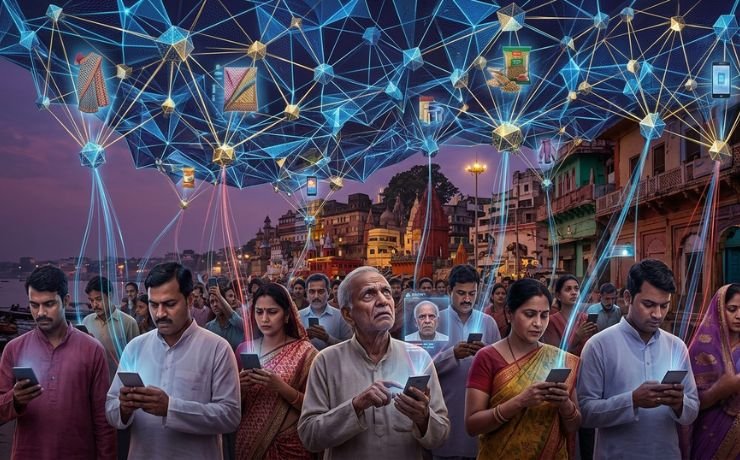
There is a particular kind of silence that follows a notification that knows too much. It isn’t the silence of being impressed. It’s the silence of doing the math — working out how a food delivery app guessed you’d want comfort food on the exact evening you’d had a bad day, or how a shopping app surfaced the product you’d only spoken about out loud, never typed, never searched. For a few seconds, the convenience and the unease sit in the same place. Then, increasingly, the unease wins.
For a decade, Indian marketing has chased personalisation as an unambiguous good — the holy grail that would finally let brands speak to millions of people as individuals instead of demographics. AI has delivered on that promise with a precision nobody quite anticipated. And now the industry is running headlong into a problem it didn’t budget for: personalisation has a ceiling, and a growing number of Indian consumers are telling brands, in surveys and in behaviour, exactly where it sits.
The numbers behind the unease
The discomfort isn’t anecdotal anymore; it’s showing up consistently in the data. Canva’s 2026 State of Marketing and AI report, conducted with the Harris Poll across seven markets including India, found that 58% of consumers do not want brands using AI to predict what they want before they’ve said so. More than half said it feels too personal when an ad appears to know what they’re about to buy before they’ve even searched for it, and an equal share said the same about ads that reference something they did entirely offline. Consumers weren’t rejecting AI outright — 68% said they don’t mind AI involvement in advertising when it genuinely makes the experience more useful or relevant. The objection isn’t to the technology. It’s to the sensation of being read.
Adobe’s 2026 AI and Digital Trends Report adds a sharper edge to this picture, and it’s particularly relevant here because India came out as the most enthusiastic market in Asia-Pacific for agentic AI — 60% of Indian consumers said they were interested in setting up a personal AI agent, and more than half said they’d be comfortable with a brand’s AI agent interacting with them directly. That’s a genuinely high appetite for AI-mediated experience. But the same report found that 61% of consumers would stop engaging with a brand altogether the moment they realised they’d been interacting with AI while expecting a human, and 76% said AI-driven interactions should still feel human rather than robotic. Put those two findings side by side and the shape of the ceiling becomes visible: Indian consumers want the outcomes AI can deliver, but they want the process to remain legible, and ideally, invisible in the wrong way rather than the right way.
Then there’s the Optimove Marketing Fatigue Report 2026, which found that 22% of consumers now describe personalisation outright as “creepy” — not intrusive, not annoying, but creepy, a word that signals something closer to violation than irritation. Academic research backs this up with more granularity. A recent qualitative study using NVivo analysis on Indian consumer interviews found that 63% of references to personalisation carried negative sentiment, clustering around themes the researchers labelled data misuse, loss of autonomy, perceived manipulation, and — again — creepiness. One respondent, a young service professional, described the now-familiar sensation of her phone appearing to “listen” and surface ads related to conversations she’d only had out loud. It’s a claim marketers have spent years denying on technical grounds. It doesn’t matter. The perception has outrun the explanation.
Why India is a distinct case
It would be a mistake to treat this as a universal, borderless phenomenon that happens to include India. The Indian market has specific characteristics that make the personalisation ceiling both higher in some respects and lower in others.
On one hand, India is demonstrably more receptive to AI-mediated commerce than most comparable markets. Sixty-five percent of Indian consumers already use AI to search for personalised product recommendations, 60% use it for customer service, and 62% say they’re open to shopping via a virtual AI concierge. This isn’t a market suspicious of AI in principle. Indian consumers have adopted AI-first interfaces — from UPI-linked recommendation engines to WhatsApp-based commerce — faster and more completely than many Western markets, largely because the convenience dividend has been so tangible.
On the other hand, India is not one audience but, as industry observers have noted, thousands of microcultures interacting simultaneously across languages, income bands, and platforms — which means personalisation done well here requires a level of contextual nuance that most brands simply haven’t built. A Gen Z consumer scrolling late at night in Bengaluru and a working mother browsing during her lunch break in Jaipur are, functionally, different audiences requiring different tact, not just different product recommendations. When AI systems flatten that nuance into generic “personalisation” — the same overfamiliar tone, the same faux-intimate copy, applied indiscriminately — the result doesn’t read as smart. It reads as surveillance wearing a friendly voice.
There is also a generational fault line worth noting. Research into AI-driven marketing in Indian cities has consistently found that younger consumers are more willing to trade data for relevance, while older users are quicker to describe the same experience as intrusive. That split matters enormously for category planning — a fintech app’s hyper-personalised nudge that lands as helpful for a 24-year-old might land as invasive for that same user’s parent, using the same product.
The transparency trap
Here is where the picture gets genuinely uncomfortable for marketers who assumed transparency was the fix. A widely cited experimental study on hyper-personalised newsletters found that when brands added a transparency disclosure — explicitly telling users their content had been adapted to their situational context — it didn’t reduce the perceived creepiness. It increased it. The disclosure didn’t reassure; it confirmed the surveillance the user had only suspected, converting ambient unease into confirmed fact. Click-through rates fell.
This finding should worry every brand currently treating “just be transparent about the AI” as a governance checkbox. Transparency without genuine value exchange doesn’t build trust — it just makes the mechanism visible. Consumers don’t want to be told how precisely they’re being modelled. They want the modelling to produce something that feels earned rather than extracted.
The Vogue Business AI survey underlines just how far execution still lags the ambition. Among global Vogue and GQ readers, only 1% found AI shopping recommendations entirely useful, fewer than a quarter said they trusted AI-curated recommendations at all, and just 3% relied on AI chatbots for style guidance. This is a category — fashion and lifestyle — where personalisation should, in theory, be a natural fit for AI’s pattern-matching strengths. Instead, the technology is producing outputs consumers rate as barely usable, while simultaneously making them feel watched. That is the worst possible combination: maximum creep, minimum payoff.
What brands are getting wrong — and right
The uncomfortable truth agencies are beginning to admit privately is that much of what passes for AI personalisation in India today is closer to automated noise than genuine understanding. Clients increasingly request “performance-friendly” creative optimised to fit algorithmic behaviour rather than to say something emotionally distinctive, and the effect compounds across a category: when every brand is hyper-targeted using the same handful of signals, nobody ends up feeling distinctive to anyone. Indian advertising built its reputation on cultural intuition and emotional sharpness. A market fully optimised for algorithmic nudges risks trading short-term click-through gains for long-term erosion of the brand memory structures that actually drive category growth.
The brands managing to stay on the right side of the ceiling share a common trait: they treat AI as an insight engine rather than a media-buying shortcut. Companies operating in ecommerce, fintech, and streaming have moved past simple click-based recommendation toward building genuinely predictive experiences around behaviour, mood, timing, and cultural context — using AI to understand a consumer’s situation rather than merely to retarget their last search. The distinction sounds subtle. Consumers experience it as the difference between a brand that remembers their name and one that remembers the relationship.
Where the ceiling actually sits
If there’s a single, usable finding buried in all this research, it’s this: Indian consumers are not rejecting personalisation, and they’re not rejecting AI. They are rejecting the specific sensation of being predicted rather than served — of a brand appearing to know their next move before they’ve made it, without ever having earned that knowledge through an exchange that felt fair. Relevance is welcome. Omniscience is not. The line between the two isn’t defined by how much data a brand holds; it’s defined by whether the consumer feels they consented to the inference, and whether the payoff justifies the intimacy.
That is a genuinely harder brief than “personalise more.” It asks brands to build restraint into systems explicitly engineered to remove restraint, and to treat the moment just before a nudge crosses from helpful to invasive as a design decision rather than a technical afterthought. The marketers who figure out where that line sits for their specific category, their specific audience, and their specific market will have found something more durable than a personalisation engine. They will have found the thing hyper-targeting was never supposed to replace in the first place — a customer’s trust that the brand actually has their interest, not just their data, in mind.
