












Athlete as Brand: What Virat Kohli’s and Hardik Pandya’s Portfolios Teach Marketers About Ownership Over Endorsement

For most of Indian cricket’s commercial history, the biggest decision an athlete made about his personal brand was which logo to put on his bat. Endorsement was the ceiling. A player signed with a shoe company, a watch brand, an insurance firm, collected a cheque, did the shoot, and moved on to the next season. The relationship was transactional by design — the brand rented the athlete’s face for a fixed period, and the athlete’s job was to look convincing wearing someone else’s product.
That model hasn’t disappeared, but it has stopped being the ambitious version of athlete monetisation. Look closely at what Virat Kohli and Hardik Pandya have actually been doing with their money over the last five years, and a different pattern emerges — one that has far more to say about where personal branding is headed than any celebrity endorsement deal currently on the market.
The Kohli recalibration
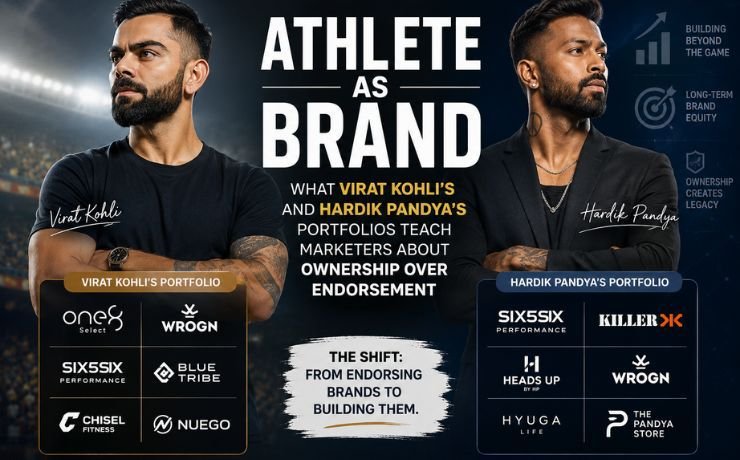
The clearest signal came in 2023, when Kohli turned down a reported ₹300 crore extension from Puma — a company he had been the face of for years — and instead redirected his energy toward Agilitas Sports, a homegrown, comparatively obscure sportswear venture founded by former Puma India managing director Abhishek Ganguly. Kohli didn’t just agree to endorse Agilitas. He invested roughly ₹40 crore of his own money into the company, picked up an equity stake reported at just under 1.5%, and folded his own lifestyle label, One8, into the venture as a co-founder rather than a licensed face.
That is a genuinely different transaction from anything Kohli had done with Puma. Under the old arrangement, One8 was a Kohli-fronted line manufactured and distributed by Puma — Kohli supplied the brand equity, Puma supplied the infrastructure, and the commercial upside flowed largely to the manufacturer. Under Agilitas, Kohli holds a direct financial stake in the company that now owns and builds One8. If the brand grows, appreciates in value, or eventually exits at a premium, Kohli’s return isn’t capped at whatever endorsement fee he negotiated for the year. It scales with the business itself.
This is not an isolated move. Kohli’s investment portfolio now spans well beyond fashion — stakes in Go Digit Insurance (which listed publicly in 2024 at a market capitalisation north of ₹31,000 crore, sharply increasing the value of an investment made years earlier for a few crore), Rage Coffee, Blue Tribe’s plant-based meat business, the fantasy and gaming platform MPL, and a 12% ownership stake in Indian Super League football club FC Goa. He has also moved into motorsport ownership through Team Blue Rising in electric powerboat racing. None of these are endorsement deals in the traditional sense — they are capital allocations, made by someone who has evidently decided that his most valuable long-term asset isn’t his match fee, but his judgment about which consumer businesses are worth backing.
The through-line across the portfolio is instructive for marketers watching from the outside: Kohli’s bets track closely with his own public identity — fitness, performance, wellness, plant-based nutrition, disciplined living. He isn’t scattering capital opportunistically across whatever pitch lands in his inbox. He’s building a coherent personal thesis and then owning pieces of the businesses that prove it out. WROGN, his earlier fashion venture managed through Universal Sportsbiz, tells the cautionary flip side of this story — the company’s income fell over 12% year-on-year in its most recent filings, a reminder that ownership cuts both ways. When you own the equity, you also own the downside a pure endorsement contract would have insulated you from entirely.
Pandya’s quieter, narrower bet
Hardik Pandya’s version of this shift is smaller in scale but structurally similar, and arguably more disciplined in its narrowness. For years, Pandya was simply a brand ambassador for The Souled Store, the pop-culture apparel retailer, in a conventional paid-endorsement arrangement dating back to 2022. In October 2024, that relationship changed shape: Pandya became a genuine equity investor in the company, converting what had been a fee-for-face arrangement into ownership in a business that expanded from eight stores to more than thirty across fifteen cities during the partnership, reportedly compounding at a 55% annual growth rate.
Pandya’s broader angel portfolio — reported stakes in fintech lender LendenClub, the D2C food brand Yu Foodlabs, and a handful of early-stage consumer names — reads as considerably more conservative than Kohli’s, both in disclosed ticket sizes and in the breadth of sectors covered. But the underlying logic is identical: convert a known, capped income stream (endorsement fees) into an uncapped one (equity), and do it selectively, in categories where the athlete’s public persona and the product’s target consumer genuinely overlap. Pandya’s estimated net worth of ₹95–120 crore is still driven predominantly by salary and endorsement income rather than equity value today — but the direction of travel, from ambassador to owner at The Souled Store specifically, is the more important data point than the current balance sheet.
Why this matters more than the numbers suggest
It would be easy to read both of these stories as simple wealth-management decisions — athletes with surplus income diversifying into startups, the way any high-net-worth individual might. That reading misses what’s actually novel here, which isn’t the investing itself but what it does to the underlying economics of celebrity endorsement as a category.
An endorsement fee is, structurally, a rental payment. The brand pays for temporary access to an athlete’s audience and credibility, for a fixed duration, at a price negotiated in advance regardless of how well the campaign actually performs. It is efficient, predictable, and fundamentally capped — Kohli’s per-deal endorsement rate, reported in the ₹7.5–10 crore range, is a ceiling no matter how successful the underlying campaign turns out to be. Equity ownership removes that ceiling entirely. When Kohli’s Go Digit stake appreciated alongside the company’s 2024 listing, that gain had nothing to do with how many Instagram posts he made about the brand that year. The asset simply grew, the way any other shareholder’s did.
For marketers and brand managers, this changes the calculus of what an athlete partnership can even be structured to deliver. The old brief was straightforward: pay for reach and borrowed credibility, measure it against sales lift and brand recall, renew or don’t. The new brief, visible in how Agilitas structured its Kohli deal, is closer to a founder relationship — the athlete isn’t just lending a face to the marketing plan, he’s sitting inside the business decisions that determine whether the product is actually good enough to justify the association in the first place. That is a materially different risk profile for both sides. The brand gets an ambassador who is financially and reputationally exposed to the outcome, not insulated from it — which tends to produce a more genuinely invested spokesperson than a fee-for-service arrangement ever could. And the athlete gets exposure to genuine business upside, but also, as WROGN’s declining revenues demonstrate, genuine downside that a pure endorsement contract would never have touched.
What this teaches marketers
The lesson for brand teams evaluating athlete partnerships isn’t that every deal should now be structured as an equity investment — most won’t be, and shouldn’t be, given how much genuine business risk that transfers onto both sides. The lesson is narrower and more useful: the era of treating a cricketer’s face as a rentable, interchangeable media asset is ending for the athletes who matter most commercially, because those athletes have started pricing their own long-term brand equity more seriously than any single campaign fee could reflect.
That has practical implications for how partnerships get pitched and negotiated. Brands courting India’s top-tier athletes should expect increasing resistance to short-term, fee-capped endorsement structures, and increasing interest in arrangements that offer some form of upside participation — equity, revenue share, co-ownership of a sub-brand — particularly from athletes who, like Kohli, have already demonstrated they’re willing to walk away from guaranteed money to get it. For categories where that structure genuinely doesn’t make sense, the more durable insight is about selection discipline: the athletes building the most coherent personal brands are the ones saying no to more deals than they say yes to, choosing only the ventures that map cleanly onto an identity they’ve spent a career building — fitness, performance, indigenous manufacturing, better-for-you consumption — rather than chasing every available cheque.
Ownership, in other words, isn’t just a smarter financial structure for the athlete. It’s a forcing function for coherence — a filter that endorsement fees, priced purely on reach, never had reason to apply. Brands that understand this distinction, and are willing to build partnership structures around it, will find themselves working with athletes who behave less like paid faces and more like genuinely invested co-founders. The ones that don’t will keep renting attention in a market that is quietly learning to sell equity instead.
