













AVOD vs SVOD: Why Ad-Supported Streaming Is Winning the Next Phase of India’s OTT Wars

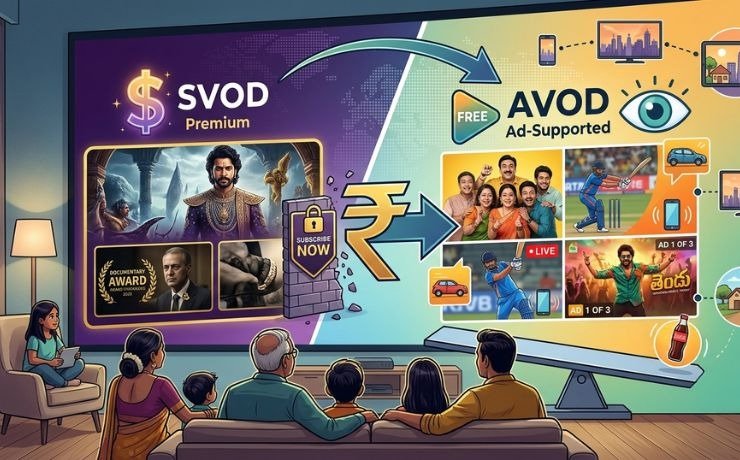
For the better part of a decade, India’s streaming story was written in the language of subscriptions. Every platform launch came with the same implicit promise: enough exclusive content, enough marquee sport, enough prestige drama, and Indian audiences would eventually pay for it the way they had learned to pay for a mobile recharge or a cable connection. That promise has not entirely failed. But it has quietly stopped being the industry’s centre of gravity. The real momentum in India’s OTT market now belongs to a less glamorous, far more pragmatic model — free, ad-supported streaming, watched by hundreds of millions of Indians who were never going to pull out a credit card for a monthly plan in the first place.
The shift is not a temporary correction. It is a recalibration of what streaming in India was always going to look like once the novelty wore off and the economics of a price-sensitive, mobile-first, largely non-metro audience asserted themselves.
The Shift, By the Numbers
Marquee cricket streams have drawn tens of millions of simultaneous free viewers — concurrency figures no subscription tier in India has come close to matching. That single data point rewrote how advertisers think about OTT scale.
A Market That Was Never Going to Be Netflix
Comparisons between India’s OTT trajectory and the American streaming boom were always somewhat misleading, and the gap has become impossible to ignore. The US streaming wars were fought largely between platforms competing for a relatively affluent, broadband-connected, credit-card-carrying audience already habituated to paying for HBO, cable, or satellite television. India’s addressable streaming audience looks nothing like that. It is overwhelmingly mobile-first, heavily weighted towards tier two and tier three markets, and drawn from a population where average willingness to pay for entertainment remains a fraction of Western benchmarks, even as smartphone and data penetration have raced ahead.
Platforms that built their India strategy around the SVOD playbook — premium originals, aggressive subscriber acquisition, price increases justified by exclusive content — have had to reckon with a hard ceiling. India’s paid streaming base, while large in absolute numbers, has grown more slowly than platforms once projected, and churn remains a persistent headache in a market where a subscriber can cancel after a single cricket season or a single hit show without much hesitation.
AVOD did what subscriptions never could — it reached the enormous population of Indians for whom streaming was previously inaccessible, not because they lacked interest, but because they lacked the willingness to pay.
The Cricket Effect, and Everything After It
No conversation about AVOD’s ascent in India is complete without acknowledging what live sport, and cricket in particular, has done to reshape audience behaviour. Free, ad-supported streaming of major cricket tournaments has repeatedly delivered concurrent viewership numbers that would be extraordinary by any global streaming standard. That scale did not simply prove that Indians would watch cricket for free online. It proved something more structurally important for advertisers: that AVOD could deliver mass-reach, appointment-viewing audiences on par with linear television, at a moment when linear’s own reach was beginning to erode.
What followed was a broader recalibration among advertisers who had, for years, treated OTT primarily as a premium, niche complement to their television spend. AVOD’s live sport moments demonstrated that ad-supported streaming could deliver both precision, through addressable and data-driven targeting, and scale, through free access that removed the paywall friction entirely.
Why Advertisers Are Leaning In — Three Forces at Work
01 · Measurement
India’s streaming ecosystem now offers granular targeting by demographics, viewing behaviour, and in some cases purchase intent signals layered in through retail and telecom data partnerships — a precision linear television never offered.
02 · Format Flexibility
AVOD platforms have moved beyond pre-roll interruption towards shoppable overlays, interactive units, and contextual placements that align creative with content instead of simply breaking it.
03 · Cost Efficiency
As linear CPMs climb even while linear reach softens among younger and rural digital-first audiences, AVOD has positioned itself as the more efficient route to many of the same eyeballs.
The Hybrid Reality Nobody Predicted
It would be a mistake to read AVOD’s momentum as a simple story of subscription models losing to advertising ones. What has actually emerged in India is something messier and more interesting: a hybrid architecture in which most major platforms now run tiered offerings, blending a free or low-cost ad-supported layer with premium ad-free tiers for content and audiences willing to pay for exclusivity or an uninterrupted experience.
This hybrid model reflects a maturing understanding that Indian streaming audiences are not a monolith. A cricket fan streaming a match on their phone during a commute has fundamentally different expectations and price sensitivity than a family watching a prestige drama together on a connected television at home. Platforms that have built genuinely tiered AVOD-SVOD architectures — rather than treating advertising as an afterthought bolted onto a subscription product — are the ones best positioned to monetise both ends of that spectrum simultaneously.
For advertisers, this hybrid reality changes the planning conversation. Rather than choosing between OTT and television, or between AVOD and SVOD platforms, media planners increasingly need to think about audience journeys across a single platform’s own tiers — recognising that the same user might migrate between free and paid experiences depending on the content, the season, or even the device they happen to be using.
What This Means for the Next Phase
Several signals suggest AVOD’s role in India’s OTT ecosystem is set to deepen rather than plateau. Connected TV adoption, while still a fraction of India’s overall television base, is growing steadily in urban and semi-urban households, and CTV inventory tends to command a premium precisely because it combines the big-screen, appointment-viewing context of television with the addressability of digital.
Retail media integration is another accelerant worth watching closely. As commerce platforms and streaming services increasingly share ownership structures or data partnerships, the ability to close the loop between an ad served on an AVOD platform and an actual purchase becomes commercially compelling in a way that pure brand-awareness advertising has struggled to demonstrate.
None of this means SVOD is finished, or that premium subscription content has lost its strategic value. Exclusive originals and marquee sport rights remain powerful subscriber acquisition tools, and a healthy subscription base continues to matter for platform economics and investor narratives alike. But the centre of gravity in India’s OTT wars has shifted. The next phase of growth will not be won primarily by whoever builds the most compelling paywall. It will be won by whoever builds the most compelling free experience — one sophisticated enough in its targeting and native enough in its ad formats that viewers barely register they are being advertised to at all.
It was never really a story about advertising beating subscriptions. It was a story about an industry finally building a streaming model shaped for the market it actually has.
