













The Formalisation Wave: Why More Indian Creators Are Registering as Businesses, Not Freelancers

Somewhere in the last eighteen months, a quiet but decisive shift took place inside India’s creator economy. It didn’t happen on a stage, and it wasn’t announced in a press release. It happened in chartered accountants’ offices, in WhatsApp groups where creators swap advice on GSTINs and TDS, and in the fine print of MCN and talent management contracts that began asking a question creators once found absurd: “What’s your company’s PAN?”
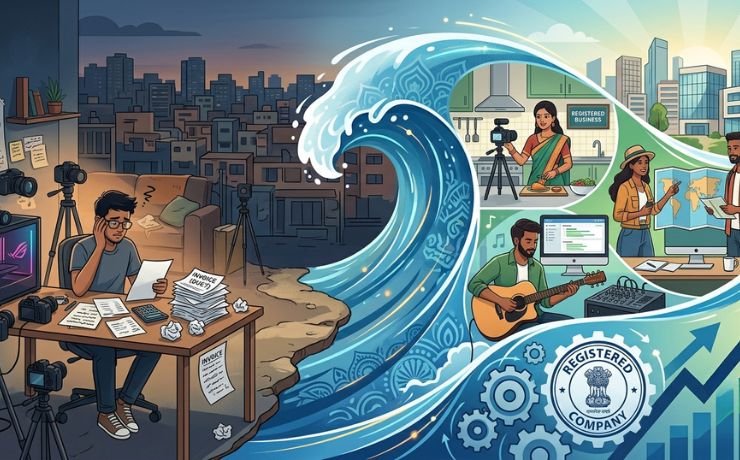
For years, the default identity of the Indian creator was the freelancer — a sole proprietor operating under their own PAN, invoicing brands directly, filing taxes under presumptive schemes, treating the whole enterprise as a side hustle that happened to pay disproportionately well. That default is eroding fast. A growing cohort of creators, particularly those crossing seven figures in annual revenue, are incorporating. LLPs, One Person Companies, and increasingly, private limited entities are replacing the individual PAN as the legal face of the creator’s business. The freelancer is formalising into a founder.
This is not a cosmetic change. It reflects a creator economy that has quietly matured past the point where informal structures can carry its weight — and it is reshaping how brands contract creators, how creators plan their finances, and how the industry as a whole thinks about what a “creator business” actually is.
The Math That Forces the Conversation
Ask any tax consultant who works with creators why incorporation conversations have spiked, and the answer starts with arithmetic rather than ambition. Under India’s GST framework, any service provider — and a creator monetising through sponsorships, affiliate commissions or brand collaborations is, in the eyes of the CGST Act, exactly that — must register for GST once aggregate turnover crosses twenty lakh rupees, or ten lakh in special category states. Below that line, registration is optional. Above it, it is not, and turnover here means gross receipts, not profit, a distinction that catches out more creators than it should.
Crossing that threshold used to feel like an administrative nuisance layered onto an individual’s tax filing. What has changed is the scale at which creators are crossing it — not by a small margin, but by multiples, as brand budgets that once treated influencer marketing as a discretionary spend now route six- and seven-figure annual retainers toward top and mid-tier creators. At that scale, the individual PAN structure starts to show real strain. Personal and business income blur together on a single return. Liability is unlimited and personal — a brand dispute, a copyright claim, a platform demonetisation event, all expose the creator’s personal assets in a way a limited liability structure simply does not. And every rupee of the business’s growth is taxed at individual slab rates that climb steeply, rather than at the comparatively flatter rates available to a registered company reinvesting in itself.
Incorporation, in this light, stops being a lifestyle upgrade and starts looking like basic risk management. An LLP or a private limited company ring-fences personal wealth from business liability. It allows a creator to draw a modest personal salary while retaining and reinvesting the rest of the revenue inside the company, deferring the full tax hit and freeing up capital to actually run the business — hiring an editor, a manager, a researcher, rather than treating every rupee as personal income the moment it lands.
When the Team Behind the Camera Outgrows the Freelancer Model
There is a second, less discussed driver behind the formalisation wave, and it has less to do with tax optimisation than with the simple reality of how creator operations have scaled. The solo creator with a ring light and an editing laptop is, for the top tier of the industry, largely a memory. What exists instead is a small studio: an editor, sometimes two; a manager negotiating brand deals; a researcher or scriptwriter; occasionally a community manager running a Discord or a WhatsApp broadcast list. That is a payroll. That is a team with its own compliance needs — PF, professional tax, employment contracts — that an individual freelancer’s PAN was never designed to support cleanly.
Once a creator is functionally running a small media company, incorporating simply names the thing that already exists. It also, practically, makes hiring easier — a registered entity can issue offer letters, structure equity or profit-sharing arrangements for a long-tenured editor or manager, and present itself to prospective hires as a stable employer rather than an individual paying informally out of personal income. For creators thinking about succession, about building something that could eventually run with less of their own daily involvement, or about eventually selling a media property outright, an unincorporated freelancer identity is close to worthless as an asset. A company, with its own accounts, contracts and IP assignments, is not.
“Brands stopped asking me for my Aadhaar and PAN card two years ago. Now the first thing their legal team wants is a company GSTIN and a board resolution authorising the contract. I incorporated because the deals demanded it, not because I woke up wanting to be a CEO.”
That shift in what brands demand is, in many ways, the sharpest accelerant of all. Marketing and legal teams at large advertisers have grown more cautious about contracting with unregistered individuals for high-value campaigns, partly for straightforward compliance reasons — GST input credit on a sponsorship fee is only claimable if the creator can issue a proper GST invoice — and partly because a registered corporate entity offers cleaner recourse in a dispute than an individual operating informally. As brand budgets have consolidated around a smaller set of “safe,” professionally structured creators, informality has effectively become a competitive disadvantage.
LLP, OPC or Private Limited — the Structure Debate
The formalisation wave has also produced its own internal debate, one playing out in creator-economy Telegram channels and CA consultations alike: which structure actually fits a creator business?
For creators in the mid-tier range, roughly ten to fifty lakh in annual receipts, the Limited Liability Partnership has emerged as the pragmatic middle ground — cheaper to set up and run than a private limited company, offering the liability protection that a sole proprietorship lacks, without the compliance overhead of a full company structure. The One Person Company structure appeals to solo creators who want incorporation’s benefits without bringing in a co-founder or partner, though its lower investor-readiness and comparatively rigid conversion rules have made it a less popular long-term choice than its early marketing suggested.
It is the private limited company, though, that has become the aspirational endpoint for creators thinking beyond content into brand-building — those eyeing product lines, course businesses, talent management verticals of their own, or simply the possibility of external investment down the line. A private limited structure is the only one of the three that meaningfully opens the door to institutional capital, to ESOP pools for a growing team, and to the kind of due diligence process a strategic acquirer or investor would actually take seriously. For creators who have watched a handful of India’s biggest content names spin off production companies, merchandise lines and even their own MCN-style talent rosters, the private limited route reads less like paperwork and more like a statement of intent.
What This Means for an Industry Still Figuring Itself Out
The broader significance of the formalisation wave is not really about tax structures at all. It is a signal that India’s creator economy is quietly shedding the “hobby that got monetised” framing that has clung to it since its earliest days, and reorganising itself around the assumptions of any other media business — payroll, liability, IP ownership, succession planning, and a clean separation between the person and the enterprise they run. That reorganisation carries real friction. Compliance costs that felt trivial for an individual — GST filings, ROC filings, annual audits above certain thresholds — become recurring line items a still-young creator business has to budget and plan for, often for the first time requiring outside professional help rather than a single family accountant filing an annual return. Creators used to treating brand income as fluid personal cash flow are learning, sometimes the hard way, the discipline of drawing a salary rather than dipping into business accounts at will. And the informal, improvisational culture that made the creator economy feel accessible to newcomers with nothing but a smartphone sits in some tension with a landscape increasingly organised around registered entities, professional managers and brand legal teams that prefer dealing with companies over individuals.
But the direction of travel looks settled. As brand budgets scale, as regulatory scrutiny around GST and TDS on creator income tightens, and as the most ambitious names in Indian content treat their channels as the foundation of a media business rather than the ceiling of one, incorporation is becoming less a milestone creators reach for and more a baseline they are expected to clear. The freelancer identity that defined the first decade of Indian influencer culture isn’t disappearing overnight. But increasingly, it is the entry point, not the destination — the phase a creator passes through on the way to becoming, on paper and in practice, something closer to a founder.
