














Live Sports on CTV: What Advertisers Are Actually Paying for During Marquee Streaming Events in 2026

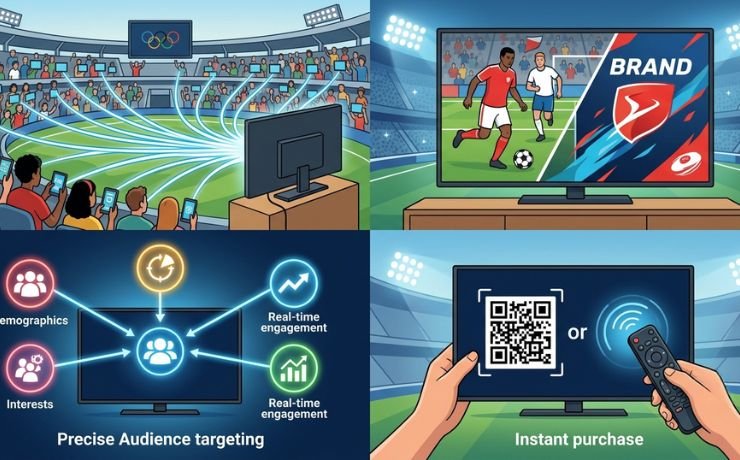
Ask a media buyer in early 2026 what they are actually purchasing when they commit crores to a marquee CTV sports package, and the honest answer is rarely “reach.” Reach was the currency of linear television, a broad and somewhat blunt instrument that advertisers accepted because it was the only instrument available. What is being sold, and bought, during live sports streaming events today is something considerably more granular, more accountable, and in several important respects, more expensive per eyeball than anything linear ever offered. The premium has not disappeared with the shift to streaming. It has simply changed shape.
This matters because the assumption baked into a lot of early digital advertising thinking, that streaming would eventually commoditise sports inventory the way programmatic commoditised display, has not played out. If anything, the opposite has happened. Live sports on CTV has become one of the few advertising environments left where genuine scarcity, genuine attention and genuine premium pricing still coexist, and understanding exactly what that premium is buying has become essential reading for any marketer weighing a streaming sports commitment against the alternatives.
The Attention Premium, Priced In
The starting point for any conversation about CTV sports pricing is attention quality, and the data underlying it has become considerably more sophisticated than the completion-rate metrics that dominated the category’s early years. Streaming platforms carrying marquee cricket, football and kabaddi properties can now offer advertisers second-by-second viewership data, split-screen and picture-in-picture engagement tracking, and increasingly, eye-tracking-adjacent attention metrics gathered through connected TV operating systems themselves. What that data consistently shows is that live sports viewers on streaming platforms are demonstrably less likely to skip, mute or second-screen away during ad breaks than viewers of virtually any other content category, including scripted entertainment on the same platforms.
Advertisers are, in effect, paying for verified attention rather than purchased reach, and the pricing reflects that distinction sharply. CPMs for premium in-stream spots during marquee live sports moments on CTV routinely run at a multiple of standard programmatic video CPMs, and in several documented cases during major cricketing events, have approached or exceeded the premium commanded by equivalent linear broadcast slots, a genuinely notable development given that streaming inventory was, only a few years ago, expected to undercut linear on price as a matter of course. The scarcity logic is straightforward: there is only one live final, it happens once, the audience watching it is unusually attentive and unusually large, and every advertiser in a relevant category wants a slot in the same narrow inventory window. That is a sellers’ market by definition, and streaming platforms have priced it accordingly.
Beyond the Spot: What the Premium Actually Includes
What separates 2026’s CTV sports advertising economics from earlier, simpler broadcast-style purchasing is that advertisers are rarely buying a straightforward :30 spot anymore. The premium packages that dominate marquee event advertising now bundle together a layered set of capabilities that, taken individually, would have been sold as separate line items even two years ago.
Addressable targeting sits at the centre of that bundle. Unlike linear broadcast, where every household watching a match sees the identical ad regardless of who they are, CTV sports inventory allows advertisers to serve genuinely different creative to different household segments within the same live broadcast, based on location, past purchase signals, streaming subscription tier or first-party data matched through clean room partnerships. A financial services brand can run one message to urban, higher-income households and a materially different message, in a different language, to Tier 2 markets, all within the same match, the same ad break, without the audience being aware that the creative they saw was not universal. This capability alone justifies a meaningful part of the pricing premium, because it converts a mass broadcast buy into something closer to a precision-targeted campaign, without sacrificing the scale and cultural centrality that only live sports can deliver.
Shoppable and interactive overlay formats have also moved from experimental to mainstream during marquee events, particularly across quick commerce, D2C and fintech categories. QR-code and remote-clickable overlays that let a viewer add a product to cart, open a UPI payment flow, or register interest without leaving the live stream have become a standard premium add-on, and advertisers are paying specifically for the measurable, closed-loop conversion data this generates, a capability linear television structurally cannot offer. Several advertisers running shoppable overlays during high-viewership match windows report conversion rates meaningfully above their standard digital video benchmarks, a data point that has become a central argument in justifying the premium spend internally to finance teams who might otherwise balk at the CPM.
Frequency and roadblock control round out the premium bundle. Streaming platforms now offer advertisers guaranteed exclusivity within specific ad pods during marquee moments, category exclusivity for the duration of a match, or first-in-pod positioning that virtually guarantees the ad plays before viewer attention has a chance to drift. These are, functionally, auction-style premiums layered on top of base CPM, and they have become significant enough line items that several large advertisers now negotiate them as separate contractual terms rather than bundled extras.
The Measurement Arms Race
Underpinning all of this is a measurement infrastructure that has matured rapidly and become, in its own right, a significant part of what advertisers are paying for. Streaming platforms carrying marquee sports content have invested heavily in incrementality measurement, using control and exposed group methodologies to demonstrate causal lift rather than simple correlation between ad exposure and downstream outcomes like app installs, website visits or in-store footfall tracked through location data partnerships. This is a fundamentally different value proposition than linear ever offered, where advertisers largely had to take reach and recall on faith, backed by post-hoc brand tracking studies with limited granularity.
The willingness of major streaming platforms to open up this level of measurement transparency, in several cases allowing independent third-party verification through measurement partners rather than relying solely on platform-reported numbers, has been a significant factor in justifying premium pricing to increasingly ROI-scrutinous marketing leadership. When a CMO can show a board-level stakeholder a causally validated lift number tied directly to a specific match-day spend, the premium CPM becomes considerably easier to defend than it would be on reach and impressions alone.
Who Can Actually Afford to Play
This layered, capability-rich pricing structure has produced a notable side effect worth naming directly: it has raised the entry barrier for marquee live sports CTV advertising considerably higher than it was even a couple of years ago, effectively concentrating the category’s premium inventory among large, well-capitalised advertisers, primarily in fintech, e-commerce, auto, FMCG and telecom, who can absorb both the base CPM and the additional cost of the addressable, shoppable and measurement infrastructure needed to extract full value from it. Smaller and mid-sized advertisers increasingly find themselves priced into secondary inventory, non-marquee matches, mid-tournament fixtures, or lower-tier ad pods, where the attention premium, and the pricing, is considerably softer.
Whether that concentration is healthy for the broader CTV sports advertising ecosystem is a genuinely open question. It has certainly sharpened the category’s economics and pushed measurement standards forward faster than a more fragmented, lower-stakes market likely would have. But it has also meant that live sports on CTV, for all its promise of democratised, addressable, accountable advertising, has in practice become a game increasingly played by the advertisers who could already afford premium linear placements in the first place, now paying a comparable premium for a materially more sophisticated, more measurable, and arguably more effective version of exactly what they were buying before.
What has genuinely changed, then, is not who gets to advertise during the moments that matter most to Indian audiences, but what those advertisers now receive in exchange for the spend. The premium has not gone away. It has simply become a great deal more precise about exactly what it is a premium for.
