














Synthetic Voice and Dubbing AI: How Regional-Language Ad Localisation Got Cheaper Overnight

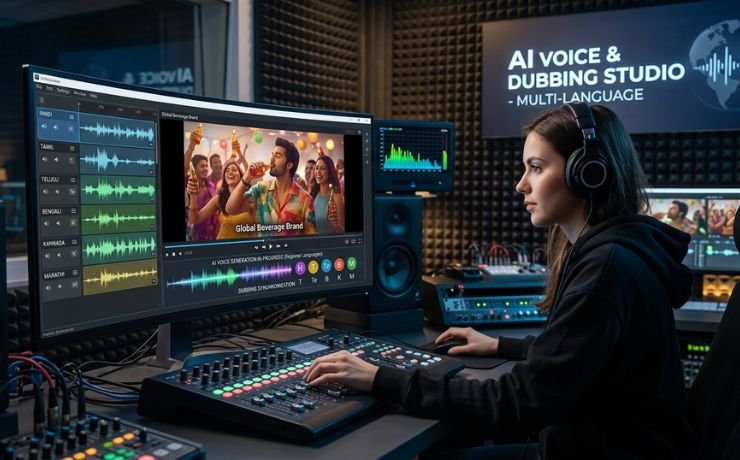
Six months ago, a mid-sized FMCG brand looking to run the same festive campaign across Tamil, Telugu, Bengali and Marathi would have budgeted for four separate dubbing sessions, four voice artists, four studio bookings, and a production timeline stretching well past three weeks. Today, that same brand can generate broadcast-ready voiceovers in all four languages before lunch, at a fraction of the cost, using nothing more than a laptop and a synthetic voice platform. The studio booking has been replaced by an upload button. The three-week turnaround has collapsed into an afternoon. And nobody in the room quite knows whether to celebrate or brace for what comes next.
This is the quiet upheaval currently reshaping regional-language advertising in India, and it has arrived with none of the fanfare that usually accompanies a genuine industry inflection point. There was no splashy product launch, no dramatic keynote moment. Instead, AI dubbing and voice synthesis tools crossed a threshold of usable quality sometime in the last eighteen months, and marketers, quietly and pragmatically, started using them.
The Economics That Changed the Calculus
To understand why this shift matters, it helps to sit with the old math for a moment. A traditional regional dubbing pipeline in India typically involved a translator adapting the script for cultural nuance, a casting call or an established roster of voice artists for each language, studio time booked in blocks, a sound engineer for mixing, and at least one or two rounds of client review and re-recording. For a national campaign spanning six or seven major languages, agencies routinely quoted anywhere from ten days to a month, with costs that scaled linearly with every additional language added to the mix. Regional versions were, in effect, a tax on ambition. Brands that wanted to go deep into Tier 2 and Tier 3 markets, where language fluency in the local tongue often outperforms Hindi or English creative by a wide margin, had to weigh that appetite against a production bill that grew heavier with every market added.
Synthetic voice platforms have inverted that equation. Tools built on neural text-to-speech and voice-cloning architecture can now take a single master script, translate and localise it, and generate a full voiceover in a target language within minutes, not weeks. Marginal cost, the thing that used to scale painfully with every new language, has effectively flattened. Adding an eighth or ninth regional variant no longer means another studio day and another artist fee; it means running the same script through the same pipeline one more time. For performance marketing teams already accustomed to testing dozens of ad variants on digital platforms, this is a familiar and welcome logic finally extending into what was, until recently, the most stubbornly manual part of the creative process.
What makes this moment different from earlier waves of “AI in advertising” hype is that the output has genuinely improved to a point of near-parity with human recording for a meaningful share of use cases. Early text-to-speech tools produced voices that sounded unmistakably synthetic, flat in cadence, indifferent to emotional beats, and often comically mismatched to regional pronunciation. The newer generation of models, trained on far larger and more phonetically diverse datasets, handle intonation, pacing and emotional inflection with a subtlety that would have seemed implausible even two years ago. Several agencies working across South Indian markets report that blind listening tests with client stakeholders have, on more than one occasion, failed to reliably distinguish the synthetic track from the human one.
Where the Real Gains Are Landing
The most immediate beneficiaries of this shift are not the large national campaigns with hero-film budgets, but the long tail of performance-driven, high-frequency creative that regional and D2C brands depend on. Quick commerce players, regional NBFCs, insurance aggregators and local D2C labels have historically underinvested in vernacular voiceover simply because the unit economics never worked; a thirty-second regional ad running for a two-week performance sprint rarely justified a full studio production cycle. Synthetic voice tools have made that calculus viable for the first time. Marketers can now localise ad copy at the same velocity they already localise ad creative on Meta and Google, testing multiple voice tones, scripts and regional variants against each other with the kind of iterative rigour that used to be reserved for text-based A/B testing.
There is also a quieter but equally significant shift happening in dubbing for long-form content, particularly in the OTT and branded-content space. Advertisers producing short branded documentaries or influencer-style long-form content for regional audiences no longer need to shoot separate voice tracks for every market; a single English or Hindi master can be dubbed into half a dozen languages with lip-sync-aware AI tools that adjust mouth movement timing to match the translated audio. For brands running pan-India content strategies on YouTube and connected TV, this collapses what used to be a genuinely painful post-production bottleneck.
Agencies handling regional media buying describe a second-order effect that is arguably more interesting than the cost savings themselves: speed to market has become a creative advantage in its own right. A brand reacting to a cricket match result, a monsoon onset, or a sudden news cycle can now localise and deploy a reactive creative across multiple regional languages within hours rather than days, a capability that was simply unavailable before. In a media environment where cultural relevance has a shelf life measured in hours, that turnaround speed is not a nice-to-have; it is increasingly the difference between a campaign that feels present in the cultural moment and one that arrives after the conversation has moved on.
The Uncomfortable Questions Nobody Has Fully Answered
None of this arrives without friction, and the industry conversation around synthetic dubbing has, appropriately, started to widen beyond pure enthusiasm. The most immediate concern is professional displacement. India’s voice artist community, particularly the mid-tier freelance talent who built careers dubbing regional commercials, dialogue replacement and IVR systems, is watching a meaningful share of its traditional workload migrate toward AI pipelines. Voice artist associations in Chennai and Mumbai have already begun raising questions about consent, compensation and the licensing of voice likeness, echoing debates that played out in Hollywood’s writers’ and actors’ strikes over AI-generated performance. The concern is not hypothetical: several voice cloning tools can now replicate a specific artist’s timbre and cadence from a relatively small sample of recorded audio, raising uncomfortable questions about whether a voice artist’s own recorded catalogue could, without explicit consent, become training data for a synthetic version of themselves.
Brand safety and cultural nuance present a second, subtler challenge. Regional language advertising in India has never been a simple matter of literal translation; it depends on idiom, regional humour, colloquial register and an intuitive feel for what lands in Coimbatore versus what lands in Madurai, even within the same Tamil-speaking market. The best human dubbing artists and copy adapters bring decades of lived cultural fluency to that task. AI localisation tools, however fluent, are still prone to flattening those distinctions into a generic, technically correct but culturally thin version of the language. Several marketers interviewed on this shift describe a hybrid workflow taking shape as the practical middle ground: AI handles the first-pass generation and the high-volume performance variants, while human linguists and cultural consultants remain in the loop for hero campaigns, sensitive categories, and any creative where cultural specificity genuinely carries the ad.
There is also a growing awareness, still nascent but building, of listener trust. As synthetic voices become harder to distinguish from human ones, questions around disclosure are starting to surface, particularly for categories like financial services, healthcare and government communication, where the perceived authenticity of the messenger can materially affect consumer trust. Regulatory frameworks in India have not yet caught up to this specific question, but agencies working in regulated categories are already building disclosure conversations into client discussions well ahead of any formal requirement, a sensible bit of self-governance that may well pre-empt the regulation rather than wait for it.
What This Means for the Agency Model
For agencies, the strategic implication is less about the technology itself and more about where value now concentrates in the localisation workflow. When the mechanical act of dubbing becomes near-instantaneous and near-free, the premium shifts decisively toward the parts of the process that AI cannot yet replicate: cultural judgement, script adaptation that understands regional nuance rather than just regional vocabulary, and the strategic decision of which markets and which creative variants actually deserve investment. Agencies that built entire production verticals around the logistics of regional dubbing, coordinating studios, scheduling artists, managing multi-language QC, will need to reposition that expertise toward orchestration and quality curation rather than production management. The agencies moving fastest on this front are the ones treating synthetic voice not as a cost-cutting shortcut but as a new creative surface, one that allows small regional-specific campaign variants, tonal experiments and rapid-response creative that simply were not economically feasible before.
There is a reasonable argument that this technology, properly deployed, could do more for genuine linguistic inclusion in Indian advertising than a decade of well-intentioned regional strategy decks ever managed. A country with more than twenty officially recognised languages and hundreds of dialects has always presented brands with an impossible choice between meaningful vernacular depth and production feasibility. If synthetic voice tools genuinely lower that barrier, the beneficiaries will not just be marketing budgets; they will be the millions of consumers in Tier 2, Tier 3 and rural India who have spent years watching ads dubbed, if dubbed at all, in a version of their language that never quite sounded like home.
Whether that promise is fully realised will depend on choices the industry is only beginning to make, around fair compensation for the voice talent whose work trained these systems, around maintaining the cultural texture that makes regional advertising actually resonate, and around resisting the temptation to treat “cheaper” as a substitute for “better.” The technology has already solved the economics. What happens next is a question of judgement, and that, at least for now, remains stubbornly human.
