














JioCinema vs Hotstar vs Prime Video: Who Holds the Ad Inventory Advantage in 2026

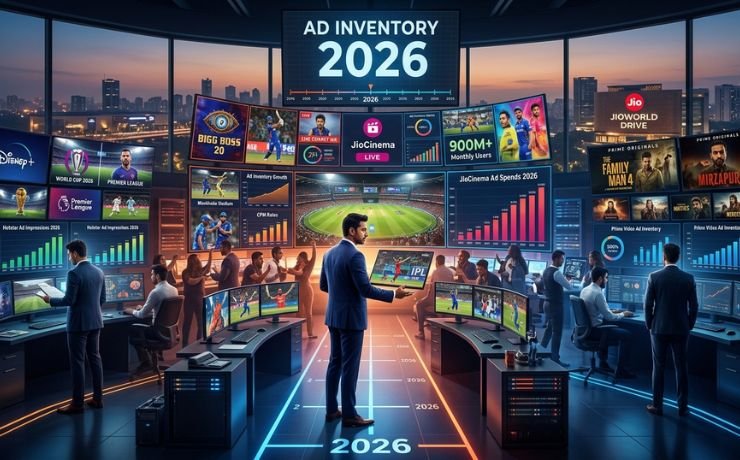
Ask a media planner in Mumbai to name India’s big three streaming ad platforms, and the question itself gives away its age. JioCinema and Disney+ Hotstar are no longer two competitors slugging it out for the same cricket-obsessed eyeball — they merged in 2025 into JioHotstar, a single ad-sales entity that now claims well over 500 million monthly users and exclusive rights across the IPL, ICC tournaments, the ISL and the Premier League. The “vs” in that old three-way fight has effectively collapsed into a two-horse race, and that collapse is itself the biggest story in Indian streaming advertising this year. What remains genuinely contested — and genuinely interesting to anyone planning a 2026 media budget — is how a newly ad-supported Prime Video, with Amazon’s shopping data behind it, stacks up against an inventory pool so large it now behaves less like a streaming platform and more like a parallel broadcast network.
The Inventory Math Nobody Else Can Match
Start with scale, because scale is where JioHotstar’s advantage stops being an opinion and starts being arithmetic. During the early rounds of IPL 2026, JioHotstar alone accounted for the largest share of connected TV ad volumes in the country by a wide margin, comfortably ahead of every other platform and OEM pool combined. That single data point tells you almost everything about how Indian CTV inventory is priced and sold in 2026: live sport delivers sustained, unskippable attention from audiences already primed for a big-screen occasion, and advertisers pay a premium for that kind of attention that no generic home-screen banner can command.
Reported CPMs on the platform run roughly ₹45–90 for display and ₹75–315 for video, with premium live-event roadblocks costing considerably more — and even those numbers understate how top-tier the top tier really is. High-impact roadblock placements around marquee live events can run ₹37–40 lakh for a single day, a figure that would have sounded like a television number five years ago and now sits comfortably inside a streaming rate card. The platform has also opened itself up at the other end of the spectrum: a self-serve advertising dashboard, modelled on the familiar Google Ads interface, now lets any registered Indian business plan, launch and manage OTT campaigns directly, without routing through an agency or JioHotstar’s internal sales desk. That is a deliberate widening of the funnel — the platform wants both the ₹40-lakh-a-day IPL masthead buyer and the regional D2C brand running a ₹15,000 test campaign, and it has built the infrastructure to serve both without cannibalising the premium end of the rate card.
What makes this more than a numbers story is what JioHotstar is doing with the inventory it already owns. Shoppable carousels let brands lay product rows across the screen for what the platform calls “product discovery” — closer to browsing than to checkout, but a genuine attempt to compress the distance between a 30-second spot and a purchase intent signal. A newer “send to phone” format skips the on-screen transaction entirely and fires a product link straight to the viewer’s mobile number, letting the second screen close the loop the big screen opened. It is a small mechanical detail, but it reveals the platform’s real strategic instinct: rather than simply selling more inventory, JioHotstar is trying to extract more value from the inventory it already has — turning appointment viewing into a funnel rather than just a reach vehicle.
The big screen sets the stage. The phone does the actual selling backstage.
Prime Video’s Different Bet
Amazon arrived at the ad-supported party late and arrived on its own terms. Ads were only folded into Indian Prime Video subscriptions from mid-2025, with an ad-free tier held out as a paid upgrade rather than the default state — a reversal of how the category has typically worked in India, where ad-free has historically been the premium promise and ads the free-rider’s tax. That sequencing matters, because it tells you Prime Video isn’t trying to out-reach JioHotstar. It cannot: its subscriber base, while substantial, is nowhere near the merged entity’s scale, and it holds none of the marquee live-sport rights that make JioHotstar’s inventory so structurally unskippable. Instead, Amazon is selling something JioHotstar cannot replicate quite as cleanly — a direct, first-party line from a video ad impression to a shopping cart.
The pitch from Amazon’s ad partners has been consistent on this point. As one agency founder working closely with the platform put it, the advantage isn’t really about expanding ad inventory at all — it’s about precision, because Prime Video’s data spans viewing habits, shopping behaviour and even voice commands, giving advertisers a level of targeting granularity that traditional broadcast, still largely reliant on panel data, simply cannot offer. That is the crux of the Prime Video argument in 2026: less reach, more resolution. A brand advertising detergent on JioHotstar during an IPL match is buying attention at scale and hoping for relevance. A brand advertising detergent on Prime Video, layered against Amazon’s purchase-history graph, is buying something closer to a qualified lead.
The category-level numbers back the strategic logic. Amazon’s ad-supported tier had already generated an estimated $1.8 billion in direct revenue by 2025, and Forrester’s 2026 outlook has brands slashing open-web display budgets by as much as 30 percent to fund exactly this kind of highly targeted, retail-linked streaming spend instead. It is not a coincidence that this shift is happening at the same moment digital fatigue is setting in across probabilistic, cookie-adjacent display advertising. Prime Video is positioning itself as the deterministic alternative — smaller in reach, but built on a data layer that display advertising, and arguably even JioHotstar’s telecom-plus-viewing data, cannot fully match on the shopping-behaviour axis specifically.
Reach Versus Resolution
This is where the 2026 comparison actually gets interesting, because it isn’t really a fight over the same battlefield. JioHotstar wins on reach, on live-sport exclusivity, on CTV volume, and on the sheer breadth of its self-serve infrastructure — a small business and a national FMCG brand can both transact on the same platform, at wildly different scales, without friction. Its telecom-linked pricing tiers, running from a Rs 149 quarterly ad-supported mobile plan up to a Rs 1,499 ad-free annual plan, also give it a subscriber funnel that most competitors, including Prime Video, cannot replicate — because that funnel is subsidised by Jio’s telecom relationship with hundreds of millions of Indians, not by streaming economics alone.
Prime Video, by contrast, wins on precision and on the credibility of closing the loop. Its data doesn’t just describe what someone watched; it describes what they subsequently bought, browsed or asked Alexa about — a form of measurement that JioHotstar’s shoppable formats are still visibly reaching for rather than natively possessing. Prime Video’s ad expansion is also widely seen as one of the biggest contributors to the growth of Connected TV inventory in India specifically, with analysts expecting Amazon to command a meaningful share of global CTV ad sales by 2026, driven in large part by the popularity of Fire TV as a distribution device alongside the app itself. That CTV angle matters because it is the one place Amazon can genuinely contest living-room attention rather than simply mobile-and-tablet viewing, narrowing — even if not closing — the gap with JioHotstar’s dominant big-screen position.
The broader market context makes both strategies look rational rather than desperate. Digital video advertising in India crossed ₹12,000 crore in 2025 and continues to grow at roughly 28 percent annually, comfortably outpacing every other advertising category in the country. A market growing that fast doesn’t need to be a zero-sum contest between two platforms; it has room for a dominant reach player and a dominant precision player to both post strong growth numbers simultaneously, which is broadly what’s happening. The real losers in that framing aren’t Prime Video or JioHotstar — they’re the mid-tier broadcast and open-web display players who offer neither JioHotstar’s scale nor Prime Video’s shopper-graph precision, and who are consequently the ones absorbing the budget cuts Forrester and others are now forecasting.
Where Netflix and the Regionals Fit
It’s worth naming the platform sitting this particular fight out. Netflix remains purely subscription-based in India — its global ad-supported tier has not been extended to the market — which increasingly reads less like principled restraint and more like a growing outlier position as every other major platform, Amazon included, moves to hybrid monetisation. With Amazon’s shift to ads now complete, nearly every major OTT platform operating in India relies on advertising to some degree, and the pressure on Netflix to eventually follow suit only intensifies with each rival’s ad-tier revenue disclosure. Regional and broadcaster-linked platforms such as ZEE5 and SonyLIV, meanwhile, occupy a third lane entirely — neither JioHotstar’s live-sport scale nor Prime Video’s shopper-data precision, but a genuine regional-language and vernacular-content depth that both larger players are still catching up to in specific markets.
The Advantage, Such As It Is
If the question is strictly volume — who can move the most impressions, at the highest premium, with the least inventory scarcity — JioHotstar’s advantage in 2026 isn’t close. A combined entity holding IPL, ICC, ISL and Premier League rights simultaneously, on top of hundreds of millions of monthly users, has effectively no domestic rival for pure inventory dominance, and the CTV data from this year’s IPL confirms it decisively. But “advantage” in advertising was never only about volume, and the smarter read of 2026 is that the two platforms aren’t actually competing for the same rupee. JioHotstar owns the top of the funnel at a scale nothing else in the market can touch; Prime Video is quietly building a claim on the bottom of it, where a video impression converts into a data-verified purchase rather than a hopeful brand-lift survey.
For media planners, that distinction should shape allocation more than any single CPM comparison. Reach-led launches, sponsorship plays and category-defining moments still belong on JioHotstar, where live sport guarantees the kind of unskippable, appointment-viewing attention that built television advertising in the first place. Performance-oriented, purchase-intent campaigns — particularly for categories where Amazon’s own commerce data adds real signal, from FMCG to electronics to beauty — increasingly belong on Prime Video, where the ad dollar is buying not just an eyeball but a measurable, closed-loop outcome. The platforms that will struggle hardest through the rest of 2026 aren’t fighting each other; they’re the ones still trying to compete on reach without JioHotstar’s rights portfolio, or on precision without Amazon’s commerce graph. That, more than any single inventory chart, is the real shape of India’s streaming ad market this year.
