














The Trade Desk, MiQ, Dentsu Amnet: Who’s Actually Winning India’s Programmatic Turf War

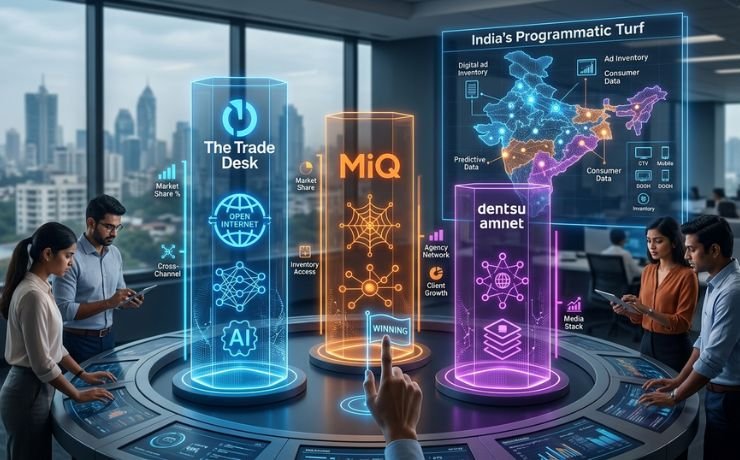
Ask three media buyers in Mumbai, Bengaluru and Gurugram who’s winning India’s programmatic market, and you’ll likely get three different answers, each delivered with total conviction. That confusion isn’t a failure of the industry to keep score. It’s a symptom of what programmatic buying in India has actually become — not a single race with one finish line, but three overlapping contests being run by very differently built machines, each optimising for a different definition of victory.
The Trade Desk, MiQ, and Dentsu Amnet occupy the same broad category on any org chart — independent, non-walled-garden programmatic players competing for a slice of India’s advertising spend that’s shifting decisively toward automated buying. But treat them as three competitors in the same race and you’ll misread all three. One is a global infrastructure company with an India strategy bolted on. One is a technology-first challenger that just made its most aggressive India bet yet. And one is a network-embedded trading desk whose core advantage has never really been technology at all. Understanding how differently each of these is built is the only way to sensibly ask who’s actually winning.
The scale of the prize
It’s worth establishing just how large the pie has become before arguing over the slices. India’s programmatic advertising market was estimated at $51.5 billion in 2024, and projected to grow to $59.77 billion in 2025, on its way to an estimated $265 billion by 2035 — a compound annual growth rate north of 16%. Programmatic isn’t a niche buying method anymore; it’s fast becoming the default. Programmatic buying already accounts for 42% of India’s digital ad spend and is forecast to reach 44% by 2026, according to the dentsu-e4m Digital Report 2025.
That scale explains why all three players have escalated their India commitments so visibly over the past year. Nobody wants to be the also-ran in a market compounding at double-digit rates for the next decade. But scale is also precisely why “who’s winning” is the wrong first question. In a market this size and this early in its programmatic maturity curve, there’s room for multiple winners running fundamentally different playbooks — which is exactly what’s happening.
The Trade Desk: winning the infrastructure argument
Globally, The Trade Desk’s pitch has always been the “open internet” argument — an independent, non-walled-garden alternative to buying inside Google or Meta’s ecosystems, built on the premise that advertisers should own their own data and audience relationships rather than renting them from a platform. That argument travels reasonably well into India, a market where CTV, retail media, and audio inventory are all expanding fast enough that no single walled garden can credibly claim to own the full picture.
The company’s global momentum lends weight to its India ambitions. Google’s DV360 remains the largest DSP globally with roughly 28% market share by spend, but The Trade Desk has been steadily closing that gap, growing from around 18% share in 2024 to approximately 22% by 2026, according to Jounce Media’s DSP market share tracking. The company reports it is growing fastest among enterprise advertisers, with revenue up roughly 34% year-on-year, driven largely by CTV and retail media integrations — categories where India’s growth curve is arguably steeper than the global average, given the scale of the country’s OTT expansion and the retail media land grab now underway among e-commerce majors.
The Trade Desk’s 2026 India narrative leans heavily on infrastructure rather than headline campaign wins — tools like Deal Desk and Blue Lists, designed to give advertisers more transparency and control over premium inventory, and an expanding identity framework built around Unified ID 2.0. That identity solution alone now reaches roughly 420 million unique profiles globally and is supported by 78% of the top 100 publishers worldwide — a scale argument aimed squarely at agencies nervous about targeting precision in a post-cookie world. The company’s bet in India is essentially that as the market matures past its early, fragmented programmatic phase, advertisers will gravitate toward the DSP with the deepest identity and measurement infrastructure, rather than the one with the flashiest quarter.
MiQ: betting big on India-built AI
If The Trade Desk’s India strategy is about importing global infrastructure, MiQ’s is closer to the opposite: building specifically for India’s fragmentation problem and exporting the confidence from there. In March 2026, MiQ launched MiQ Sigma, its AI-powered marketing platform, in India at an event in Mumbai — a move the company’s leadership framed as central to its broader India expansion in one of the world’s fastest-growing advertising markets.
What makes Sigma notable isn’t just that it’s another AI layer bolted onto an existing DSP stack — plenty of players have done that. MiQ built Sigma from the ground up around programmatic excellence, uniting more than 300 diverse data feeds spanning roughly 700 trillion consumer signals covering what consumers watch on TV, browse on the web, and buy in stores. The platform connects multiple DSPs, SSPs, and programmatic channels into a single interface, aimed specifically at streamlining campaign execution in India’s mobile-first, multilingual advertising environment.
MiQ’s positioning is unambiguous about the problem it believes it’s solving. The company frames Sigma as designed to help advertisers navigate the complexity of India’s mobile-first, multilingual ecosystem through faster turnaround times and more localised insights — a direct response to the fragmentation that global DSPs, built for more homogenous Western markets, often struggle to handle gracefully at India’s linguistic and platform scale. The platform’s modular design supports integration with multiple DSPs and offers audience discovery, automated buying, and real-time insights through what the company describes as agentic AI capable of executing multi-platform media buys from a natural-language prompt.
The company isn’t shy about the numbers it’s chasing either. MiQ has cited global trials showing a 132% boost in conversions and 57% lower cost per action using Sigma — aggressive figures that will inevitably face scrutiny as India case studies accumulate, but which signal a company betting its India credibility on measurable performance rather than brand storytelling. MiQ has been operating commercially in India for over six years, building a presence gradually before this more assertive AI-led push — Sigma reads less like an entry into the market and more like an attempt to convert six years of quiet groundwork into a louder, more technologically distinct position.
Dentsu Amnet: winning through embeddedness
Amnet plays a structurally different game, and it’s worth being explicit about why. Amnet is dentsu’s specialist programmatic group, integrated directly with dentsu’s full network of agencies across dozens of markets, operating a consistent technology, operations and people stack designed to plug into each client’s individual requirements. Where The Trade Desk and MiQ are selling a platform that agencies and brands choose to buy into, Amnet’s core advantage is that it doesn’t need to be chosen in the same way — it’s already inside the room, embedded within dentsu’s existing creative, media planning and client relationships.
That embeddedness is both Amnet’s greatest strength and the reason it rarely gets discussed with the same excitement as an independent DSP launch. Its wins don’t tend to look like platform announcements; they look like campaigns quietly executed inside a broader dentsu account, where programmatic is one component of an integrated media plan rather than a standalone purchase decision. This is a genuinely different value proposition — for a CMO who has already consolidated their creative, media planning and programmatic buying under one network relationship, the friction of switching to an independent DSP has to clear a much higher bar than the friction of simply extending an existing dentsu mandate.
The risk in this model is equally structural. Amnet’s fortunes are tied tightly to dentsu’s overall client wins and losses in India, in a way that MiQ and The Trade Desk’s are not — an independent DSP can win a piece of a client’s programmatic spend even when that client’s primary creative or media agency-of-record relationship sits elsewhere. Amnet, by contrast, largely rises and falls with dentsu’s broader account health. In a market where AI-native trading desks and specialist DSPs are increasingly winning direct mandates from brands that want programmatic decoupled from their creative agency entirely, that dependency is worth watching.
Three different definitions of winning
Put side by side, the real story isn’t which of these three is pulling ahead — it’s that “winning” means something different to each of them, and India’s market is large and fragmented enough to reward all three definitions simultaneously, at least for now.
The Trade Desk is winning the infrastructure argument: identity resolution, CTV inventory access, and cross-channel measurement built at a scale no India-specific challenger can match on its own. MiQ is winning the localisation-and-speed argument: a platform explicitly engineered around India’s linguistic fragmentation and mobile-first behaviour, willing to make bold performance claims to back it up. And Amnet is winning the embeddedness argument: it doesn’t need advertisers to actively choose programmatic as a separate line item, because it’s already woven into the broader dentsu relationship that many large Indian advertisers have already committed to.
None of these are mutually exclusive victories, and that’s precisely why a single “who’s winning” headline undersells what’s actually happening in the market. What’s more instructive is watching where the tension points are emerging. Independent DSPs like The Trade Desk are increasingly building the kind of localisation and AI-native tooling that used to be MiQ’s clearest differentiator. India-built platforms like Sigma are explicitly designed to integrate with, rather than replace, incumbent DSPs — Sigma’s own architecture connects to The Trade Desk and Google DV360 rather than competing head-on for the same media spend. And network-embedded players like Amnet are under growing pressure to prove their programmatic execution can match the technical sophistication of standalone specialists, or risk clients pulling that specific budget line out of the broader agency relationship altogether.
What agencies should actually be watching
For media planners trying to make sense of this landscape rather than simply pick a side, the more useful question isn’t which DSP or trading desk is “winning” India — it’s which specific problem a given campaign or client relationship is actually trying to solve. A brand chasing best-in-class identity resolution and premium CTV access across a fragmented open internet has good reason to lean toward an infrastructure-first player. A brand wrestling with genuinely difficult multilingual, mobile-first audience targeting across dozens of regional markets has a real case for an India-built, AI-native platform designed around that exact fragmentation. And a brand that has already consolidated its media and creative relationships under a single network, and values integration and account continuity over best-of-breed technology, has a legitimate reason to stay embedded.
As India’s programmatic spend continues its climb toward that projected $265 billion figure by the mid-2030s, the market will almost certainly not consolidate down to a single winner. It’s more likely to bifurcate further, with global infrastructure players, India-native AI challengers, and network-embedded trading desks each carving out durable, differently shaped positions — competing less on who has the biggest platform, and more on who has correctly read what a fragmented, fast-growing, intensely multilingual market actually needs from programmatic buying next.
