














Inside a Microdrama Brand Integration: How One D2C Label Sponsored a Vertical Series Instead of a Reel

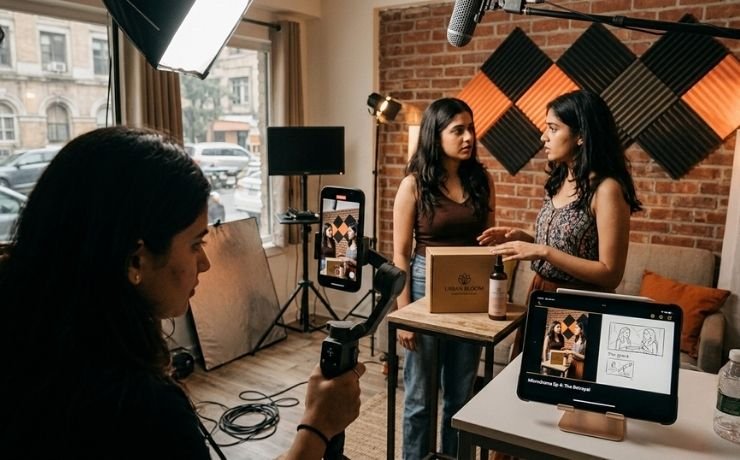
There is a version of this story that opens with a market-sizing statistic, the usual throat-clearing about how vertical video consumption in India has grown by some impressive multiple over the past eighteen months. That version exists elsewhere. This one opens the way the campaign itself did — as a pitch meeting where a Mumbai-based D2C beauty label was handed three story concepts instead of three media plans, and asked to pick the one it wanted to live inside for three weeks.
What follows is less a conventional case study than a walk through the campaign in the format it was built for: episode by episode, the way the fourteen-part microdrama itself unfolded for the roughly 40,000 viewers who followed it start to finish.
It is worth pausing, before the story starts, on why a brand would even consider this trade in the first place. Microdrama as a category has moved fast in India over the past year and a half — borrowed in structure from China’s duanju boom, adapted rapidly by short-video apps and a growing cluster of dedicated microdrama platforms, and consumed almost entirely by audiences scrolling the same feeds where they’d otherwise watch a reel. The genre compresses soap-opera plotting into ninety-second bursts, released daily, engineered to end every instalment on a hook sharp enough to survive a full day’s gap before the next one drops. For marketers, that daily cadence has looked, from the outside, like either an enormous opportunity or an enormous scheduling headache, depending on who in the building you ask.
EPISODE ONE — THE BRIEF THAT WASN’T A BRIEF
The brand’s marketing lead had spent three years running the standard influencer-reel playbook and had grown tired of a completion rate that told her nothing about whether anyone cared about the product on screen. A fifteen-second reel gets watched, or skipped, before a viewer can form an opinion. So when a Mumbai-based microdrama studio pitched sponsorship of a full vertical series rather than a single branded video, she says the appeal was structural before it was creative: fourteen episodes meant fourteen separate moments across three weeks for the product to appear inside a story someone had chosen to keep following, rather than one interruption they hadn’t.
The studio arrived with three story concepts already drafted, each built around a different plausible reason the product category might matter to a protagonist’s arc. The brand picked a workplace-rivalry drama over a romance and a family saga, on the theory that ambition and imposter syndrome would sit more naturally next to a personal care product than either of the other two premises would.
That decision alone marks a departure from how most brands still approach creator partnerships, where the brand typically supplies the brief and the creator supplies the execution within it. Here, the studio’s writers’ room held the pen throughout, and the brand’s role narrowed to a single veto power over anything that felt tonally off, rather than line-by-line script approval. The marketing lead admits this required a genuine leap of faith internally — persuading a leadership team accustomed to sign-off on every frame of a shoot that the story would work better if the brand let go of exactly that kind of control.
EPISODES TWO THROUGH SEVEN — LEARNING TO DISAPPEAR
The product appears in six of the fourteen episodes, and the studio’s creative director describes the governing rule for each appearance in a single test: the product had to survive being deleted from the script without the scene falling apart, and survive being left in without the scene feeling like an advertisement. The second condition, she notes, is the harder one, because it’s the condition most influencer briefs never bother to apply.
“We weren’t buying an ad. We were buying fourteen chances for someone to fall in love with a character who happens to use our product the way they’d use it themselves,” the brand’s marketing lead said. “That’s a completely different relationship than a fifteen-second cameo.”
In practice, that meant a desk shot during a scene about pre-presentation nerves, with the product placed exactly where a viewer’s eye would expect real desk clutter to sit, unremarked upon. It meant a single throwaway line of dialogue from a supporting character needling the lead about her morning routine — a placement doing more product-association work than a dedicated ad ever could, precisely because it wasn’t trying to. What the brand explicitly turned down, on the studio’s own advice, was a standalone “brand episode.” Early scouting conversations with other studios had shown the team that dedicated sponsored instalments get noticeably lower completion rates than narrative episodes, because audiences who’ve spent a week invested in a plot can feel the exact moment a story stops to sell them something.
EPISODES EIGHT THROUGH ELEVEN — THE DISTRIBUTION PROBLEM
Producing a well-integrated series turned out to be only half the job. Microdramas live or die on daily release discipline; even a single missed day measurably depresses completion on every episode after it, because the format’s entire retention mechanic runs on habit. The brand ran the series simultaneously across the studio’s own app, a short-video platform’s dedicated microdrama vertical, and its own Instagram and YouTube Shorts channels, staggered by a few hours to seed momentum before wider release.
That decision meant reconciling three different completion-rate definitions and two visibly different audiences: app viewers binged episodes back-to-back far more often than Instagram followers did, who tended to watch one a day and drop off without a notification reminder. A media planner used to a single-platform reel buy, the team found, has to build genuinely new muscle to plan a serialised, cross-platform release — and most agencies in the market are still building that muscle in real time, rather than executing an established playbook.
There was a second, quieter distribution decision that mattered almost as much: what to do about paid amplification. The brand resisted the temptation to boost early episodes with performance media budget, on the studio’s advice that artificially inflated early-episode reach without organic follow-through would only depress the completion metrics that mattered later in the arc. Instead, paid spend was held back and deployed selectively from episode six onward, once organic viewership had established which segments were actually returning daily — a sequencing choice that ran counter to nearly every instinct a performance marketing team is trained to have, and one the brand’s lead says she would not have made without the studio pushing back twice on an earlier, more aggressive media plan.
EPISODE TWELVE — WHAT THE AUDIENCE ACTUALLY DID
The brand shared performance figures on the condition that exact numbers stay off the record, but the shape of the result is worth stating plainly. Completion through the full arc, among viewers who started episode one, came in meaningfully higher than the brand’s own benchmark for long-form YouTube pre-roll — a comparison the marketing lead considers more honest than one against reels, which are built for near-total completion by design and reveal little about sustained attention.
More telling was what happened after each release: a distinct spike in branded search and direct site visits in the hours following every new episode, tight enough that the team could roughly map a conversion curve to the show’s own calendar. Not formal incrementality testing, but clean enough to convince leadership the narrative was doing conversion work, not just brand-awareness work — a distinction that mattered to a performance-oriented D2C business weighing whether to repeat the experiment.
EPISODE THIRTEEN — THE PART THAT DIDN’T RESOLVE CLEANLY
Comment sentiment across the series ran overwhelmingly toward plot and characters, with product mentions appearing organically in perhaps one comment in twenty. The studio reads that as proof the integration worked precisely because it didn’t dominate the conversation. The brand’s marketing lead is more circumspect, noting that a format engineered to be invisible is, by definition, hard to prove was responsible for anything at all — the same ambiguity that has quietly followed branded content since long before vertical video existed.
The economics aren’t fully settled either. A fourteen-episode series with a real writers’ room and professional cast costs meaningfully more than a comparable volume of influencer content, and studios are still working out pricing that makes sense for mid-sized D2C budgets rather than only the larger brands currently willing to experiment. Several agency executives tracking the category expect a shakeout within the year between studios capable of genuinely good serialised writing and those simply relabelling cheap skits as microdrama to ride the trend.
EPISODE FOURTEEN — THE TAKEAWAY, SUCH AS IT IS
Nothing about this campaign suggests microdrama sponsorship should replace reel-based influencer marketing wholesale. It’s a different instrument with different demands — well suited to brands with a genuine narrative hook and the patience to plan a three-week release instead of a single-day post, poorly suited to anyone chasing an immediate performance spike or unwilling to fund real writing over a repurposed script.
What this integration does demonstrate, more clearly than any single metric it produced, is that the format rewards brands willing to hand creative control to people who understand plotting rather than people who understand product photography. The product that survives being both essential and invisible to the story is the one audiences remember once the series ends. For a brand tired of measuring itself against a completion rate that resets every fifteen seconds, that turned out to be a trade worth making — even if, true to the format itself, the story ended without a tidy bow on it.
