















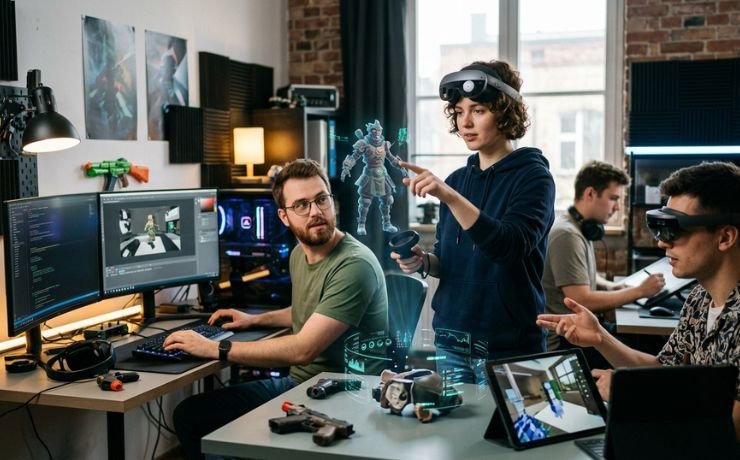
Walk into any media plan review at a large Indian advertiser today and you will find the usual suspects present and accounted for: television, digital video, social, e-commerce media, perhaps a line item for influencer marketing that has grown fat over the last three years. What you will not find, more often than not, is a single rupee allocated to gaming creators or extended reality experiences, even though the audiences sitting inside those formats are larger, younger, and more attentive than almost anything else on the plan.
This is the strange contradiction at the heart of Indian advertising in 2026. Gaming has quietly become one of the largest media consumption categories in the country, with mobile gaming alone crossing well past half a billion users and live-streamed gaming content pulling in audiences that rival prime-time television on certain evenings. Extended reality, after a bruising few years of metaverse hype and subsequent disillusionment, has re-emerged in a quieter, more useful form through smart glasses, mixed-reality headsets, and AR-native social filters. And yet brand budgets have barely moved. The category exists, the audience exists, the creators exist — what is missing is an advertising industry that knows what to do with any of it.
The audience brands keep underestimating
Part of the problem is generational myopia. Most media planning still assumes an audience that watches, scrolls, or reads passively, and gaming does not fit that mould. A viewer watching a streamer play a battle royale title for two hours is not a passive audience member in the traditional sense; they are participating in a live, unscripted narrative, chatting in real time, reacting to in-game decisions, and often spending real money on cosmetic items inside the game itself. That is an extraordinarily high attention state, arguably higher than anything television can offer, and it is happening on platforms like Loco, Rooter, and YouTube Gaming at a scale that would embarrass most linear channels.
The demographic sitting inside that attention state is precisely the one every consumer brand in India claims to be chasing: Gen Z and young millennials, disproportionately male but with a rapidly growing female base, urban and Tier 2 in near-equal measure, and financially independent enough to make discretionary purchases. Yet when agencies build audience personas for this cohort, gaming behaviour is treated as a footnote rather than the primary signal it actually is.
Why the money hasn’t followed the eyeballs
Ask a media buyer why gaming remains underfunded and the answer usually circles back to three things: measurement, brand safety anxiety, and a lack of internal muscle memory. Television has decades of standardised ratings. Digital video has largely converged on viewability and completion metrics that every stakeholder, however imperfectly, agrees to trust. Gaming has no such consensus. Impressions inside a live stream, engagement on a Discord community built around a creator, or the value of a branded in-game asset are all measured differently by every platform, and agencies have been reluctant to build reporting frameworks around numbers they cannot easily defend to a CFO.
Brand safety concerns, meanwhile, are frequently inherited rather than current. The instinct that gaming content is unpredictable, laced with profanity, or populated by a fringe audience is a hangover from an earlier era of gaming culture that no longer reflects the polished, professionally managed creator ecosystems that dominate the space today. Top Indian gaming creators now run their channels with the same content calendars, brand guidelines, and sponsorship decks as any lifestyle influencer, yet the perception lag persists inside client organisations that have simply never sat through a full stream to see what the format actually looks like now.
Gaming and XR are not niche adjacencies waiting for the mainstream to arrive. The mainstream has already arrived inside them — advertising just hasn’t walked through the door yet.
Extended reality’s quiet second act
If gaming is underfunded despite obvious scale, extended reality is underfunded because its first attempt at relevance was botched so thoroughly that the category is still recovering its credibility. The metaverse land rush of a few years ago left a trail of expensive, poorly attended virtual storefronts and NFT-adjacent activations that advertisers now associate more with wasted budget than genuine innovation. That failure was real, but it was a failure of execution and premature ambition, not of the underlying technology.
What has followed is a far more grounded second act. Smart glasses from major consumer technology players have moved from novelty to genuinely useful accessory, AR filters have become a default creative format on every major social platform, and mixed-reality headsets, while still a premium category, are increasingly used for training, retail visualisation, and immersive brand experiences rather than speculative virtual real estate. This version of extended reality is less flashy but considerably more advertiser-friendly, because it slots into existing consumer behaviour instead of demanding an entirely new one.
Where the category is actually being tested
A handful of categories have started experimenting seriously, and their early results are instructive for everyone still on the sidelines. Automotive brands have used AR try-before-you-buy experiences to let prospective buyers visualise vehicles in their own driveways. Beauty and fashion brands, already comfortable with AR filters from years of Instagram and Snapchat experimentation, have extended those capabilities into shoppable try-on formats that shorten the path from discovery to purchase. Quick commerce and food delivery platforms, always hunting for engagement mechanics, have begun sponsoring in-game placements and creator-led gaming tournaments, betting that the attention captured during a live match converts more reliably than a skippable pre-roll ad ever could.
What unites these early movers is a willingness to treat gaming and XR as genuine creative canvases rather than cheaper versions of existing formats. The brands still hesitating tend to make the opposite mistake, attempting to bolt a standard 15-second television creative onto a livestream sponsorship and wondering why it underperforms. The format punishes lazy adaptation and rewards native thinking, which is precisely why agencies without in-house gaming expertise struggle to deliver results that justify a second campaign.
The creator economy gaming built and forgot to advertise to
India’s gaming creator ecosystem has matured into something closer to a full media industry than a collection of individual influencers. Esports organisations now run talent rosters, production teams, and merchandise lines with the same operational seriousness as a broadcast network. Individual streamers have built communities that check in daily for hours at a stretch, a retention pattern that most digital publishers would consider close to miraculous. And unlike traditional influencer marketing, where a single sponsored post is often the entire relationship, gaming sponsorships lend themselves naturally to sustained, season-long integrations: jersey sponsorships, branded in-stream overlays, tournament title sponsorships, and co-branded merchandise drops that keep a brand visible across weeks rather than a single afternoon.
This depth of engagement should, in theory, make gaming creators among the most efficient marketing partners available to Indian brands. In practice, most marketing teams still route gaming sponsorships through the same influencer marketing playbook used for a beauty vlogger or a comedy content creator, applying pricing logic and success metrics that were never designed for the format. The result is chronic undervaluation on the creator side and chronic underperformance on the brand side, a mismatch that neither party seems eager to fix because neither has built the internal expertise to do so properly.
The agency skills gap nobody wants to admit to
Perhaps the most honest explanation for why this category remains untapped has less to do with the audience or the technology and more to do with the people responsible for buying media. Very few Indian media agencies have a dedicated gaming or XR specialist on staff, and fewer still have built the reporting infrastructure needed to prove return on investment in a format that clients do not yet fully trust. Planning teams default to what they can measure and defend, and gaming currently sits outside that comfort zone. Until agencies invest in genuine specialism, rather than treating gaming as an occasional add-on handled by whoever on the team happens to play video games personally, brands will keep underfunding a category their own consumers have already embraced.
There are early signs this is changing. A small but growing number of specialist gaming and esports marketing agencies have emerged in India over the past two years, offering the kind of native expertise that generalist agencies lack. Some large holding companies have begun quietly building gaming desks of their own, recognising that the category has outgrown its status as a curiosity. The question is whether this specialisation scales fast enough to meet an audience that is not waiting around for the advertising industry to catch up.
What catching up actually requires
Closing the gap between audience scale and ad spend will not happen through a single flagship campaign or a viral case study, however tempting that narrative is. It requires brands to treat gaming and XR measurement with the same seriousness they apply to television and digital, even if the metrics look unfamiliar at first. It requires creative teams to build for the format natively, understanding that a livestream audience wants integration and authenticity, not an interruption dressed up as a sponsorship. And it requires media agencies to make a genuine talent investment rather than continuing to borrow frameworks built for entirely different formats and hoping they translate.
The brands that move first will have an advantage that is likely to compound. Gaming creator rates in India remain comparatively low precisely because demand has not caught up with the audience, which means the window for efficient, high-attention reach is open right now in a way it will not remain for long. Extended reality, similarly, is cheap to experiment with today compared to what it will cost once every category competitor has already run their own pilot. The category is not waiting for permission. It has already built the audience, the creators, and increasingly the hardware. The only thing left to arrive is the advertising industry itself, and the brands willing to walk through that door early are the ones who will define what this category looks like once everyone else finally notices.
