














Linear TV Advertising in India: The Broadcaster Pivot

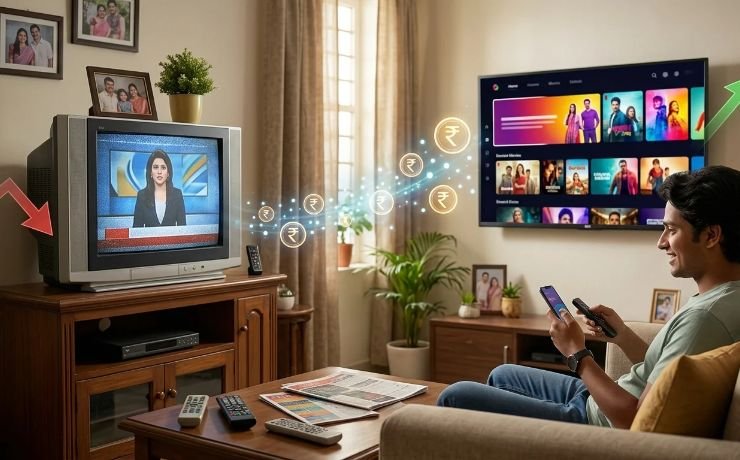
For the better part of three decades, Indian television worked on a simple promise: put a brand in front of enough households at the right hour, and the market would move. Prime-time slots were currency, the Friday night film premiere was a ritual, and the annual upfront was as close to a coronation as the advertising calendar offered. That promise has not vanished, but it is thinning. And the latest forecast from WPP Media puts a number on how quickly.
In its This Year, Next Year (TYNY) Midyear 2026 report, WPP Media expects total television advertising in India to fall 6.8% to around ₹43,600 crore, with linear weakening even as streaming gains share. The figure lands in an otherwise buoyant picture. India’s overall ad market is projected to grow 8.8% to roughly ₹2,00,000 crore this year, comfortably ahead of the IMF’s real GDP growth forecast of 6.5%. Television, in other words, is shrinking inside a market that is growing around it.
That gap is the real story. It explains why the country’s biggest broadcasters are no longer talking about television as a business line but as a legacy engine that must fund, and eventually give way to, something else.
A Market Growing Around Television, Not Through It
The arithmetic is worth sitting with. Social and other digital advertising is forecast to reach about ₹73,800 crore, growing 13.2%. Commerce media, the category that barely registered in planning decks a few years ago, is projected at around ₹34,700 crore, up 29%, with a further 21.7% expected in 2027. Television, at ₹43,600 crore, now accounts for roughly a fifth of the total pie, while digital alone commands well over a third.
It would be convenient to read this as a simple migration story, with budgets leaving one screen and landing on another. The reality is messier. Some of the money is moving to streaming, which WPP Media counts within the wider television picture. Some is moving to social platforms and creators. And a growing slice is heading to marketplaces and quick-commerce apps such as Amazon, Flipkart, Blinkit, Zepto and Instamart, where advertising sits a few taps away from the checkout. The advertiser who once bought reach on a general entertainment channel is now often buying proximity to purchase.
Because the headline decline covers total TV, the pressure on linear specifically is, if anything, sharper than the number suggests. Streaming is absorbing share inside the category, which means the traditional channel business is losing ground faster than the aggregate implies.
The Macro Backdrop Is Not Helping
Linear television’s difficulties would be manageable in a benign economy. They are harder in this one. WPP Media is explicit that India’s 2026 growth is being tested by energy disruption linked to the Iran conflict, imported inflation and currency pressure. With India importing roughly 85% of its crude oil and about half of its natural gas, a sustained oil shock can squeeze household incomes and raise input costs across the very categories that have historically bankrolled television: FMCG, autos, cement and consumer durables.
The behavioural response from marketers is predictable. When inflation bites, media plans get scrutinised harder, promotions take priority over brand building, and budgets drift toward channels that can show results quickly. Television, built on the slow accumulation of reach and recall, is not naturally suited to that kind of accountability. Digital and commerce media, with their dashboards and attribution models, are.
This is the uncomfortable truth for broadcasters. Even when advertisers admire the scale of television, a nervous CFO prefers a number he can trace.
Inside the Broadcaster Pivot
The pivot is already visible in how India’s largest networks report their own numbers. Reporting on recent results has described the same pattern across Zee Entertainment, JioStar, Sun TV and Sony: a deliberate push to strengthen digital offerings, expand subscription revenue, and invest in long-form content and sports properties. Zee’s own results have underlined the urgency; Reuters has noted that advertising, which makes up about 40% of its sales, fell in twelve of thirteen quarters at one point during the downturn.
Sony Pictures Networks India offers a telling case study. For FY25, its advertising revenue declined to ₹2,606 crore from ₹2,856 crore a year earlier, while subscription revenue rose to ₹3,244 crore. Read that again. At one of the country’s best-known entertainment networks, subscriptions now outweigh advertising. That is not a footnote. It is a reordering of the business model, and it changes what the company sells, to whom, and on what terms.
JioStar’s recent trajectory tells a related but more optimistic story. Its results have pointed to strong subscription growth across digital and television, along with record digital advertising revenue driven by connected TV, even as linear advertising remained soft. In other words, the gains are real, but they are being made on the streaming side of the ledger while the linear side continues to apologise for itself.
The pricing conversation reinforces the point. When JioStar set the tone for 2026 with its revised reference interconnect offer, the industry watched Sony and Zee closely to see whether a broader tariff reset would follow. Broadcasters are increasingly leaning on distribution and subscription levers because the advertising lever, on its own, is no longer enough.
The Microdrama Experiment
One of the more revealing details in the WPP Media report is the rise of microdramas, the short, serialised, mobile-first stories that have found a hungry audience among younger and regional-language viewers. The report notes that broadcasters and digital platforms are moving into the format, citing Zee’s Z Bullet, JioStar’s Tadka and MX Player’s Fatafat.
It is easy to dismiss this as a fad. It is more useful to see it as a signal. For decades, broadcasters were in the business of the half-hour and the hour: daily soaps, weekly reality formats, event films. Microdramas compress that logic into minutes, designed for scrolling thumbs rather than living-room sofas. A broadcaster building a microdrama product is not merely experimenting with a format. It is acknowledging that the competition is no longer another channel, but the short-video feed.
There is a commercial logic as well. Industry commentary around JioStar’s Tadka has framed it as a potential testbed for content-commerce models, where viewing and buying sit closer together. If that thesis holds, the broadcaster of the future earns not only from the ad break and the subscription, but from the transaction itself. It is a long way from the spot buy.
Sport: The Last Great Moat
If there is one asset that still gives linear television a claim on mass attention, it is live sport, and cricket above all. This is why the WPP Media report singles out the 2027 Indian Premier League rights auction, covering the 2028 cycle, as the next major inflection point for the category.
Sport is the one content genre that resists time-shifting. Nobody waits for the highlights package when the match is on. It brings together enormous reach, high attention and a ready-made advertiser base, and it is the reason broadcasters have been willing to commit billions to rights. But it also concentrates risk. A network that leans too heavily on one property is exposed to the cost of renewing it and the possibility of losing it. The auction will therefore shape not only who owns the biggest screens, but how the next generation of television and streaming is bundled, priced and sold.
For smaller networks and general entertainment players without a marquee sports franchise, the calculus is harder. Their moat is narrower, their audiences more fragmented, and their dependence on advertising more acute.
What Advertisers Actually Want
It would be a mistake to read the 6.8% decline as advertisers losing their appetite for premium video. They have not. What has changed is the terms on which they will buy it. The WPP Media analysis makes this point directly: mass reach and high-impact environments remain valuable, but advertisers increasingly want them paired with targeting, measurement and flexible planning.
That is why connected TV has become such a charged conversation. It promises the big-screen experience of television with the addressability of digital. Yet as it scales beyond premium reach, buyers are asking harder questions about frequency, transparency and business outcomes. The measurement gap in CTV is not a technical footnote. It is the central question on which the next phase of broadcaster-led streaming advertising will be decided.
Agencies, for their part, are being asked to behave differently. WPP Media’s own framing for 2026 is that the year may be less about selling growth and more about proving resilience. For a media planner, that means fewer grand declarations and more defensible spreadsheets. For a broadcaster, it means arriving at the pitch table with proof of incremental reach, verified delivery and outcomes that survive a sceptical procurement team.
The Uneven Road Ahead
None of this suggests that linear television is about to disappear. India’s television universe is vast, its regional markets are deep, and large parts of the country still experience video primarily through a set-top box. The broader picture from WPP Media is one of uneven growth, where digital, commerce, AI-led formats and short-form content gain share, linear faces sustained pressure, and even out-of-home, which is projected to grow 8.6% to around ₹4,450 crore, digitises only slowly, with digital OOH still under 5% of the total.
What is changing is the role television plays in the plan. It is moving from default to deliberate: from the medium every campaign began with to the one that must justify its place alongside creators, commerce platforms and connected screens. Broadcasters that understand this are rebuilding themselves as multi-platform media companies, with linear as one limb rather than the spine.
The strategic challenge is considerable. Streaming businesses are still working toward sustainable profitability. Subscription growth is not limitless in a price-sensitive market. Microdramas and content-commerce are promising but unproven at scale. And the next big sports rights decision could redraw the map within a single auction cycle.
Yet the direction of travel is clear enough. The broadcasters that emerge strongest will be those that stop defending the old model and start monetising audiences wherever they happen to be: on the living-room screen at nine in the evening, on a phone during a commute, inside a shopping app on a Sunday afternoon. They will sell outcomes rather than slots, and they will treat measurement as a product rather than an afterthought.
The slide in linear is real, and the 6.8% figure will not be the last of its kind. But a decline in a category is not the same as a decline in attention. Indian audiences are watching more video than ever. The question for broadcasters is whether they will still be the ones getting paid for it.
