










Who Owns an AI-Made Ad? Copyright, licensing and agency contracts

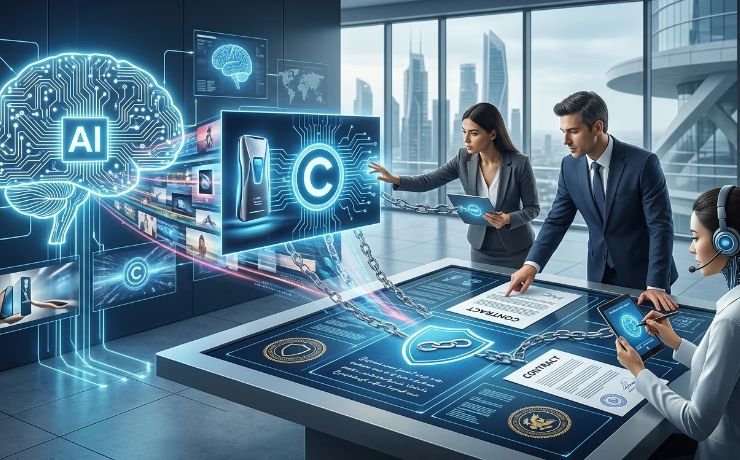
Somewhere in an Indian agency right now, a creative team is finalising a festive film whose storyboard was drafted by one AI tool, whose hero visual was generated by another, and whose voiceover was produced by a third. The client loves it. The turnaround was a fraction of what it used to be. And buried beneath the delight is a question that almost nobody in the room has asked aloud: who actually owns this?
It sounds like a lawyer’s question, and for years it was treated as one. But as generative tools move from experiment to production line, ownership has become a commercial question with real money attached. A brand that cannot prove it owns its hero asset cannot easily stop a competitor from lifting it. An agency that promises originality it cannot guarantee is carrying risk it may not have priced. And a contract signed in 2022 almost certainly says nothing useful about any of it.
India’s Law Meets the Machine
India has no statute written specifically for generative AI. The Copyright Act, 1957 was drafted for a world of human authors, and it shows. Section 13 protects original literary, dramatic, musical and artistic works. Section 17 says the author is the first owner. And Section 2(d)(vi), which deals with computer-generated works, names the author as the person who causes the work to be created.
That last phrase is doing a great deal of work, and a recent order from the Copyright Office shows how. On 31 August, the Registrar rejected an application by American computer scientist Stephen Thaler, who had listed his AI system DABUS as the author of an artwork. The Office did not find the artwork unoriginal. On the contrary, it held that the work met the originality threshold under Section 13. What it refused to do was recognise a machine as an author. DABUS has no statutory recognition or legal personality, the order reasoned, and creating a new category of technological legal person is a matter for Parliament. The application failed because Thaler, even when offered the chance, declined to name himself as the author.
The order is instructive for advertisers precisely because of what it did not say. The Registrar observed that Thaler had designed and configured the system, supplied and curated the inputs and initiated the process, and treated him as the person who caused the work to be created. In other words, the door to human authorship of AI-assisted work was left open. Equally, the order said it was not deciding the copyright status of every form of AI-assisted creation. It is a finding on specific facts, not a licence to assume that anything typed into a prompt box belongs to whoever typed it.
The Indian story has an earlier chapter. The Copyright Office briefly registered an AI painting app, RAGHAV, as co-author of an artwork called Suryast alongside its human creator, then issued a withdrawal notice questioning the AI’s legal status. The United States Copyright Office, for its part, refused to register the same image, citing the lack of human authorship. Across jurisdictions the pattern is consistent: courts and registries are comfortable protecting human creative contribution, and uncomfortable protecting the machine’s.
An Ad Is Not One Work
The practical difficulty for marketers is that a finished commercial is rarely a single creative object. It is a stack. There is the script, the storyboard, the visual design, the footage or generated imagery, the edit, the music, the voice and the end-card copy. Each layer can have a different degree of human involvement, and each may stand on a different legal footing.
A line written by a copywriter and polished by software sits very differently from a frame produced from a one-line prompt and used untouched. The more a human selects, arranges, directs and transforms, the stronger the claim to protection over those human contributions. The less a human contributes, the more likely the output sits in a grey zone where nobody can confidently assert exclusive rights. For a brand, that grey zone is uncomfortable. If a campaign visual becomes a recognisable part of brand identity, the inability to stop copycats from reproducing it is not an abstract risk.
This is why the smartest agencies are beginning to think about AI use as a spectrum rather than a switch. Using a tool to brainstorm headlines carries little ownership risk. Using one to generate the central, distinctive asset of a campaign carries a great deal more. The decision of where to place each element on that spectrum is, increasingly, a legal and commercial decision as much as a creative one.
The Other Side of the Ledger: What Went In
Ownership of the output is only half the problem. The other half concerns what the model learned from, and whether the result could land the brand in trouble with someone else’s rights.
That debate is live in India. Asian News International sued OpenAI in the Delhi High Court in November 2024, alleging that its copyrighted news articles were used without authorisation to train ChatGPT. The case is pending, and its outcome is expected to shape how Indian law treats the training of models on protected material. Meanwhile, the Department for Promotion of Industry and Internal Trade (DPIIT) published the first part of a working paper on generative AI and copyright in December 2025. It explores a hybrid licensing model, under which AI developers would get broad access to publicly available works in exchange for a statutory scheme of remuneration to rights holders. Consultation on the paper was extended to 6 February 2026. It is a proposal rather than law, but it signals the direction of policy thinking.
For an advertiser, the immediate worry is less about the grand questions of training and more about the mundane risk of output that resembles something existing. Generative systems can produce images, tunes or phrases that echo a protected work without anyone intending it. If a campaign ends up too close to an artist’s illustration or a competitor’s jingle, the brand that ran it is the party in the headlines, regardless of which tool produced the first draft.
The Fine Print of the Tools Themselves
Between the law and the contract sits a layer that most creative teams never read: the terms of the AI tools. Platform terms vary widely. Some assign output rights to the user. Some grant only a licence. Some restrict commercial use on free tiers. Some reserve rights to reuse prompts and outputs. A campaign built on a tool whose terms prohibit commercial exploitation has a problem that no amount of agency goodwill can fix later.
Vendor protection is similarly uneven. Several large providers now offer intellectual property indemnities on their paid business products, with Adobe’s cover for Firefly outputs and Microsoft’s Customer Copyright Commitment for Copilot among the best known. But these assurances come with conditions: enterprise-level plans, adherence to built-in guardrails, and in some cases a limitation to the provider’s own models rather than third-party models offered through the same interface. An agency using the free version of a tool, or a partner model inside a premium app, may not be covered at all.
The lesson is that the terms travel with the asset. A brand receiving a deliverable inherits whatever rights, and whatever gaps, the tool’s licence allowed. The agency cannot hand over what it never had.
Where Agency Contracts Are Showing Their Age
Most agency agreements were negotiated before AI became a routine part of production, and the gaps are now obvious. The World Federation of Advertisers found in 2024 that 80% of multinational brand owners had concerns about how their creative and media agencies were using generative AI. Yet only 36% had introduced terms governing that use, and fewer than three in ten had reviewed their creative and media contracts to add AI provisions. Those figures are two years old, and practice has moved since, but the direction is unmistakable: clients are worried, and the paperwork has lagged behind.
The first gap is the assignment clause. Under Indian law, a transfer of copyright is not valid unless it is in writing and signed by the assignor. It must identify the work, the rights assigned, the duration and territory, and the consideration payable. Where the period is not stated, the law presumes five years, and where the territory is not specified, it presumes India. A casual clause promising that all rights in the deliverables pass to the client may therefore be thinner than the client assumes, and it becomes thinner still when part of the deliverable cannot be owned by anyone in the first place. A careful assignment should say what the agency owns and transfers, and be honest that rights in AI-generated material may be limited by law and by the tool’s own terms.
The second gap is the originality warranty. Agency contracts routinely promise that all work is original and non-infringing. That promise made sense when a human wrote every line. It is harder to give when part of the work emerges from a model whose training data the agency cannot inspect. Many lawyers now suggest replacing absolute originality promises with a warranty that the agency has no knowledge of infringement and has used reasonable care, coupled with a capped indemnity that excludes claims arising from the client’s own prompts, materials or instructions.
The third gap is disclosure and approval. The Association of National Advertisers in the United States proposed a model clause as early as June 2023 requiring agencies to disclose AI use in media buying and obtain client consent first. The same logic applies to creative production. A client should know which tools are being used, for which elements, and should sign off before AI-generated images, voices or claims go live. Clients who direct agencies to use generative AI, or who approve fully AI-made deliverables, have a reasonable case for sharing the risk. Those who never knew AI was involved will argue, with justification, that they were not given the chance.
The fourth gap is confidentiality. Uploading a client’s unreleased product images, brand guidelines or campaign strategy into a public tool may breach confidentiality duties or feed material into systems the client never approved. A contract that ignores the data flowing into AI tools is incomplete, however well it handles the output.
Faces, Voices and the Question of Consent
There is one area where ownership law is the lesser concern, and consent is the greater: synthetic people. Advertising has always used celebrities and models, but generative tools make it trivially easy to clone a voice, extend a performance or conjure a lookalike. The Delhi High Court has already been hearing personality-rights pleas against the unauthorised use of public figures’ likeness in AI content, and the DPIIT working paper has floated a registry through which performers could record their objection to such use.
For brands the rule of thumb is simple. No synthetic likeness or cloned voice of an identifiable real person should appear in a campaign without that person’s written consent and the client’s explicit approval. Talent contracts need to say, in plain terms, whether a performance may be digitally extended, reused or replicated, and for how long. Many existing talent agreements do not.
A Practical Playbook
None of this is a reason to retreat from AI. The efficiencies are real, and absolute bans on its use are impractical in most agency relationships. The better response is governance. Agencies and brands that handle this well tend to do a handful of things consistently.
They keep records. Prompt histories, iteration logs and notes on where human creative decisions were made are inexpensive to maintain and valuable if ownership is ever questioned. They are the evidence that a person, and not merely a machine, shaped the final work.
They classify their assets. Hero creative and distinctive brand elements are treated differently from throwaway social variants, with greater human authorship and stricter review wherever exclusivity matters.
They vet their tools. Someone in the agency reads the terms of every platform used on client work, understands which plans carry indemnities, and keeps a list of approved tools for each category of deliverable.
They put it in writing. An AI addendum to the master services agreement, covering disclosure, ownership, warranties, indemnities, approvals, likeness and data, is quickly becoming standard practice. Even a short, plain-language schedule is better than silence.
And they keep watching. The ANI case, the DPIIT process and the Copyright Office’s evolving approach to AI-assisted works could each change the picture. Contracts that anticipate review, rather than pretending the law is settled, will age better.
Ownership as a Creative Advantage
It is tempting to file all of this under compliance, a chore for the legal department. That would miss the point. In a market where anyone can generate a passable image in seconds, what distinguishes a brand is increasingly what it can claim as distinctively its own: the characters, voices, worlds and ideas that audiences associate with it and competitors cannot freely copy.
The agencies that will earn the most trust in the AI era will not be those who promise the most dazzling output. They will be those who can tell a client, with evidence, what in a campaign is genuinely owned, what is licensed, what is merely borrowed from a tool, and who stands behind each piece. The law will take time to settle. The contracts, at least, can be written today.
This article is for general information and is not legal advice. Brands and agencies should seek specific advice on their own contracts and campaigns.
